


The government's failure to appoint members to the Public Television Service's (PTS) board before March 1, has resulted in confusion surrounding the station's future management, members of its supervisory committee said yesterday.
"With almost two month's delay, the Government Information Office (GIO) and the Legislative Yuan have not only violated the Public Television Law, but also shown their lack of concern about the station's interests," said Ho Te-fen (

PHOTO: CHIANG YING-YING, TAIPEI TIMES
First proposed in 1980, PTS finally began broadcasting in 1998. A 10-member board and a five-person supervisory committee were set up to monitor the station's management and to elect its chairman, who would be in charge of forming the management team to run the station. As the three-year term for both the board and the supervisory committee came to an end this year, however, the GIO was supposed to recommend a list of new members and submit the list to a review committee whose members would be recommended by the legislature, for approval by March 1.
Director of the GIO Su Tzen-ping (蘇正平) said that the cause of the delay was that the legislature had not established a review committee to select new board members. But Ho put the blame on both the GIO and the legislature, which, she said, recommended "mostly politicians, who try to interfere with the station's policies and personnel."
"Politicians exert their influence to control the media [and the PTS]. You can see how absurd it has become," Ho said, adding that the Public Television Law strictly forbids any government or party official from taking part in the selection process.
The New Party has nevertheless recommended its convener Hsieh Chi-ta (
"If a precedent [to allow politicians in the review committee] is set, it may endanger the station's reform and future programming policies," independent legislator Chu Hui-liang (
Despite the objections of Ho and Chu, the KMT-dominated legislature has agreed on the nominations of Chao and Lin, but remains deadlocked over that of Hsieh.
The delay has postponed the renewal of the station's management team. This has raised questions about the legitimacy of the current management team, which should have left office on March 1. The incumbent chairman Wu Feng-shan (
Despite all the difficulties, the clauses in the Public Television Law, which limit the PTS' funds, are likely to be erased during the current legislative session. Under the law, the government was obliged to subsidize the PTS in its first year of operation -- an appropriated budget of NT$1.2 billion -- and the subsidy was to be gradually reduced in subsequent years by a rate of 10 percent per year. In its sixth year of operation, the subsidy will be reduced by half to NT$600 million.
"The Cabinet will propose that the legislature delete these clauses and embrace the idea of maintaining the station's annual budget at a fixed amount of NT$900 million," Su said, adding that some legislators had expressed their support for such a proposal.
Echoing Su's view, both Chu and Ho said that PTS deserved the government's financial support to strive for excellence in programming instead of market share.
"It took the US' PBS 20 years to reduce the financial resources it received from the government by half. We should not be too strict with our own PTS," Chu said.
"As long as the PTS makes good use of its every penny to serve the interests of minority groups and the greater public, the budget's size -- whether NT$600 or NT$900 million, is not really the issue," Ho said.
However, Ho added that the station had allocated too much of its budget to certain items such as personnel costs and production. She said that the levels of the managing team's salaries, for example, were set years ago in accordance with the salary structure of Taiwan's three other terrestrial television networks. After cable television channels mushroomed in Taiwan, however, increasing competitiveness has been pressuring the three networks to gradually lay off unnecessary staff and cut back on generous staff salaries. But PTS's personnel structure remains unchanged as it is relatively protected from the worst effects of competition, she said.
A report prepared by the supervisory committee in mid-March suggested that the station should produce more locally-made programs rather than purchase foreign-made programs. It should also minimize the bureaucracy involved in the running of the station, and increase programs targeted at women, the elderly and other minority groups, the report concluded.
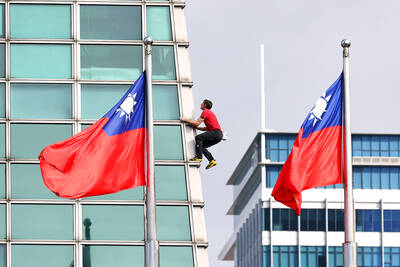
DAREDEVIL: Honnold said it had always been a dream of his to climb Taipei 101, while a Netflix producer said the skyscraper was ‘a real icon of this country’ US climber Alex Honnold yesterday took on Taiwan’s tallest building, becoming the first person to scale Taipei 101 without a rope, harness or safety net. Hundreds of spectators gathered at the base of the 101-story skyscraper to watch Honnold, 40, embark on his daredevil feat, which was also broadcast live on Netflix. Dressed in a red T-shirt and yellow custom-made climbing shoes, Honnold swiftly moved up the southeast face of the glass and steel building. At one point, he stepped onto a platform midway up to wave down at fans and onlookers who were taking photos. People watching from inside

A Vietnamese migrant worker yesterday won NT$12 million (US$379,627) on a Lunar New Year scratch card in Kaohsiung as part of Taiwan Lottery Co’s (台灣彩券) “NT$12 Million Grand Fortune” (1200萬大吉利) game. The man was the first top-prize winner of the new game launched on Jan. 6 to mark the Lunar New Year. Three Vietnamese migrant workers visited a Taiwan Lottery shop on Xinyue Street in Kaohsiung’s Gangshan District (崗山), a store representative said. The player bought multiple tickets and, after winning nothing, held the final lottery ticket in one hand and rubbed the store’s statue of the Maitreya Buddha’s belly with the other,

‘NATO-PLUS’: ‘Our strategic partners in the Indo-Pacific are facing increasing aggression by the Chinese Communist Party,’ US Representative Rob Wittman said The US House of Representatives on Monday released its version of the Consolidated Appropriations Act, which includes US$1.15 billion to support security cooperation with Taiwan. The omnibus act, covering US$1.2 trillion of spending, allocates US$1 billion for the Taiwan Security Cooperation Initiative, as well as US$150 million for the replacement of defense articles and reimbursement of defense services provided to Taiwan. The fund allocations were based on the US National Defense Authorization Act for fiscal 2026 that was passed by the US Congress last month and authorized up to US$1 billion to the US Defense Security Cooperation Agency in support of the

‘COMMITTED TO DETERRENCE’: Washington would stand by its allies, but it can only help as much as countries help themselves, Raymond Greene said The US is committed to deterrence in the first island chain, but it should not bear the burden alone, as “freedom is not free,” American Institute in Taiwan Director Raymond Greene said in a speech at the Institute for National Defense and Security Research’s “Strengthening Resilience: Defense as the Engine of Development” seminar in Taipei yesterday. In the speech, titled “Investing Together and a Secure and Prosperous Future,” Greene highlighted the contributions of US President Donald Trump’s administration to Taiwan’s defense efforts, including the establishment of supply chains for drones and autonomous systems, offers of security assistance and the expansion of


 RSS
RSS