


The family of the late Hsieh Tung-ming (
Instead it chose to accept help from Hsieh's former party, the KMT, in arranging the service.
"We will assist the family in handling the funeral but will not form a funeral committee," said the KMT's spokeswoman Chen Feng-hsin (
Hsieh died on Sunday in the US and on Monday both the KMT and the government offered their help in handling the funeral.
The presidential office held a meeting yesterday, hosted by advisor to the president Lee Yuan-tsu (
KMT Chairman Lien Chan (連戰), who was invited to the meeting, refused to attend. During the meeting, Hsieh's daughter-in-law, Helen Lin (林澄枝), turned down the government's offer, saying the family wanted to keep the funeral as simple as possible.
Because Hsieh had been a vice president, President Chen Shui-bian (
Chen insisted on assigning 12 government officials to assist the family with the funeral, including Lee, Premier Chang Chun-hsiung (
The group concluded that a funeral committee would not be formed to hold the service, but that the government would instead later publish a commemorative anthology, to be compiled by Academia Historica President Chang Yen-hsien (
The Executive Yuan will also require government agencies to lower their national flags to half-mast on April 22, the day of the funeral.
Participants in yesterday's meeting suggested that Hsieh's family be presented with the national flag at the funeral. But Hsieh's relatives insisted that the service be kept simple and that such a presentation not be made.
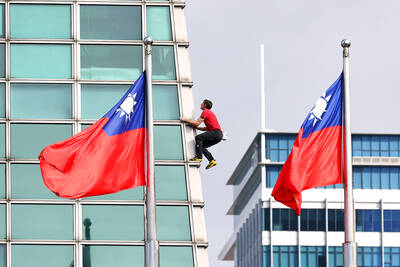
DAREDEVIL: Honnold said it had always been a dream of his to climb Taipei 101, while a Netflix producer said the skyscraper was ‘a real icon of this country’ US climber Alex Honnold yesterday took on Taiwan’s tallest building, becoming the first person to scale Taipei 101 without a rope, harness or safety net. Hundreds of spectators gathered at the base of the 101-story skyscraper to watch Honnold, 40, embark on his daredevil feat, which was also broadcast live on Netflix. Dressed in a red T-shirt and yellow custom-made climbing shoes, Honnold swiftly moved up the southeast face of the glass and steel building. At one point, he stepped onto a platform midway up to wave down at fans and onlookers who were taking photos. People watching from inside
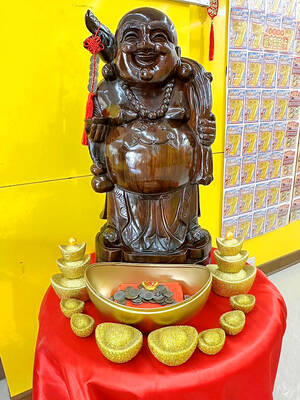
A Vietnamese migrant worker yesterday won NT$12 million (US$379,627) on a Lunar New Year scratch card in Kaohsiung as part of Taiwan Lottery Co’s (台灣彩券) “NT$12 Million Grand Fortune” (1200萬大吉利) game. The man was the first top-prize winner of the new game launched on Jan. 6 to mark the Lunar New Year. Three Vietnamese migrant workers visited a Taiwan Lottery shop on Xinyue Street in Kaohsiung’s Gangshan District (崗山), a store representative said. The player bought multiple tickets and, after winning nothing, held the final lottery ticket in one hand and rubbed the store’s statue of the Maitreya Buddha’s belly with the other,
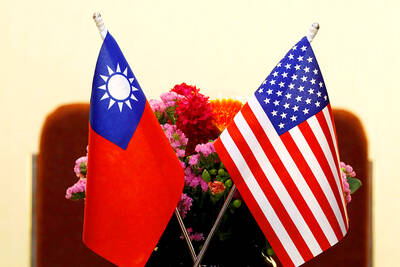
‘NATO-PLUS’: ‘Our strategic partners in the Indo-Pacific are facing increasing aggression by the Chinese Communist Party,’ US Representative Rob Wittman said The US House of Representatives on Monday released its version of the Consolidated Appropriations Act, which includes US$1.15 billion to support security cooperation with Taiwan. The omnibus act, covering US$1.2 trillion of spending, allocates US$1 billion for the Taiwan Security Cooperation Initiative, as well as US$150 million for the replacement of defense articles and reimbursement of defense services provided to Taiwan. The fund allocations were based on the US National Defense Authorization Act for fiscal 2026 that was passed by the US Congress last month and authorized up to US$1 billion to the US Defense Security Cooperation Agency in support of the

‘COMMITTED TO DETERRENCE’: Washington would stand by its allies, but it can only help as much as countries help themselves, Raymond Greene said The US is committed to deterrence in the first island chain, but it should not bear the burden alone, as “freedom is not free,” American Institute in Taiwan Director Raymond Greene said in a speech at the Institute for National Defense and Security Research’s “Strengthening Resilience: Defense as the Engine of Development” seminar in Taipei yesterday. In the speech, titled “Investing Together and a Secure and Prosperous Future,” Greene highlighted the contributions of US President Donald Trump’s administration to Taiwan’s defense efforts, including the establishment of supply chains for drones and autonomous systems, offers of security assistance and the expansion of


 RSS
RSS