

Wu Tieh-hsiung (吳鐵雄), president of National Tainan Teachers College (
"I have already made up my mind, Wu Tieh-hsiung is a very good choice because he completely meets our criteria -- he has a good public image, is a good team player and is keen about educational reform," said Tzeng.
Although the decision will not be finalized until it wins the approval of the Executive Yuan next Wednesday, the minister said he was quite certain the executive department would endorse his finding.
"[The executive branch] always respects our opinions because [the ministry's officials] always make decisions out of professional considerations."
Since Tzeng took office last May, he and Wu have had frequent contact concerning a number of educational issues.
After Lin made public his intention to retire last Thursday following his demotion, Tzeng sought out Wu to see if he was willing to assume the post of vice minister.
Asked how he felt about stepping into a ministry stricken by problems, Wu told the Taipei Times yesterday that he didn't think the ministry should take all the blame, because it would only be through painstaking reform that the educational system could be ameliorated.
"To carry out educational reform, everything needs to be well planned and cautiously implemented. And it is only natural and inevitable that problems will arise along the way, and criticism as well," he said.
"But this does not mean the ministry is moving in the wrong direction," said the educator, who has been teaching for almost 30 years.
"What's more important is that once you determine to do something, you ought to put all your energy into overcoming any difficulties," he added.
Responding to a question regarding how he would prepare himself for the transformation from being a scholar to being an executive official, Wu said he had a lot of learning to do but expressed confidence in his ability to do the job.
"Whether I work at the educational or the administrative department, I always make sure that I am fully engaged. It is true that the two are different environments and I will need to fumble about for a while to search for a clear path, but with my abundant experience within educational circles and my willingness to learn, I don't think there will be any major problem," he said.
Despite his lack of experience as an executive, the 62-year-old scholar is not a novice when it comes to educational reform, something the education ministry is intensively promoting.
Wu, who holds a doctoral degree in educational statistics from the State University of New York in Buffalo, has also been hired by the education ministry as an adviser for the "Nine-Year Educational Program" (
The initiative is slated to be launched this September and aims to integrate the two stages of Taiwan's educational system -- its elementary and high school programs.
Wu also actively champions computer-based learning for elementary and high school students.
Wu has been the president of the the Tainan-based teachers college since 1992, before which he was a professor at National Taiwan Normal University (
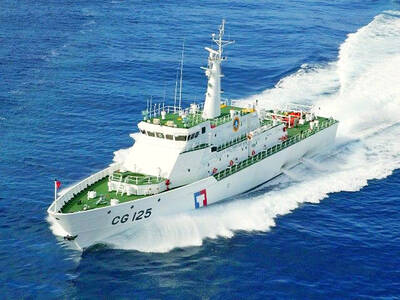
GEOPOLITICAL SIGNIFICANCE: The CGA’s nonmilitary role makes it a tool to avert diplomatic issues, an official said, while confirming the donation of a ship to Manila Coast Guard Administration (CGA) ships are scheduled to sail to the Philippines bearing the words “Taiwan Coast Guard” in a high-profile visit in October next year, the first such visit by a Taiwanese maritime law enforcement vessel to the Southeast Asian nation, the agency said yesterday. The CGA also confirmed that it had donated one of its decommissioned patrol vessels to the Philippines in a rare transfer of a retired ship to a nondiplomatic ally. The Republic of China (ROC) Navy last made such a visit in 1974, shortly before the Philippines switched diplomatic recognition to the People’s Republic of China in

SOFT TENNIS: Yu Kai-wen and Huang Shih-yuan narrowly defeated their Japanese rivals to capture Taiwan’s first gold at the Asian Games in Nagoya Yu Kai-wen (余凱文) and Huang Shih-yuan (黃詩媛) won Taiwan’s first gold of this year’s Asian Games, defeating a Japanese duo in a nail-biter in the soft tennis mixed doubles final in Nagoya, Japan, while Johnny Sun (孫家閎) won silver in wushu and Shih Cheng-chung (石政中) won bronze in men’s kumite. Yu and Huang narrowly defeated Japan’s Toshiki Uematsu and Rena Temma 5-4 (2-4, 5-3, 4-2, 1-4, 1-4, 4-0, 1-4, 4-1, 7-5) to give Taiwan its first gold in soft tennis mixed doubles at an Asian Games since 2018. Sun secured Taiwan’s first wushu medal at this year’s game, with a combined score
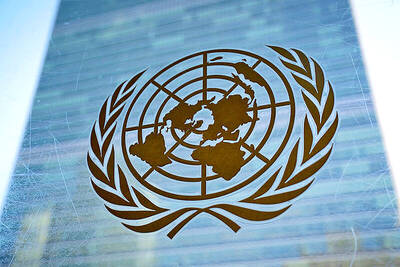
CALL FOR CHANGE: They urged the UN to facilitate Taiwan’s involvement in the body, recognize its peace efforts and to work with members in preventing military conflict Representatives to the UN from five of Taiwan’s diplomatic allies sent a joint letter to UN Secretary-General Antonio Guterres on Friday, calling for the country’s inclusion in the body. Allies in the letter sent ahead of the 81st session of the UN General Assembly General Debate made three demands in support of Taiwan: inclusion, recognition and camaraderie. They implored the UN to seek an appropriate way to facilitate Taiwan’s meaningful involvement in the world governing body, saying that UN Resolution 2758, which accepted the People’s Republic of China (PRC) as a member of the UN, does not exclude Taiwan. Beijing claims that the
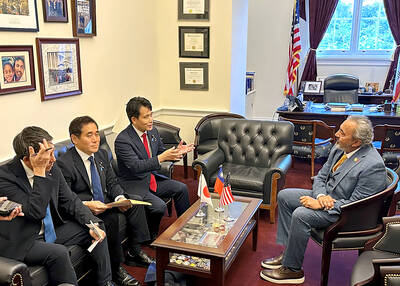
WASHINGTON MEETING: Japan’s Hirofumi Takinami said participants rejected the idea that the US should limit its defensive perimeter to the Second Island Chain US and Japanese lawmakers agree that the US must defend the First Island Chain, including Taiwan, and should not fall back to the Second Island Chain, while “a Taiwan contingency is a Japan contingency and therefore a US-Japan alliance contingency,” media reported after a meeting between officials of the two nations in Washington on Tuesday. A delegation of Japanese lawmakers from the Liberal Democratic Party met with US Senator Thom Tillis, co-chair of the Senate Taiwan Caucus, and US Representative Ami Bera, co-chair of the US Congressional Taiwan caucus, to discuss issues concerning East Asia and the Taiwan Strait. The Japanese and


 RSS
RSS