


US President Donald Trump should get the Nobel Peace Prize should he be able to convince Chinese President Xi Jinping (習近平) to abandon the use of force against Taiwan, President William Lai (賴清德) told a conservative US radio show and podcast in an interview.
The US is Taiwan’s most important international backer, despite the absence of formal ties, but since Trump took office earlier this year he has not announced any new arms sales to the nation.
Trump could meet Xi at the APEC summit in South Korea on Oct. 31 and Nov. 1.
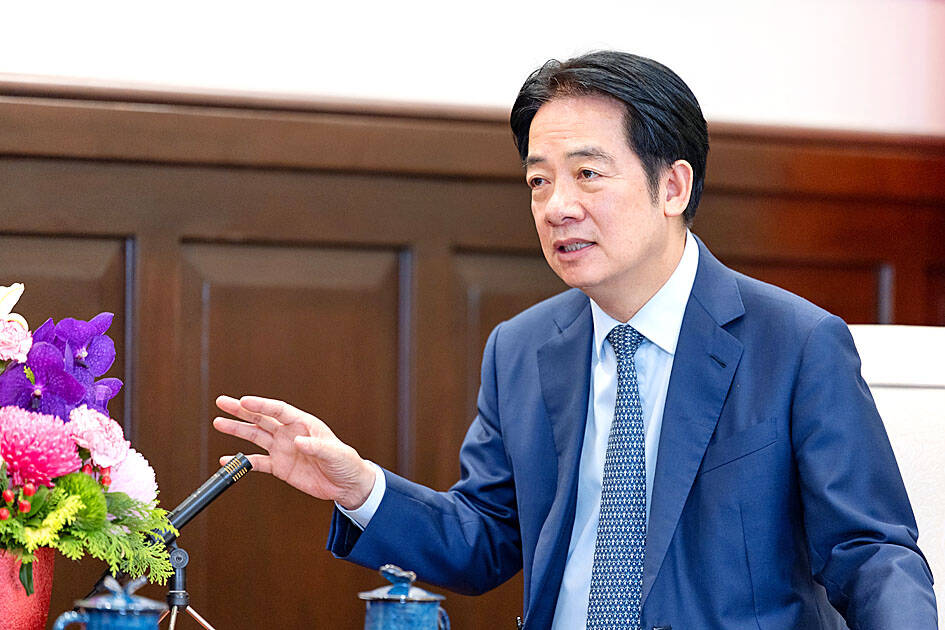
Photo: Screen grab from the Presidential Office’s Flickr page
Lai, speaking on The Clay Travis and Buck Sexton Show, which is carried on more than 400 talk radio stations, referred to comments Trump made in August, in which he said Xi told him China would not invade Taiwan while he was US president.
“We hope to continue receiving President Trump’s support. Should President Trump persuade Xi Jinping to permanently abandon any military aggression against Taiwan, President Trump would undoubtedly be a Nobel Peace Prize laureate,” Lai said.
Trump has said he deserves the accolade given to four of his White House predecessors. This year’s prize is to be announced in Norway on Friday.
Asked what he would tell the US president if he were to meet him, Lai said he would advise Trump to pay attention to Xi’s actions.
“I would advise him to pay particular attention to the fact that Xi Jinping is not only conducting increasingly large-scale military exercises in the Taiwan Strait, but is also expanding military forces in the East China Sea and South China Sea,” Lai said, according to a transcript of his remarks released by the Presidential Office yesterday.
China’s increasing military activities further and further from its own shores are not only a challenge for Taiwan, Lai added.
“The challenge extends beyond merely annexing Taiwan. Once Taiwan is annexed, China will gain greater strength to compete with the United States on the international stage, undermining the rules-based international order,” he said.
“Ultimately, this will also impact US homeland interests. Therefore, I hope President Trump will continue to uphold peace and stability in the Indo-Pacific,” he said.
Taiwan, along with major Western allies, has worked to address Washington’s concerns that it is not spending enough on its own defense — Lai has set a target of defense spending to reach 5 percent of GDP by 2030.
“I will tell them that Taiwan is absolutely determined to safeguard its national security,” Lai told the show, when asked about how he would show the US Taipei’s resolve to defend itself.
Lai also clarified a number of points to a US audience.
First, the Republic of China and the People’s Republic of China (PRC) are “not subordinate to each other. Taiwan is not a part of the PRC. China does not have the right to invade Taiwan,” he said.
Second, “China has been holding military exercises in the Taiwan Strait, undermining peace and stability in the region. So it is China, not Taiwan, that is disrupting the cross-strait status quo,” he said.
“The fact that the Taiwanese people seek to protect their sovereignty, and pursue a way of life based on democracy, freedom and human rights should not be seen as a provocation against China,” he said.
In addition, despite increasing threats from China, “Taiwan has not given up on seeking peace and mutual prosperity across the Strait. We understand that peace is priceless and that there are no winners in war,” as it is essential to global security and prosperity, he said.
“Our pursuit of peace is an ideal, not a fantasy,” he added, referencing his “Four Pillars of Peace and Action Plan” to strengthen national defense, build economic security, strengthen democratic partnerships, and engage in stable and principled cross-strait leadership.
On the topic of semiconductors, Lai said that despite Taiwan’s achievements in the global semiconductor industry, particularly in manufacturing, the US is the “leader in this ecosystem.”
Taiwan is willing to help the US “industrialize and become a global AI [artificial intelligence] hub,” and “make America great again,” he said.
Additional reporting by Hollie Younger

‘NO SECURITY RISK’: The Railway Bureau reassured the public that the technicians’ activities were limited to technical guidance and did not involve sensitive systems The Railway Bureau yesterday said it had invited eight Chinese technicians to assist with an airport MRT construction project. The bureau issued the confirmation after an Internet user said Chinese nationals had entered the construction zone of Taiwan Taoyuan International Airport’s Terminal 3 project. They asked why “individuals from an enemy state” were allowed access to such a major national infrastructure project, which raised serious concerns over Taiwan’s industrial safety, sensitive systems and information security. The bureau’s Northern Region Engineering Branch Office said subcontractor Taiwan Handle Industrial Co (台灣手把工業) of the Taoyuan airport MRT’s “Contract No. CU05 Project A14 Station Civil, MEP &

A US uncrewed surface vessel (USV) encountered multiple Chinese warships during an autonomous transit of the Taiwan Strait, US defense company Seasats said in a statement on Wednesday. Seasats announced that a Lightfish USV had completed the first autonomous transit of the Taiwan Strait. Over five days, the USV traversed the entire length of the Strait while constantly monitoring surface vessel traffic, the company said. The Lightfish encountered multiple Chinese warships, one of which was a Chinese People’s Liberation Army Navy (PLAN) Type 056 corvette, it said. The Chinese vessels were operating “well within Taiwan’s exclusive economic zone without transmitting their identity via the

Taiwan is still in the process of assessing the possibility of recruiting workers from Eswatini, the Ministry of Foreign Affairs said yesterday, adding that its goal is to help Eswatini upgrade its vocational training centers. If there are plans to recruit workers from Eswatini, safeguarding national security, protecting public health and ensuring the employment rights of Taiwanese would be prerequisites, Department of West Asian and African Affairs Director-General Yen Chia-liang (顏嘉良) told a news conference. Key considerations would also include filling labor shortages in specific industries, and fostering bilateral professional and technical exchanges, he said. Yen was asked about the progress of labor
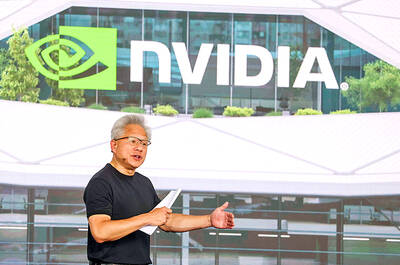
‘BOOMING’: ’ The number of partners we have here is incredible. You can see from their stock prices. They’re doing so well, they’re so happy,’ Jensen Huang said Nvidia Corp’s spending in Taiwan has ballooned to about US$150 billion a year, 10 times the US$10 billion to US$15 billion the company spent five years ago, Nvidia chief executive officer Jensen Huang (黃仁勳) said yesterday, suggesting Taiwan’s strategic importance in the global artificial intelligence (AI) supply chain. “Taiwan is the epicenter of the AI revolution. This is where the chips come, packaging comes. This is where the systems are made. This is where AI supercomputers were created,” Huang said at a meeting for the company’s employees in Beitou-Shilin Technology Park (北投士林科技園區) in Taipei, the planned site of Nvidia’s Taipei headquarters. “Taiwan


 RSS
RSS