


Since 1992, when it was discovered that Taiwanese women had been recruited as so called "comfort women" -- military prostitutes -- for the Japanese army during Word War II, the issue has received surprisingly little attention in Taiwan.
Only with the arrival of Yoshinori Kobayashi's comic On Taiwan (台灣論), has the comfort women issue loomed large in both the media and everyday discussions.
One could hardly have imagined the effect the comic would have on Taiwan's media -- many of which have launched campaigns against the Japanese right-wing activist's book.
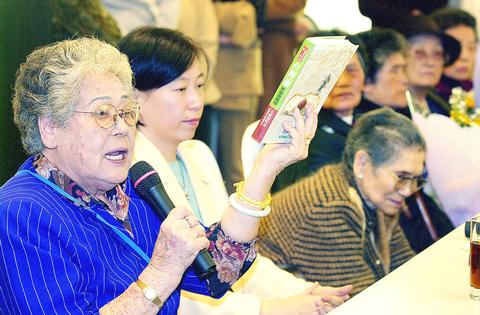
TAIPEI TIMES FILE PHOTO
But while opposition politicians have mounted vicious attacks against the author and two business leaders, Shi Wen-lung (
Both opponents and proponents of the book have been using Kobayashi's presentation of Taiwan's history to strengthen their political ideologies. In fact, the differing opinions among Taiwanese on the issue of national identity underlie the debate of Kobayashi's book.
For those who identify with China ideologically, both Kobayashi's accounts of the Nanking Massacre and his acknowledgement of Taiwan as an independent entity are irresponsible and dangerous.
However, those who strongly maintain Taiwan is independent of China believe On Taiwan provides a rare view which differs from the prominently Chinese accounts of Taiwan's status. With pro-unification forces lodged in intense attacks against Shi, a long-time supporter of Taiwan independence, Taiwan's ever-present ethnic and ideological divisions have been widened.
Deception, not abduction
When Shi first came forward to speak about the comfort women issue, he maintained Japanese military personnel did not use force or coercion to gather Tai-wanese women and girls. He said the women were sold by their poverty-stricken parents and that was just a fact of life at that difficult time.
The remarks caused such a heated row that Shi offered a written apology last Tuesday, admitting his knowledge on the issue was limited which resulted in misunderstandings which hurt survivors.
In fact, many people in Taiwan agree with Shi based on their own experiences or those of acquaintances. Arguably, the view that the Japanese military did not directly round up Taiwanese women by force is correct since private operators and procurers carried out the job for the military.
And in colonized areas, there was a system whereby the officials did not do the dirty work but had procurers do it for them.
In Taiwan, the methods of recruiting comfort women differed from those in Japan's occupied territories.
While there was a considerable number of abductions in China, Southeast Asia, and the Pacific region, there were fewer instances in the Japanese colonies of Korea and Taiwan.
According to research on the issue, the first recruiting method was for the army in the field to appoint a director or private operator and send him or her to Taiwan to recruit comfort women.
The second is that the army in the field sent requests to army units in Japan or Taiwan, which would then choose an agent to round up comfort women.
Having received 92 complaints since 1992, investigations by the Taipei Women's Rescue Foundation have confirmed 68 of them were in fact former comfort women. And it was found that a majority of them were deceived about the nature of the work they were being forced into.
They were told by procurers that they would be transporting food for military cafeterias and bars, doing menial tasks, or working as waitresses and barmaids, but not selling their bodies.
Survivors' tales
A-tao (
Lu Mang-mei (
"Thinking it was only a one-year contract and thinking of the pay, I myself and the other two girls decided to go. We were very poor at that time and expected to improve the living standards of our families by working there," said Lu, whose reasons for accepting the job offer are the same as most.
Aside from the private procurers, Taiwan's police were also involved in the rounding up of comfort women.
Lin Shen-chung (林沈中), a 72-year-old aboriginal survivor said that at the age of 16, the chief of police recruited her and three other girls to sew clothes and buttons for the Japanese army stationed in her township. It was not long after she began working their that she was raped by Japanese soldiers and forced to provide sex services for them.
"Our tribe is very strict about chastity, and might end a woman's life if they find a violation, so I could not tell my family and could only hide the pain in my heart," Lin said.
While the Korean victims of Japan's wartime sexual slavery system initiated a movement for reparation in the late 1980s and early 1990s, it was not until 1992 that records concerning the recruitment of Taiwanese comfort women was made known to the public.
Three cables between Japan's army commander and the head army officer in Taiwan vividly disclose the fact that Taiwanese women were rounded up to comfort women stations at the request of the Japanese military.
Following the disclosure, the Taipei Women's Rescue Foundation began investigating the cases of Taiwanese comfort women. Out of the 68 confirmed cases since 1992, only 38 are still alive.
Documented evidence
Aside from testimonies of former comfort women, documented evidence has been found in the files of the Taiwan Colonial Trade Corp-oration (台灣拓殖株式會社). Under the request and assistance of Japanese military forces, the government-sponsored corporation had carried out a significant part of the recruitment of Taiwanese comfort women.
Over the last few years, Taiwan has cooperated with NGOs of other victim countries to request justice and repatriation from Japan's government. Legal suits have been filed not only in Japanese courts but in US courts as well.
When the Japanese government established the private Asian Women's Fund in 1995 to compensate victims, Taiwan's Ministry of Foreign Affairs rejected the private donations from Japanese citizens and asked that the Japanese government take full responsibility.
Instead, the ministry gave each of the survivors NT$ 500,000 in 1997 as an advance of the compensation they might get from the Japanese government in the future.
Even though the money from the Asian Women's Fund could bring relief to financially constrained survivors, they have insisted the Japanese government, not Japanese citizens, should take responsibility for their suffering.
"I don't want the money from Japanese citizens because they're not responsible for my suffering. It is only compensation from the Japanese government that I insist I get since it is the party responsible for all the hurt suffered by former comfort women," A-tao said sternly.

RESILIENCE: Taiwan plays a key role in semiconductors, energy, information infrastructure and advanced manufacturing, AIT Director Raymond Greene said Taiwan’s continued investment in deterrence and resilience remains vital, especially in uncrewed systems and other emerging technologies, American Institute in Taiwan (AIT) Director Raymond Greene said yesterday. Greene made the remarks at the annual National Strategic Summit on Supply Chain Resilience held by the Research Institute for Democracy, Society and Emerging Technology (DSET), a government-backed think tank. As Taiwan last year became the US’ fourth-largest trading partner and supply chain security is becoming more important, cooperation in emerging technologies continues to deepen between the two countries, he said. The US is committed to accelerating innovation, building key infrastructure, strengthening cooperation

The National Chungshan Institute of Science and Technology yesterday showcased its locally developed variants of the Vision 60 robotic patrol dog, which it plans to deploy on the nation’s outlying territories in the South China Sea. The variants were produced under the Joint Lab project — created by the institute and domestic companies — and assembled with domestically produced motors, lenses and artificial intelligence (AI) systems alongside licensed tech from the US, Missile and Rocket Systems Research Division deputy director Jen Kuo-kang (任國光) told the media event at a military base in Taipei’s Dazhi (大直) area. Taiwan has built up its strengths

RIGHT DIRECTION: Taiwan’s efforts to prevent forced labor include a proposal to ‘fully prohibit’ employers from withholding workers’ documents, an official said Taiwan is to establish a mechanism to restrict imports of goods linked to forced labor, the Executive Yuan said yesterday, after the US proposed imposing additional tariffs on Taiwanese goods over labor concerns. “The Ministry of Labor and the Ministry of Economic Affairs are to establish an interministerial review procedure,” Executive Yuan spokesperson Michelle Lee (李慧芝) said at a news briefing in Taipei. “The government is to use the Foreign Trade Act [貿易法] as the legal basis to restrict imports of goods produced with forced labor” and bring its supply chain governance more in line with international standards on human rights, resilience

NOT IMMEDIATE: Taiwan has a chance to appeal the proposed 10 percent tariff before it starts, while other countries face a 12.5 percent tariff from the trade office Taiwan is among 60 economies determined by the US to have failed to impose or enforce a ban on the importation of goods produced with forced labor, according to a notice released on Tuesday by the Office of the US Trade Representative (USTR), which proposed imposing an additional 10 percent or more tariff on them. The USTR in a statement said that following an investigation, it had determined under Section 301 of the Trade Act of 1974 that the failure of the 60 economies to impose and effectively enforce a prohibition on the importation of goods produced with forced labor is


 RSS
RSS