


Dozens of children, accompanied by conservationists, presented tree saplings (
Dressed in traditional clothes, Han and Atayal tribe (
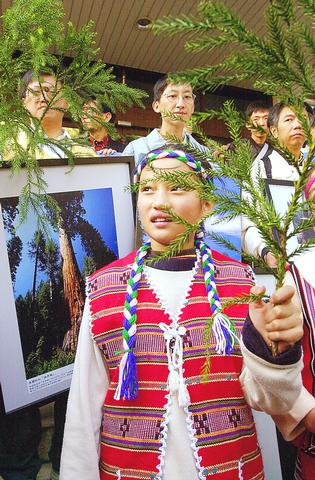
PHOTO: CHEN CHENG-CHANG, TAIPEI TIMES
The children later walked to the Presidential Office to present saplings to the president, but Chen was unable to meet with the group because he was in southern Taiwan. As the children sang Christmas songs, the saplings were accepted by Kuo Yao-chi (郭瑤琪), director of the Department of Public Affairs of the Presidential Office.
Activists who accompanied the children called for the establishment of Chilan Mountain National Park, saying that Christmas Day especially was an appropriate day to appreciate one of the gifts given by the God to Taiwanese people -- the only extensive and homogenous Taiwanese red and yellow cypress (
Conservationists urged the government to establish a national park on Chilan Mountain based on a new concept, which combines aboriginal culture with Western forest management.
Activists said they have learned from their efforts over the past few years that forest-related problems will not be solved until Aborigines can live in mountainous areas.
The controversy over the establishment of Chilan Mountain National Park emerged several years ago when environmentalists grew upset with what they called the government's "ironic forestry policy," so deemed because Taiwan's Forest Protection Department once supported logging. The government believed that the more logging there was, the richer the country would be. Activists, therefore, called for the preservation of trees, claiming that the government had logged 44 million cubic meters of trees from 1945 to 1989.
According to conservationists, due to the lack of balance between timber harvesting and protection of ecosystems, the Forest Protection Department under the Vocational Assistance Commission for Retired Servicemen (退輔會) had logged 6,000 hectares of red and yellow cypress trees over the past 30 years in the Chilan Mountain region, the location of the sources of water supplies to half of Taiwan's population.
Under pressure from environmentalists, a ban on logging in mountain areas was announced officially in 1989. But by then many Aborigines had been forced to relocate and leave their traditional place of residence.
Just this week Aboriginal groups joined together with environmentalists to express their support for the establishment of a national park at Chilan Mountain. They suggested the park be called Magou Mountain (馬告山) in the Atayal language, stressing that the process of planning a national park should include opinions from Aboriginal and other local residents.
Other Aboriginal groups, however, are opposed to the idea. They said that the National Park Act is in need of revision. Existing laws prohibit individuals from entering some areas in national parks.
Some Aboriginal people said at a public hearing at the Legislative Yuan early this month that, as long as they were allowed to enter the park freely, they did not mind the government managing the forests.

PROVOCATIVE: Chinese Deputy Ambassador to the UN Sun Lei accused Japan of sending military vessels to deliberately provoke tensions in the Taiwan Strait China denounced remarks by Japan and the EU about the South China Sea at a UN Security Council meeting on Monday, and accused Tokyo of provocative behavior in the Taiwan Strait and planning military expansion. Ayano Kunimitsu, a Japanese vice foreign minister, told the Council meeting on maritime security that Tokyo was seriously concerned about the situation in the East China and South China seas, and reiterated Japan’s opposition to any attempt to change the “status quo” by force, and obstruction of freedom of navigation and overflight. Stavros Lambrinidis, head of the EU delegation to the UN, also highlighted South China Sea

SILENCING CRITICS: In addition to blocking Taiwan, China aimed to prevent rights activists from speaking out against authoritarian states, a Cabinet department said The Ministry of Foreign Affairs (MOFA) yesterday condemned transnational repression by Beijing after RightsCon, a major digital human rights conference scheduled to be held in Zambia this week, was abruptly canceled due to Chinese pressure over Taiwanese participation. This year’s RightsCon, the world’s largest conference discussing issues “at the intersection of human rights and technology,” was scheduled to take place from tomorrow to Friday in Lusaka, and expected to draw 2,600 in-person attendees from 150 countries, along with 1,100 online participants. However, organizers were forced to cancel the event due to behind-the-scenes pressure from China, the ministry said, expressing its “strongest condemnation”
Taiwan Semiconductor Manufacturing Co (TSMC, 台積電), the world’s largest contract chipmaker, said it expects its 2-nanometer (2nm) chip capacity to grow at a compound annual rate of 70 percent from this year to 2028. The projection comes as five fabs begin volume production of 2-nanometer chips this year — two in Hsinchu and three in Kaohsiung — TSMC senior vice president and deputy cochief operating officer Cliff Hou (侯永清) said at the company’s annual technology symposium in Silicon Valley, California, last week. Output in the first year of 2-nanometer production, which began in the fourth quarter of last year, is expected to

Taiwan’s economy grew far faster than expected in the first quarter, as booming demand for artificial intelligence (AI) applications drove a surge in exports, spilling over into investment and consumption, the Directorate-General of Budget, Accounting and Statistics (DGBAS) said yesterday. GDP growth was 13.69 percent year-on-year during the January-to-March period, beating the DGBAS’ February forecast by 2.23 percentage points and marking the most robust growth in nearly four decades, DGBAS senior official Chiang Hsin-yi (江心怡) told a news conference in Taipei. The result was powered by exports, which remain the backbone of Taiwan’s economy, Chiang said. Outbound shipments jumped 51.12 percent year-on-year to


 RSS
RSS