


The government's "no haste, be patient" policy on China-bound investment is mainly aimed at encouraging Taiwan enterprises to keep their business roots at home, a senior policy planner for cross-strait policy said yesterday.
Mainland Affairs Council (MAC) Chairwoman Tsai Ing-wen (
"The most important spirit of the `no haste' policy is to make our entrepreneurs keep their business roots in Taiwan," Tsai stressed.
She went on to say that Taiwan's government is reviewing the policy with the aim of giving local businesses greater freedom in deciding whether to launch investment projects in China.
According to Tsai, Taiwan's investment policy for China will be eased step by step.
"Local entrepreneurs need not feel disappointed if the initial relaxation of restrictions on mainland investment is not very large," she said, adding that there will be follow-up adjustment measures announced later.
While easing restrictions on the kinds of business to be allowed for Taiwanese investment in China, Tsai said, the government hopes to simultaneously develop a system that will allow Taiwanese capital to flow home, to protect Taiwan from a capital drain.
"To reach this goal, we must create a favorable economic climate that will make it attractive for Taiwanese investors on the mainland to willingly remit their capital gains back to Taiwan, " Tsai said.
The "no haste, be patient" policy was first adopted by the previous KMT government in 1996 to cool a prevailing China investment fever.
Economics Minister Lin Hsin-yi (
Tsai said an inter-ministerial task force composed of officials from the MAC, MOEA and other relevant government agencies, has almost completed its review of the "no haste" policy.
"What we are mulling is the speed and scope of the liberalization of mainland China-bound investment," Tsai said.
Meanwhile, Vice Economics Minister Chen Ruey-long (陳瑞隆) said six kinds of technology products, including semiconductors, wireless communications products and high-end personal computers, will be opened for Taiwanese investment in China under the adjusted policy. The six items are currently on an off-limits list.
Chen said the revised policy will basically offer greater freedom for local companies to decide the items they plan to produce in China, while imposing harsher restrictions on capital management.
"We hope local companies can develop capital risk management systems while launching investment projects across the Taiwan Strait," he added.
MOEA sources said that investment in production of 189 high-tech products, including DRAM (dynamic random access memory chips) and SRAM (static random access memory chips), will still be banned under the revised policy.
During the meeting with the New Party Tsai said there is no timetable yet for the implementation of the full direct links between Taiwan proper and China and that the MAC will consider the introduction of Chinese laborers to Taiwan and allowing more relatives of Taiwan residents to travel to Taiwan.

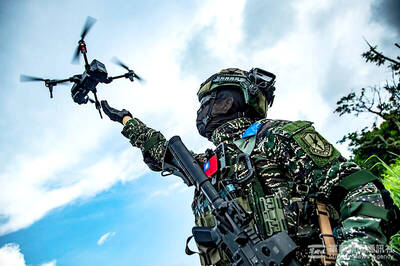
RESILIENCE: Taiwan plays a key role in semiconductors, energy, information infrastructure and advanced manufacturing, AIT Director Raymond Greene said Taiwan’s continued investment in deterrence and resilience remains vital, especially in uncrewed systems and other emerging technologies, American Institute in Taiwan (AIT) Director Raymond Greene said yesterday. Greene made the remarks at the annual National Strategic Summit on Supply Chain Resilience held by the Research Institute for Democracy, Society and Emerging Technology (DSET), a government-backed think tank. As Taiwan last year became the US’ fourth-largest trading partner and supply chain security is becoming more important, cooperation in emerging technologies continues to deepen between the two countries, he said. The US is committed to accelerating innovation, building key infrastructure, strengthening cooperation

The National Chungshan Institute of Science and Technology yesterday showcased its locally developed variants of the Vision 60 robotic patrol dog, which it plans to deploy on the nation’s outlying territories in the South China Sea. The variants were produced under the Joint Lab project — created by the institute and domestic companies — and assembled with domestically produced motors, lenses and artificial intelligence (AI) systems alongside licensed tech from the US, Missile and Rocket Systems Research Division deputy director Jen Kuo-kang (任國光) told the media event at a military base in Taipei’s Dazhi (大直) area. Taiwan has built up its strengths
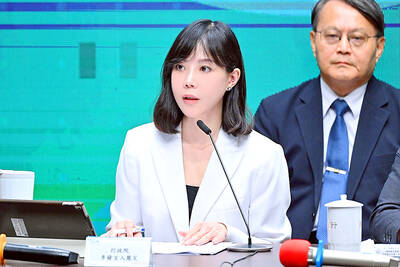
RIGHT DIRECTION: Taiwan’s efforts to prevent forced labor include a proposal to ‘fully prohibit’ employers from withholding workers’ documents, an official said Taiwan is to establish a mechanism to restrict imports of goods linked to forced labor, the Executive Yuan said yesterday, after the US proposed imposing additional tariffs on Taiwanese goods over labor concerns. “The Ministry of Labor and the Ministry of Economic Affairs are to establish an interministerial review procedure,” Executive Yuan spokesperson Michelle Lee (李慧芝) said at a news briefing in Taipei. “The government is to use the Foreign Trade Act [貿易法] as the legal basis to restrict imports of goods produced with forced labor” and bring its supply chain governance more in line with international standards on human rights, resilience

NOT IMMEDIATE: Taiwan has a chance to appeal the proposed 10 percent tariff before it starts, while other countries face a 12.5 percent tariff from the trade office Taiwan is among 60 economies determined by the US to have failed to impose or enforce a ban on the importation of goods produced with forced labor, according to a notice released on Tuesday by the Office of the US Trade Representative (USTR), which proposed imposing an additional 10 percent or more tariff on them. The USTR in a statement said that following an investigation, it had determined under Section 301 of the Trade Act of 1974 that the failure of the 60 economies to impose and effectively enforce a prohibition on the importation of goods produced with forced labor is


 RSS
RSS