


Taipei Times: Many observers believe that if Gore becomes the next US president, his administration will basically follow current China policy. Do you agree with that assumption?
Lieberthal: We recognize the PRC as the sole legal government of China, that is America's official diplomatic position. We have never recognized ambiguity on that. The Shanghai Communique indicates that we acknowledge China's claim that all Chinese on both sides of Taiwan Strait recognize there is "one China."
I have never thought that there was strategic ambiguity in America's China policy. That term was developed by people who wanted a clearer statement of the condition under which the US would become directly involved in any cross-strait conflict, but we have had a longstanding policy even before the Clinton administration. We highly value a peaceful approach to resolving the cross-strait debate, so if China should use force without being triggered by some remarkable provocation, China cannot assume safely that the US will not become militarily involved. At the same time, because we have a "one China" policy and we seek peaceful resolution on this issue, if Taiwan should unilaterally declare independence, Taiwan cannot assume that the US will recognize its independence and come to their support. I think this is quite clear.
TT: Governor Bush said in a recent interview that he hoped Taiwan would not declare independence. But some of his advisors said that Bush would review and possibly change the "three no's."
Lieberthal: President Clinton said the same thing about Taiwan independence. I think our fundamental policy toward China and Taiwan is bipartisan.
In each party, there are people within the margins, but the center remains very consistent over a long period of time. But I have not heard anything from Bush's advisors on a possible change of the "three no's." I have not seen evidence that Governor Bush disagrees with Vice President Gore in any fundamental fashion. And we do not know in each party who will be the major player in regional policy, so it is too early to tell.
According to my experience in the Clinton administration, an issue as fundamental as the "three no's" policy will require a presidential decision. I have not seen evidence that Governor Bush would change the policy that his father adhered to. I think there will be great caution to change any of that.
There have been some allegations that when President Clinton articulated those "three no's" in Shanghai that he had changed our long-standing policy. I looked back over every detail and the reality is that he didn't change a thing. The "three no's" was articulated by Nixon when he went to China in 1972 and has been reiterated by every president since.
But he is the first person to say those together in public in China. You can say that's a matter of body language, but as for the substance of American policy, there has been no change.
In fact, when I look back carefully on those documents, from Taiwan's perspective, Taiwan would feel least comfortable with Ronald Reagan, as he actually went farther than anyone else went [in the Shanghai Communique]. I am not against anything particular about Reagan, but I just want to point out that this is not a partisan issue. This is an issue of US interests and what we feel about the people in that region. And fundamentally that is to avoid military conflict, and the "three no's" serve that aim as well.
TT: But on the other hand, President Clinton was the first US leader to speak publicly that any final resolution of the cross-strait problem must have the consent of the people of Taiwan.
Lieberthal: Taiwan completed the process of democratization in 1997 during the Clinton administration, although that process began in the 1980s. What he said is that any final agreement would have to have the consent of the people of Taiwan. That simply stated is democracy. It is not a suggestion of support for a referendum or anything like that.
TT: There is no objection in Taiwan to President Clinton's acknowledgement that Taiwan has become a democratic country. Can we assume that his intended audience is actually Beijing?
Lieberthal: Beijing's leaders totally accept the fact that Taiwan has become a democracy, but they do not fully understand it. I have not had any conversations with anyone from China to suggest that they are seeking to make Taiwan anything other than a democratic system. But I do think that many of them do not know what democracy is and how it functions.
TT: Is that one of the major reasons why China tried to intimidate voters during the election in Taiwan?
Lieberthal: Yes, I think so. They try to change the votes and you can see each time they try to change the vote, it backfires. They just increase what they want to decrease. They highlight that they do not understand the nature of politics in Taiwan, but that's very different than saying they want to change the nature of politics in Taiwan. There is only one outcome they fear, which is independence.
TT: During your service in the NSC, former president Lee Teng-hui (李登輝) announced Taiwan's "special state-to-state relations" and China released its controversial White Paper. Both incidents raised tension in the Taiwan Strait. Can you tell us how the US government handled these crises?
Lieberthal: I agree that both of those created problems. What we tried to do is that for each incident, we went back to fundamentals. We remind everyone of the importance of reducing cross-strait tension and establishing an effective dialogue because there is no military solution to this problem.
Our judgment is that China would use military force because they feel they do not have any other choice. We have consistently sought to encourage Taiwan and China to talk to see whether they can find a way to resolve the issue. It is always presumed that the solution has to be acceptable to Taiwan since you can't use force to impose it, and the only solution acceptable to people in Taiwan is to maintain their democratic system and freedom.
TT: Is it true that China was planning to take an offshore island last year?
Lieberthal: I can say that we do not have any specific knowledge that the Chinese planned to take an offshore island. It is logical that when cross-strait tensions are raised, one of the reasonable options for China would be to seize one of the offshore islands, so we have to think about how we should react to that, and I believe that Taiwan's military was thinking about that too.
TT: President Chen Shui-bian (陳水扁) mentioned the "five no's" in his inauguration speech, including not declaring independence. Is it fair to say that the US has got its message through?
Lieberthal: We used to have a lot of contact with then-president Lee and you have to have contact with leaders in Taiwan. I am confident that President Chen is not someone that takes the script handed to him by the American side and reads it. It is not his style.
The whole purpose of communication is so that someone understands better than your own analysis what the situation is. It is not true that we dictated what President Chen said in his inauguration speech, that is absurd.
To be continued tomorrow
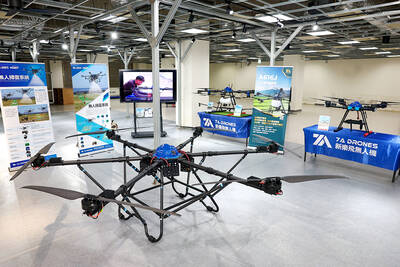
DRONE CENTRAL: Taiwan aims to become Asia’s democratic hub for drones, with most exports focused on high-quality military-grade models, an official said Taiwan’s drone industry is expected to expand significantly by 2030, producing 100,000 units per month and exporting half of them, the Ministry of Economic Affairs said yesterday. Current drone production capacity is about 15,000 units per month, but the industry can quickly scale up as demand increases, Industrial Development Administration Director-General Chiou Chyou-huey (邱求慧) told a news conference in Taipei. Taiwan’s drone output grew 2.5-fold last year to NT$12.9 billion (US$408.3 million) under a government program to develop the uncrewed vehicle sector, he said. The Executive Yuan in October last year approved plans to invest NT$44.2 billion into domestic production of uncrewed aerial
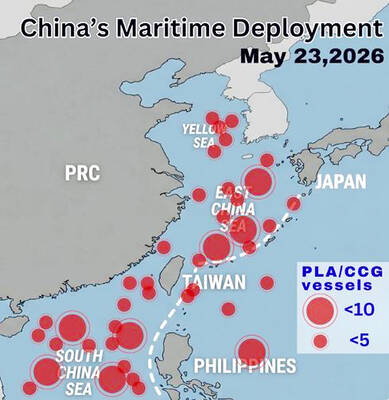
WARNING: China should stop engaging in actions that undermine regional peace and stability, as it would only build resentment among people across the Strait, the CGA said China has deployed more than 100 navy, coast guard and other vessels in waters from the Yellow Sea to the South China Sea and the western Pacific since US President Donald Trump and Chinese President Xi Jinping (習近平) met in Beijing, National Security Council Secretary-General Joseph Wu (吳釗燮) said yesterday. “In this part of the world, #China is the one & only PROBLEM wrecking the #StatusQuo & threatening regional peace & stability,” Wu wrote on X. In a separate post, he said Beijing was coercing Taiwan’s maritime domain, calling it illegal and provocative, after the Coast Guard Administration (CGA) expelled a
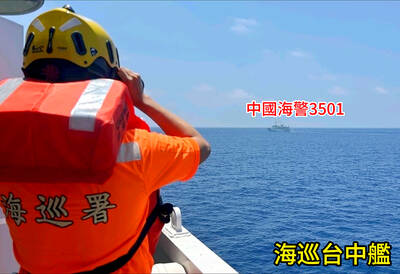
VERBOSE VESSELS: A CGA cutter and a China Coast Guard exchanged verbal barbs for more than a day in Taiwanese-controlled waters before the Chinese vessel left The Taiwanese and Chinese coast guards had a standoff near the strategically located Pratas Islands (Dongsha Islands, 東沙群島) in the north of the South China Sea, the Coast Guard Administration (CGA) said yesterday. The two sides engaged in intense radio exchanges over sovereignty claims during the 33-hour standoff. China Coast Guard vessel 3501 eventually left the restricted waters, 26.6 nautical miles (49.2km) west of the Pratas Islands, at 5pm yesterday, the CGA said. Lying approximately between southern Taiwan and Hong Kong, the Taiwan-controlled Pratas are seen by some security experts as vulnerable to Chinese attack due to their distance — more than
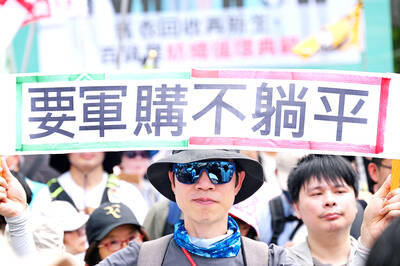
More than 8,000 people took part in a rally in Taipei yesterday to express support for more defense spending, after the opposition slashed the Cabinet’s proposed NT$1.25 trillion (US$39.6 billion) special defense budget and capped it at NT$780 billion. The demonstrators urged the Cabinet to propose another bill. Taiwan Economic Democracy Union convener Lai Chung-chiang (賴中強) said the main problem of the passed budget plan is the removal of funding for critical items, not just that the total amount is smaller. Critical budget items included purchasing or developing uncrewed vehicles, Strong Bow (強弓) missile systems, additional ammunition, artificial intelligence-powered combat systems and Taiwan-US


 RSS
RSS