


Taipei City Councilor Wang Shih-chien (
DPP Councilor Wang made the appeal following his allegations yesterday that the Taipei City Bus Administration (TCBA, 台北市工車處) and the city's Bureau of Transportation (交通局) have teamed up to bilk millions of dollars from customers by installing poor quality card readers on buses and of failing to conduct regular inspections.
"I'm afraid that the amount of money syphoned off may be in the millions of dollars," Wang said.
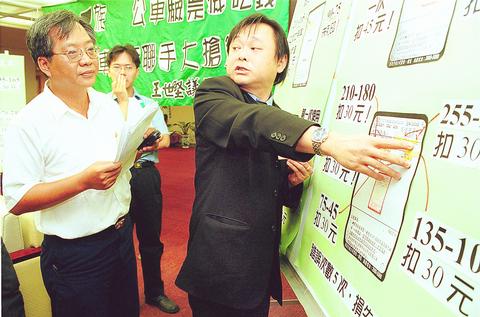
PHOTO: CHEN CHENG-CHANG, TAIPEI TIMES
Showing six bus cards he had collected from colleagues and friends, Wang said the phenomenon is not unusual, and the deducted amount for a one-way trip can go as high as NT$70, or NT$55 more than the standard NT$15 adult fare.
"Although it's a common practice, not many people know about it because most passengers usually don't bother to check their cards or even care that they've been overcharged as the amount is, after all, only NT$70," he said. "Besides, they don't want to get involved with the bureaucracy of sorting it out or face the possible hostility of bus drivers and/or the authorities."
According to Wang's own investigations, out of 462 city residents questioned for a survey administered by his office, only 5.7 percent respondents said they have noticed when too much money is taken off their bus card.
Data collected by Wang also showed that bus companies, both city-run and private ones, do a poor job of sending their card readers for overhauls, with repair rates ranging between 4 percent and 8 percent.
Huang Tsung-chou (
"We encourage passengers to report incidents to the bus driver as soon as they happen, or to mail the card back to the company that issued it for a refund," he said.
Since bus companies are required to conduct regular overhauls of their card readers, bus companies face a fine of NT$9,000 per machine should mistakes result from machine problems, Huang said.
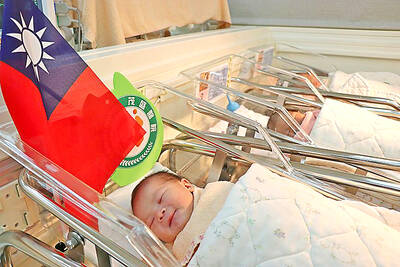
AGING: As of last month, people aged 65 or older accounted for 20.06 percent of the total population and the number of couples who got married fell by 18,685 from 2024 Taiwan has surpassed South Korea as the country least willing to have children, with an annual crude birthrate of 4.62 per 1,000 people, Ministry of the Interior data showed yesterday. The nation was previously ranked the second-lowest country in terms of total fertility rate, or the average number of children a woman has in her lifetime. However, South Korea’s fertility rate began to recover from 2023, with total fertility rate rising from 0.72 and estimated to reach 0.82 to 0.85 by last year, and the crude birthrate projected at 6.7 per 1,000 people. Japan’s crude birthrate was projected to fall below six,
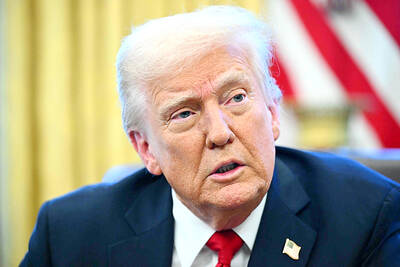
US President Donald Trump in an interview with the New York Times published on Thursday said that “it’s up to” Chinese President Xi Jinping (習近平) what China does on Taiwan, but that he would be “very unhappy” with a change in the “status quo.” “He [Xi] considers it to be a part of China, and that’s up to him what he’s going to be doing, but I’ve expressed to him that I would be very unhappy if he did that, and I don’t think he’ll do that. I hope he doesn’t do that,” Trump said. Trump made the comments in the context
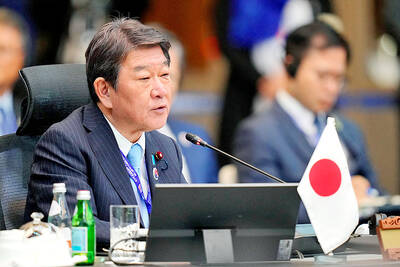
SELF-DEFENSE: Tokyo has accelerated its spending goal and its defense minister said the nation needs to discuss whether it should develop nuclear-powered submarines China is ramping up objections to what it sees as Japan’s desire to acquire nuclear weapons, despite Tokyo’s longstanding renunciation of such arms, deepening another fissure in the two neighbors’ increasingly tense ties. In what appears to be a concerted effort, China’s foreign and defense ministries issued statements on Thursday condemning alleged remilitarism efforts by Tokyo. The remarks came as two of the country’s top think tanks jointly issued a 29-page report framing actions by “right-wing forces” in Japan as posing a “serious threat” to world peace. While that report did not define “right-wing forces,” the Chinese Ministry of Foreign Affairs was

PREPAREDNESS: Given the difficulty of importing ammunition during wartime, the Ministry of National Defense said it would prioritize ‘coproduction’ partnerships A newly formed unit of the Marine Corps tasked with land-based security operations has recently replaced its aging, domestically produced rifles with more advanced, US-made M4A1 rifles, a source said yesterday. The unnamed source familiar with the matter said the First Security Battalion of the Marine Corps’ Air Defense and Base Guard Group has replaced its older T65K2 rifles, which have been in service since the late 1980s, with the newly received M4A1s. The source did not say exactly when the upgrade took place or how many M4A1s were issued to the battalion. The confirmation came after Chinese-language media reported


 RSS
RSS