


The young child turned from the public telephone to his grandmother. "Papa said he would only come back for Harvest Festival," he said. The urgent, repeated request for further confirmation that followed from the grandmother reflected her longing for her son.
The sight of the old woman walking with her grandchild back to her house, veiled in a curtain of darkness, seemed helplessly lonesome, like that of most of the elderly here.
In 1980, this village, Pulhakele (
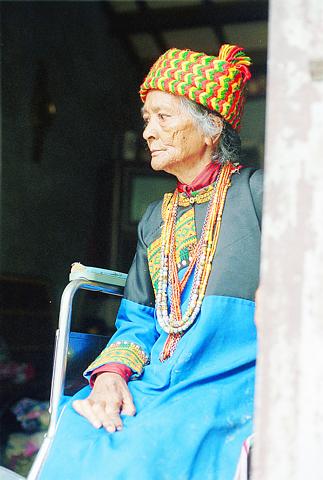
PHOTO: CHEN CHENG-CHANG, TAIPEI TIMES
The village, with approximately 100 Rukai households, might, that day, have been bustling in anticipation of its yearly sports meeting.
Instead, the number of people in the area remained the same as usual: 50 or so senior citizens and pre-school children.
Twenty years have passed since the 500 Rukai residents of Kochapongan trudged for hours along the rocky path to Pulhakele, where most of them chose to live. It was the dream of "a much improved modern lifestyle" there that conquered their reluctance to abandon the picturesque home of their ancestors.
"Kochapongan's beauty is indescribable," said Gawararane Pelheng from the Pulhakele Community Development Association (PCDA), who spent 30 years in Kochapongan. He said that they had decided to move for the reason that the closer they were to the plain, the greater access they would have to resources, but that the decision "was influenced heavily by the lifestyle and values of Han people."
"Our villagers decided to move down the mountain for financial reasons, convenience, and to get our children educated in the Han system to enable them to compete in the Han-dominated society," said Madarallape Kaynwane, president of the PCDA.
Decades ago, starting work at daybreak and retiring at sunset were the guiding principles of their life. In Kochapongan, the Rukai simply exchanged goods, or took what they needed from mother nature on their land until currency was introduced by city workers.
Even nowadays, modern conveniences make little difference to the elders who had long ago embraced nature high in the mountains. Old women weaving colorful beads to make traditional wedding dresses seldom turn on their fluorescent lamps, accustomed as they are to relying on sunlight.
Even those happy to migrate, however, realized that the grim reality of what they consider the dominance and inflexibility of the Han people would always prevent them from being truly accepted as well as from sharing existing resources.
Discrimination
"People would openly call me `Darkie,'" said Salilun Wugusun, a Rukai truck driver who worked in Taipei. Many who moved to Pulhakele eventually left for jobs in urban areas with the greater contact with Han society that that entailed.
"Most of our population has moved into the cities. The concern for family and the tribe has almost evaporated, while young people brought up and educated in Mandarin Chinese and Han culture are completely disconnected from the tribe," said Gawararane Pelheng. "Sure, we can't isolate ourselves from the modern world, but we should maintain the uniqueness of our culture," Gawararane Pelheng remarked solemnly.
"Government policy is just too inflexible and shows too little concern for our people," Gawararane Pelheng said.
"For example, although learning our mother tongue in infancy is crucial to the preservation of our root culture, the authorities have just closed the only local primary school, forcing our kids to attend school in the city."
"Sometimes I feel terribly ashamed that I can barely speak the language of my ancestors, which hinders me from further understanding our culture and past," said Madaralapu Camela, a Rukai young man who has graduated from a college in the city.
Facing the prospect of disbursal of the tribe due to lack of the critical cohesive force that the Rukai tribe's understanding of its culture and people might bring, members of the tribe founded the "Return to Kochapongan Movement" in 1990.
A number of Rukai people started rebuilding the dilapidated stone houses in Kochapongan. "We take the reconstruction of stoneware as a prelude to the recapture of the Rukai mind," said Taipon Sasala, a major Rukai activist devoted to the movement.
While the Rukai were informed that the government was planning to build the Machia Reservoir (
Reconstruction
The reconstruction program, a symbol of the Rukai people's desire to embrace their culture before it fades into the Han social structure, continues. Activities to trace the roots of the tribe in Kochapongan are held twice a year and have influenced young people to discover and affirm their ties with their own people.
"I do feel closer to my Rukai origins for having visited Kochapongan, while I have no feelings for where I live in the city," said Doragai Bawandaka, a young Rukai woman. "Without the association, with my ancestors in Kochapongan, I'm just like a rootless duckweed in the city," Madaralape Camala said.
Villagers also realized that they had to return to their land, whether Kochapongan or Pulhakele, to develop their own economic mechanisms to make the community prosperous without being manipulated by Han society.
"We are planning to develop tourism here with the attraction of stone houses in Kochapongan as relics recognized by the government," said Madaralhape Kaynwane.
"We intend to offer at least one job opportunity to every household to draw our people back, then we should be able to start our own primary school again, which will acquaint the next generation more with our culture," he said.
Many villagers regard tourism as the best and only means to develop the community.
"We have to consolidate the tribe with job opportunities and income founded on tourism," said Abudwa Ramazan, the village chief.
Taipon Sasala, however, strongly objected to the idea of tourism.
"As soon as tourism starts, the tribe will be destroyed," he warned, arguing that not only would tourists destroy the peaceful village life, but also, the business would fall into the hands of Han people.
"Tourism simply accelerates the invasion of Han people and the disintegration of the tribe," he said.
Taipon Sasala, agreeing with Pelheng Gawararane that indigenous people should have the right to participate in policy-making related to their rights, argued that the government should return to indigenous people the land where those people had been hunting, farming and picking fruits until such activities were banned under the policy of "forest conservation."
"The government's claiming of our land as national property and restricting our use of it, despite our living here, relying on commercial activity for hundreds of years without endangering any species," said Taipon Sasala, "is a form of violence."

CREDIT-GRABBER: China said its coast guard rescued the crew of a fishing vessel that caught fire, who were actually rescued by a nearby Taiwanese boat and the CGA Maritime search and rescue operations do not have borders, and China should not use a shipwreck to infringe upon Taiwanese sovereignty, the Coast Guard Administration (CGA) said yesterday. The coast guard made the statement in response to the China Coast Guard (CCG) saying it saved a Taiwanese fishing boat. The Chuan Yu No. 6 (全漁6號), a fishing vessel registered in Keelung, on Thursday caught fire and sank in waters northeast of Diaoyutai Islands (釣魚台). The vessel left Keelung’s Badouzih Fishing Harbor (八斗子漁港) at 3:35pm on Sunday last week, with seven people on board — a 62-year-old Taiwanese captain surnamed Chang (張) and six

RISKY BUSINESS: The ‘incentives’ include initiatives that get suspended for no reason, creating uncertainty and resulting in considerable losses for Taiwanese, the MAC said China’s “incentives” failed to sway sentiment in Taiwan, as willingness to work in China hit a record low of 1.6 percent, a Ministry of Labor survey showed. The Directorate-General of Budget, Accounting and Statistics (DGBAS) also reported that the number of Taiwanese workers in China has nearly halved from a peak of 430,000 in 2012 to an estimated 231,000 in 2024. That marked a new low in the proportion of Taiwanese going abroad to work. The ministry’s annual survey on “Labor Life and Employment Status” includes questions respondents’ willingness to seek employment overseas. Willingness to work in China has steadily declined from
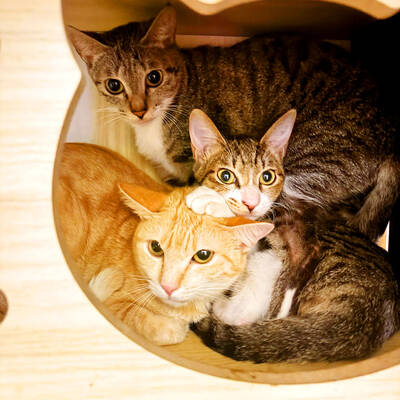
The number of pet cats in Taiwan surpassed that of pet dogs for the first time last year, reaching 1,742,033, a 32.8 percent increase from 2023, the Ministry of Agriculture said yesterday, citing a survey. By contrast, the number of pet dogs declined slightly by 1.2 percent over the same period to 1,462,528, the ministry said. Despite the shift, households with dogs still slightly outnumber those with cats by 1.2 percent. However, while the number of households with multiple dogs has remained relatively stable, households keeping more than two cats have increased, contributing to the overall rise in the feline population. The trend

LEVERAGE: China did not ‘need to fire a shot’ to deny Taiwan airspace over Africa when it owns ‘half the continent’s debt,’ a US official said, calling it economic warfare The EU has raised concerns about overflight rights following the delay of President William Lai’s (賴清德) planned state visit to the Kingdom of Eswatini after three African nations denied overflight clearance for his charter at the last minute. Taiwanese allies Paraguay and Saint Kitts and Nevis, as well as several US lawmakers and the Inter-Parliamentary Alliance on China (IPAC) condemned China for allegedly pressuring the countries. Lai was scheduled to fly directly to Taiwan’s only African ally from yesterday to Sunday to celebrate the 40th anniversary of King Mswati III’s accession and his 58th birthday, but Seychelles, Mauritius and Madagascar suddenly revoked


 RSS
RSS