


More foreigners are working in Taiwan than ever these days, despite a government get-tough policy to stem the importation of labor which has seen a record number of deportations and a rash of new employment regulations.
It appears that President Chen Shui-bian's (
According to the latest figures from the Employment and Vocational Training Administration, there was a total of 309,424 foreigners working in the country at the end of June, up from 294,967 at the start of this year. A record number.
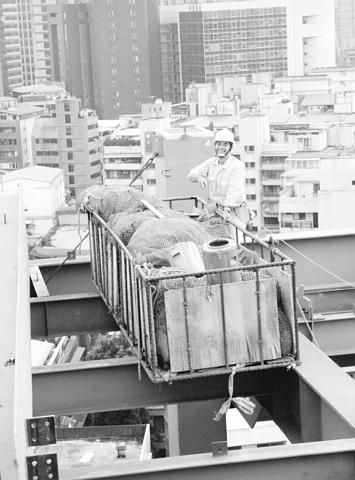
PHOTO: JULES QUARTLY
New measures to stem the tide of imported labor -- which range from a fresh ban on foreign students taking up work, to a policy of reducing the numbers of overseas workers, to toughening entry qualifications for domestic helpers have all proven ineffective or have backfired.
Clampdown
The only clampdown which has had an effect has been on the suspension of new laborers from the Philippines.
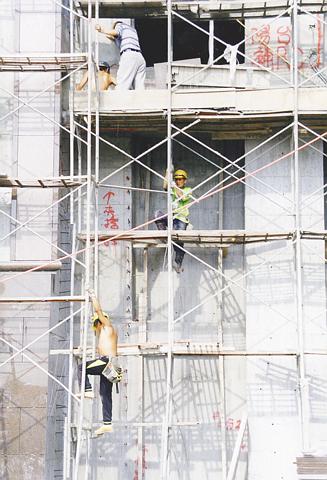
PHOTO: JULES QUARTLY
Certainly, the "problem" of foreigners working in Taiwan has been attacked with a broad and double-edged sword. At the same time as restrictions on foreign workers have been implemented, the National Police Administration has been busy chasing down illegal workers and throwing them out of the country.
The number of aliens deported because of criminal acts has been relatively stable since 1995, with an average of 96 deportations a year. Up until recently the number of foreigners that were forced to leave the country because they were working illegally, violated their contracts, or overstayed their visas, hovered between 16,000 and 18,000, probably because quotas were set within this range.
However, in the four-month period between November last year up to March this year, there were 7,900 foreigners deported, 1,900 more than usual, or a 76 percent increase. This level of activity has been maintained up to the present, as confirmed by Council of Labor Affairs (CLA) Chairperson Chen Chu (
These figures, she claimed, were significant because they represent an increase in the number of "escaped" overseas workers, ie, workers who leave their authorized job or overstay their visa.
"There are fewer `escaped' foreign laborers because they were caught and deported. The results show the positive effects of better intelligence gathering by the police and their hard work catching these people," Chen said. Chen also said the policy of cutting down the number of foreign workers began in 1998, when the shortage of labor in the manufacturing sector was a relatively high 4 percent.
She said this policy had been reasonably successful: "The labor shortage problem is not as bad as it used to be and the productivity of each worker has been improved."
But, other factors could more readily explain the situation. Manufacturing and other traditional labor-intensive industries like agriculture have been experiencing a steady fall in terms of their percentage contribution to GDP and a corresponding slide in employee numbers.
For instance, production of processed foods, leather, wood and bamboo products which once dominated exports have steadily decreased since the 1980s. And this is where the problems begin.
Though capital-and-technology intensive industries, such as the production of chemicals, petrochemicals, electronic items and information technology have all experienced moderate to very strong growth, they mask the decline of traditional sunrise industries going to the wall and the human cost this brings.
Some of these people get retrained or begin again with a job in the service industries, if they are not too old, others become taxi drivers, like Mr Kuo (
A shift in the economy
Some Taiwanese, especially those who have been badly affected by this shift in the economy, naturally resent the fact that foreigners have jobs when they do not, or are struggling.
The government is forced to take action or get voted out of office.
Chen Ju said that since 1997 the unemployed population had hovered around 250,000.
But, from January to April 2000 it reached 272,000.
"We have to cut down foreign labor to protect the rights of locals," she said.
"To meet the demand of Taiwan's development we import foreign labor at a reasonable rate to supplement the labor needed. Given these reasons we think cutting down on foreign labor is necessary to ease unemployment." This policy drive is in particular targeted at the Aboriginal population whom President Chen has pledged to help, which largely works in the blue-collar construction and manufacturing industries and has the highest unemployment rate among all the ethnic groups on the island.
Foreign workers work longer, for less
However, many employers prefer foreign workers because they are willing to work longer, harder and for less pay. These employers fear that cutting their numbers will make Taiwan's traditional "sunset" industries even less competitive in the international markets.
"Our labor costs are three times higher than surrounding countries," Huey Sheng, an economic specialist at the CLA said. "Business people must consider profit before people." Taiwan has a well-educated, highly trained and top heavy work force, that, like many Western countries is beginning to depend on foreign labor to do the "dirty, dangerous and difficult jobs" they no longer have to do themselves.
"Taiwanese prefer to work in an office with air conditioning and dress in a suit," Sheng said.
Hence the need for Indonesian, Thai and increasingly Vietnamese workers, who are lured from their countries' rural areas by agents promising good money and conditions.
Thai workers are in the majority in Taiwan, comprising 45 percent of foreign labor, or 140,487 workers, as of June this year. Asoke Srichantr, at the Thailand Trade and Economic Office said the reason so many Thai workers are employed in Taiwan is due to their "easygoing" nature.
They dominate the manufacturing and construction industries, where they will mostly be housed in dormitories and go from work to bed, day in day out, for an average wage of NT$15,840 per month. Srichantr said most locals would not work under these conditions for this money. He said the new government was introducing policies and caps on foreign workers, but that the effect on inflows had been minimal.
"The president says this and that. I do not understand the policies, though I understand the problems. Perhaps the policies are deliberately confusing," he said.
President Chen's pledge to reduce by 5 percent annually the number of overseas workers is floundering not because of a lack of political will but because of practical need.
Cutting the number of foreign workers will cause employers in traditional industries to move their plants to China or other third country destinations, where overheads, particularly labor, are cheaper.
This will also have an impact on domestic employment levels, which is partly why Premier Tang Fei (唐飛) recently ordered the CLA to reassess its cap on foreign workers and halt imports if necessary.
The other main reason is that if the workweek is shortened from 48 hours a week to 84 hours every fortnight in 2001, then labor costs will rise by an estimated NT$177.6 billion a year, further reducing international competitiveness and raising the number of business closures, and further increasing unemployment levels.
Also, anticipated large-scale growth in local employment opportunities of around 2.7 percent is expected with likely WTO entry.
President Chen has to navigate a difficult course and it is foreseeable that the numbers of foreign workers and deportations may continue to go up for some time, or for as long as the economic miracle continues.

‘NO SECURITY RISK’: The Railway Bureau reassured the public that the technicians’ activities were limited to technical guidance and did not involve sensitive systems The Railway Bureau yesterday said it had invited eight Chinese technicians to assist with an airport MRT construction project. The bureau issued the confirmation after an Internet user said Chinese nationals had entered the construction zone of Taiwan Taoyuan International Airport’s Terminal 3 project. They asked why “individuals from an enemy state” were allowed access to such a major national infrastructure project, which raised serious concerns over Taiwan’s industrial safety, sensitive systems and information security. The bureau’s Northern Region Engineering Branch Office said subcontractor Taiwan Handle Industrial Co (台灣手把工業) of the Taoyuan airport MRT’s “Contract No. CU05 Project A14 Station Civil, MEP &

The National Chungshan Institute of Science and Technology yesterday showcased its locally developed variants of the Vision 60 robotic patrol dog, which it plans to deploy on the nation’s outlying territories in the South China Sea. The variants were produced under the Joint Lab project — created by the institute and domestic companies — and assembled with domestically produced motors, lenses and artificial intelligence (AI) systems alongside licensed tech from the US, Missile and Rocket Systems Research Division deputy director Jen Kuo-kang (任國光) told the media event at a military base in Taipei’s Dazhi (大直) area. Taiwan has built up its strengths

NOT IMMEDIATE: Taiwan has a chance to appeal the proposed 10 percent tariff before it starts, while other countries face a 12.5 percent tariff from the trade office Taiwan is among 60 economies determined by the US to have failed to impose or enforce a ban on the importation of goods produced with forced labor, according to a notice released on Tuesday by the Office of the US Trade Representative (USTR), which proposed imposing an additional 10 percent or more tariff on them. The USTR in a statement said that following an investigation, it had determined under Section 301 of the Trade Act of 1974 that the failure of the 60 economies to impose and effectively enforce a prohibition on the importation of goods produced with forced labor is

TIT-FOR-TAT: The US allegedly revoked the visa of a Chinese national working at Xinhua News Agency in the US in response to Beijing’s expulsion of Vivian Wang The Presidential Office yesterday condemned China for expelling a New York Times correspondent from Beijing following the newspaper’s interview with President William Lai (賴清德), saying the move highlighted Beijing’s suppression of press freedom and its threat to international news media. Taiwan has noted a series of recent incidents in which Beijing used similar tactics to “threaten and pressure international media outlets and journalists,” Presidential Office spokeswoman Karen Kuo (郭雅慧) said in a statement. “This concerns not only press freedom and freedom of expression, but also the safety of journalists, and Taiwan and relevant partners are paying close attention to the situation,” she


 RSS
RSS