


Anti-nuclear activists urged the public yesterday to join a massive demonstration scheduled for this Saturday, intended to highlight hopes that the new government will reform Taiwan's energy policy.
The activists insisted, however, that the activity is not intended as a political scheme to oppose the new government led by DPP President-elect Chen Shui-bian (
At a press conference held by Taiwan Environmental Protection Union (TEPU) yesterday, environmentalists said some DPP supporters -- mostly anti-nuclear activists -- appeared to be reluctant to join.
"Taking part in the demonstration is meant to express people's eager expectations of a reasonable energy policy," said Kao Cheng-yan (
"We hope these DPP supporters can free themselves from their psychological complex regarding Chen Shui-bian. We are helping Chen to run the government," said Kao, adding that protesters would voice their indignation at the energy policy created by the KMT-led central government.
"If the DPP does not cash their [political] check of abandoning nuclear energy, [the party] will be rejected by the people in the next presidential election four years from now," Kao said.
Activists predicted that the demonstration would attract more than 3000 supporters, and would pressure future economics minister Lin Hsin-yi (
Still, Lin has promised take four four months to assess the viability of the project, and whether or not it should continue.
Strong opposition to the plant began in 1986 by members of the so-called "tang-wai" (黨外) movement -- the forerunner of the DPP -- who protested in front of the Taiwan Power Corp (台電) headquarters. Since then, anti-nuclear demonstrations have also been associated with political dissent.
In the past decade, many DPP political figures have worked to gain public support for the movement against the Fourth Nuclear Power Plant.
More recently, however, environmentalists said they have sensed a gradual shift in the sentiment of DPP political figures away from involvement in the movement.
"Last year, the DPP mobilized just 200 people to join the anti-nuclear demonstration to mark the anniversary of the Three Mile Island incident," Kao said.
TEPU activists said yesterday that people should not be misled by recent information released by the Energy Commission (
These and other nuclear energy developers have recently reiterated their stance that adopting nuclear energy is an efficient way to reduce growing carbon dioxide emission rates -- one of main causes of global warming.
Environmentalists said they were looking forward to seeing the new government adjust the operations of Taiwan's industrial infrastructure.
They added that more than 3,000 people would likely join the "513" Anti-nuclear Demonstration in Taipei's downtown area on Saturday
Several Japanese anti-nuclear officials and congressmen also said will join the march.


RESILIENCE: Taiwan plays a key role in semiconductors, energy, information infrastructure and advanced manufacturing, AIT Director Raymond Greene said Taiwan’s continued investment in deterrence and resilience remains vital, especially in uncrewed systems and other emerging technologies, American Institute in Taiwan (AIT) Director Raymond Greene said yesterday. Greene made the remarks at the annual National Strategic Summit on Supply Chain Resilience held by the Research Institute for Democracy, Society and Emerging Technology (DSET), a government-backed think tank. As Taiwan last year became the US’ fourth-largest trading partner and supply chain security is becoming more important, cooperation in emerging technologies continues to deepen between the two countries, he said. The US is committed to accelerating innovation, building key infrastructure, strengthening cooperation

The National Chungshan Institute of Science and Technology yesterday showcased its locally developed variants of the Vision 60 robotic patrol dog, which it plans to deploy on the nation’s outlying territories in the South China Sea. The variants were produced under the Joint Lab project — created by the institute and domestic companies — and assembled with domestically produced motors, lenses and artificial intelligence (AI) systems alongside licensed tech from the US, Missile and Rocket Systems Research Division deputy director Jen Kuo-kang (任國光) told the media event at a military base in Taipei’s Dazhi (大直) area. Taiwan has built up its strengths

RIGHT DIRECTION: Taiwan’s efforts to prevent forced labor include a proposal to ‘fully prohibit’ employers from withholding workers’ documents, an official said Taiwan is to establish a mechanism to restrict imports of goods linked to forced labor, the Executive Yuan said yesterday, after the US proposed imposing additional tariffs on Taiwanese goods over labor concerns. “The Ministry of Labor and the Ministry of Economic Affairs are to establish an interministerial review procedure,” Executive Yuan spokesperson Michelle Lee (李慧芝) said at a news briefing in Taipei. “The government is to use the Foreign Trade Act [貿易法] as the legal basis to restrict imports of goods produced with forced labor” and bring its supply chain governance more in line with international standards on human rights, resilience
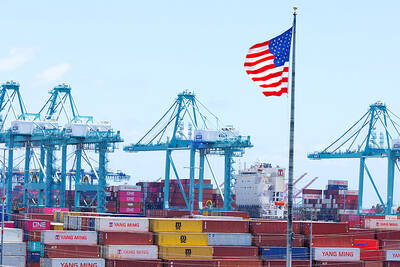
NOT IMMEDIATE: Taiwan has a chance to appeal the proposed 10 percent tariff before it starts, while other countries face a 12.5 percent tariff from the trade office Taiwan is among 60 economies determined by the US to have failed to impose or enforce a ban on the importation of goods produced with forced labor, according to a notice released on Tuesday by the Office of the US Trade Representative (USTR), which proposed imposing an additional 10 percent or more tariff on them. The USTR in a statement said that following an investigation, it had determined under Section 301 of the Trade Act of 1974 that the failure of the 60 economies to impose and effectively enforce a prohibition on the importation of goods produced with forced labor is


 RSS
RSS