


Through 11 years of construction and an estimated NT$400 billion in spending, the company running Taipei's mass rapid transit system had a difficult time shaking off its image as a clunky bureaucracy with a shaky safety record.
But with the opening of the Hsintien Line today, transport analysts and officials said Taipei's rapid transit corporation is trying hard to prove it has learned from its mistakes.
"I am pleased to see that the city's MRT system has at last started to win the public's trust," said Lin Neng-pai (
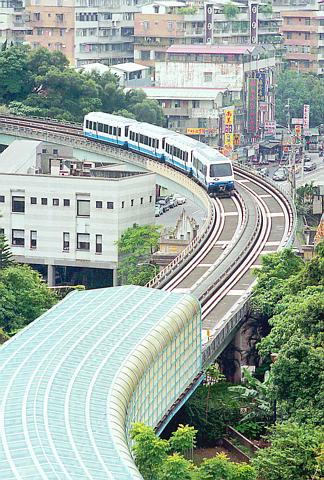
PHOTO: CHEN CHENG-CHANG, TAIPEI TIMES
"When the Mucha Line [the city's first MRT line] opened, many people didn't dare ride it because they were worried about safety," said Lin. "But people seldom question the safety of the MRT lines anymore."
But Lin, who is dean of the College of Management at the National Taiwan University and also an expert in civil engineering, did express regrets over the city's MRT project -- which, he said, should have been completed decades ago.
Growing pains
From preliminary planning, which began in 1975 to the opening of the Mucha Line in 1996, the project was dogged with controversy nearly every step of the way.
The Taipei City Government's Department of Rapid Transit Systems, established in 1987, coordinates and contracts building projects for the MRT system, from electrical to computers systems, to private companies.
The state-run Taipei Rapid Transit Corporation (TRTC), meanwhile, manages operations for the network.
The Mucha Line opened to the public in 1996 after eight years of construction and testing -- four of those mired in a series of safety problems and accusations of organized crime involvement, bid-rigging and costly delays.
After it began operations, it became a showcase for all of the potential nightmares a mass rapid transit system could suffer.
Its shaky record triggered distrust between the department and the corporation and put the two at loggerheads, Lin said.
"Corporation officials felt that the department shouldn't hand over a line to a corporation that wasn't ready to operate. But the officials at the department would argue that the line was good enough to commence operations," Lin said.
And of course, the setbacks at the Mucha Line not only upset the public but also the officials involved.
TRTC Vice President Yen Pang-chieh (
"Even when the line passed inspection, we were still not sure if it was actually ready to go. So we had to keep a low profile," Yen said, referring to the fact that the line was only open for two hours a day during its first week of operation. The line took an additional three weeks before it was running at full capacity.
Both the department and the corporation had a series of expensive and bitter disputes with Matra Transport, the French company contracted to build the line. The battle eventually went to court but was not settled until July this year when the Taiwan High Court awarded Matra NT$1.13 billion in damages for delays and cost overruns.
Shortly after completing construction on the Mucha Line, the company withdrew from the project.
Then DPP City Councillor Lin Ruey-tu (
`Strategic mistake'
Another major factor that impeded Taipei's MRT project, according to Lin, was the "strategic mistake" to begin construction work on several lines -- Hsintien, Tamshui, Chungho and Panchiao -- virtually all at the same time.
"One cannot accumulate experience in this manner," Lin said.
Part of the rationale for beginning the work at the same time was to apply for a combined budget of NT$400 billion from the central government for construction.
Another reason, observers said, was to show the city's determination to complete the project.
The city should have concentrated its efforts on one line first to accumulate experience before starting a large-scale MRT construction project, he said.
Lin said Taipei's formula meant that it was not possible to learn from experience, "which was quite a detrimental move."
High fees for overseas consultants to the MRT system also became a bone of contention. In June 1995, the department failed to renew its contract with its general consultants from the US after disputes over consulting fees.
Chiang Yao-chung (
"I believed I could do something to make the city's metro work," said Chiang.
Officials yesterday said they had learned from history.
"Now that we're further on in the project, things are getting smoother ... Our accumulated experience has helped us cope with similar difficulties more easily," Yen said.
And as the Hsintien Line opened today -- three weeks ahead of schedule -- many said they have high hopes for the city's MRT system.
"I am really glad to see that Taipei's transit system has passed through its `dark ages' and helped transform Taipei into a modern metropolis," Lin said.

‘NO SECURITY RISK’: The Railway Bureau reassured the public that the technicians’ activities were limited to technical guidance and did not involve sensitive systems The Railway Bureau yesterday said it had invited eight Chinese technicians to assist with an airport MRT construction project. The bureau issued the confirmation after an Internet user said Chinese nationals had entered the construction zone of Taiwan Taoyuan International Airport’s Terminal 3 project. They asked why “individuals from an enemy state” were allowed access to such a major national infrastructure project, which raised serious concerns over Taiwan’s industrial safety, sensitive systems and information security. The bureau’s Northern Region Engineering Branch Office said subcontractor Taiwan Handle Industrial Co (台灣手把工業) of the Taoyuan airport MRT’s “Contract No. CU05 Project A14 Station Civil, MEP &

The National Chungshan Institute of Science and Technology yesterday showcased its locally developed variants of the Vision 60 robotic patrol dog, which it plans to deploy on the nation’s outlying territories in the South China Sea. The variants were produced under the Joint Lab project — created by the institute and domestic companies — and assembled with domestically produced motors, lenses and artificial intelligence (AI) systems alongside licensed tech from the US, Missile and Rocket Systems Research Division deputy director Jen Kuo-kang (任國光) told the media event at a military base in Taipei’s Dazhi (大直) area. Taiwan has built up its strengths

NOT IMMEDIATE: Taiwan has a chance to appeal the proposed 10 percent tariff before it starts, while other countries face a 12.5 percent tariff from the trade office Taiwan is among 60 economies determined by the US to have failed to impose or enforce a ban on the importation of goods produced with forced labor, according to a notice released on Tuesday by the Office of the US Trade Representative (USTR), which proposed imposing an additional 10 percent or more tariff on them. The USTR in a statement said that following an investigation, it had determined under Section 301 of the Trade Act of 1974 that the failure of the 60 economies to impose and effectively enforce a prohibition on the importation of goods produced with forced labor is

RIGHT DIRECTION: Taiwan’s efforts to prevent forced labor include a proposal to ‘fully prohibit’ employers from withholding workers’ documents, an official said Taiwan is to establish a mechanism to restrict imports of goods linked to forced labor, the Executive Yuan said yesterday, after the US proposed imposing additional tariffs on Taiwanese goods over labor concerns. “The Ministry of Labor and the Ministry of Economic Affairs are to establish an interministerial review procedure,” Executive Yuan spokesperson Michelle Lee (李慧芝) said at a news briefing in Taipei. “The government is to use the Foreign Trade Act [貿易法] as the legal basis to restrict imports of goods produced with forced labor” and bring its supply chain governance more in line with international standards on human rights, resilience


 RSS
RSS