


For Taiwanese film director Chang Tso-chi (
At the moment, life is good for Chang. His latest film, Darkness and Light, just picked up three major prizes at the recently-concluded Tokyo International Film Festival (TIFF), and the news made front page headlines around Taiwan.
Not expecting to win any prizes, Chang flew back from Tokyo to Taipei before the TIFF awards ceremony. He found out he won on the Internet.
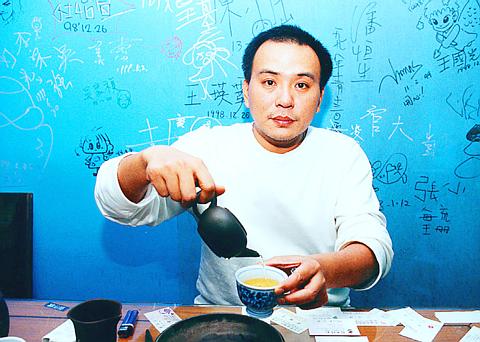
PHOTO: TAI LI-AN
But while Chang is happy about the Tokyo awards and the publicity the news has generated in film circles around the world, he is still worried about the debt he incurred in making Darkness and Light. The still-unreleased film cost around NT$16 million, with the government chipping in NT$10 million as a grant. Chang finished the movie last year, but has yet to find a distributor for it. The TIFF awards should help, he said. And the prize money should help clear some of his outstanding debts, he added.
"I hope the `light' in the film can also bring light to Taiwan's local film market," Chang said.
The TIFF awards mark the first time that a Taiwanese director has won three prizes at the Tokyo film festival, which began in 1987.
On Saturday, Chang was awarded the Asian Special Prize, a US$9,432 prize specifically for Asian films. On Sunday, he was awarded the the festival's top prize -- the US$94,000 Tokyo Grand Prix -- and the TIFF best director prize.
The Government Information Office, which handles funding and subsidies for Taiwanese films, also announced a special award of NT$2 million in recognition of Chang's work. In all, the Tokyo Film Festival presented Chang with a nice bonus -- a total of around NT$4 million.
Participating in overseas film festivals before domestic distribution -- in hopes of coming back with prestigious awards -- has become a pattern in the promotion of Taiwanese films, including movies by Hou Hsiao-hsian (
But according to Chang, this was not his goal in Tokyo.
"I always consider my films to be commercial," Chang said.
"We don't have the funds to find film distributors to sell our movies. This is the only way we could think of," said Lu Shi-yuan (
Taiwan's film industry has been in decline over the past 10 years, with less than 20 domestic films made in the last two years, according to industry sources.
Darkness and Light is set in a massage center run by blind people, where a young woman lives with her blind parents and a retarded brother. The film recounts the woman's love affair with a young man from a neighborhood gang.
Chang, who has been called a great storyteller by critics, likes to focus his films on people who have been marginalized by society.
Chang said that he has already written the script for his next film, to be titled King of the Betel Nut Stands. The movie will focus on the people who work in the betel nut "industry," Chang said.

‘NO SECURITY RISK’: The Railway Bureau reassured the public that the technicians’ activities were limited to technical guidance and did not involve sensitive systems The Railway Bureau yesterday said it had invited eight Chinese technicians to assist with an airport MRT construction project. The bureau issued the confirmation after an Internet user said Chinese nationals had entered the construction zone of Taiwan Taoyuan International Airport’s Terminal 3 project. They asked why “individuals from an enemy state” were allowed access to such a major national infrastructure project, which raised serious concerns over Taiwan’s industrial safety, sensitive systems and information security. The bureau’s Northern Region Engineering Branch Office said subcontractor Taiwan Handle Industrial Co (台灣手把工業) of the Taoyuan airport MRT’s “Contract No. CU05 Project A14 Station Civil, MEP &

The National Chungshan Institute of Science and Technology yesterday showcased its locally developed variants of the Vision 60 robotic patrol dog, which it plans to deploy on the nation’s outlying territories in the South China Sea. The variants were produced under the Joint Lab project — created by the institute and domestic companies — and assembled with domestically produced motors, lenses and artificial intelligence (AI) systems alongside licensed tech from the US, Missile and Rocket Systems Research Division deputy director Jen Kuo-kang (任國光) told the media event at a military base in Taipei’s Dazhi (大直) area. Taiwan has built up its strengths

NOT IMMEDIATE: Taiwan has a chance to appeal the proposed 10 percent tariff before it starts, while other countries face a 12.5 percent tariff from the trade office Taiwan is among 60 economies determined by the US to have failed to impose or enforce a ban on the importation of goods produced with forced labor, according to a notice released on Tuesday by the Office of the US Trade Representative (USTR), which proposed imposing an additional 10 percent or more tariff on them. The USTR in a statement said that following an investigation, it had determined under Section 301 of the Trade Act of 1974 that the failure of the 60 economies to impose and effectively enforce a prohibition on the importation of goods produced with forced labor is

TIT-FOR-TAT: The US allegedly revoked the visa of a Chinese national working at Xinhua News Agency in the US in response to Beijing’s expulsion of Vivian Wang The Presidential Office yesterday condemned China for expelling a New York Times correspondent from Beijing following the newspaper’s interview with President William Lai (賴清德), saying the move highlighted Beijing’s suppression of press freedom and its threat to international news media. Taiwan has noted a series of recent incidents in which Beijing used similar tactics to “threaten and pressure international media outlets and journalists,” Presidential Office spokeswoman Karen Kuo (郭雅慧) said in a statement. “This concerns not only press freedom and freedom of expression, but also the safety of journalists, and Taiwan and relevant partners are paying close attention to the situation,” she


 RSS
RSS