


In the wake of the 921 earthquake, many members of Taiwan's Aboriginal community have been asking the same question: will local opinion leaders, when they also become political representatives, continue to pursue the interests of their constituents -- or pursue their own interests instead?
The question has been on the minds of many after the now-infamous "urinating incident" last week, which occurred when Vice President Lien Chan (
On Oct. 23, when Lien was on his way to the center of Jenai township, a group of Aborigines from the township's Huchu village (
According to one Aboriginal leader, however, there was only one catch.
"They [the protesters] were not indigenous people from that place," legislator Walis Pelin, an Aboriginal also elected from Jenai township, told Lien.
After stopping by the village and visiting the toilet at a private home, Lien told reporters and villagers that he "understood the situation here," and promptly left the site.
The move was later satirized as the "magic piss" by Hu Te-fu (
Following the incident, more than 300 of the group's members gathered at the CKS Memorial Hall in Taipei to protest what they said was the government's indifference towards the plight of Aborigines. These actions, in turn, aroused media and public concern over the suffering of the Aborigines in the mountains of central Taiwan.
The presidential office held two press conferences in the following two days to explain Lien's stance.
Meanwhile, various announcements concerning loan funds that would address the living standards of Aborigines -- all totaling different amounts, from NT$100 million to NT$80 billion -- were announced to alleviate the complaints.
Then, this past Friday, the Cabinet-level Post-disaster Reconstruction Committee approved a loan of NT$2.3 billion specifically earmarked for helping Aborigines with rebuilding their homes.
To residents of Jenai who had taken part in the protest, however, their disappointment had less to do with Lien or the central government, but was focused toward their elected representative.
"Why did Walis say those words?" said one villager, surnamed Chang. "Every day, we are facing the terror of potential mudslides. How can you say we're not local?"
According to Hu, who organized a service team of non-Aborigine volunteers, Huchu village remains buried under thousands of tons of rocks and mud.
"But neither the township mayor nor other politicians have come to the site to check. They came only one day before Lien Chan went to the village," Hu said.
"It is too obvious that he [Walis] was taking the credit and seeking rewards from the powerful people," Hu said.
In other words, Hu said, as a local Aborigine of Jenai township, Walis Pelin wanted to take Lien to see "the right people" -- the "real" victimized villagers.
Other Aboriginal leaders, such as Nantou County councilor Yukan Nabu and the current chairman of the Taiwan Aboriginal Rights Association, agreed, saying Walis had indeed taken the chance to benefit his own local "boosters," or prominent local personalities who are capable of gathering votes during elections.
The government's disaster relief actions, with officials touring disaster sites and giving out consolatory money, is another form of electoral campaigning, and it's also true in the villages of the Aborigines, Nabu said.
"During ordinary times, resour-ces of any kind are always in shortage. But with big events happening, such as elections or a disaster, many forms of supplies are rushed in and all factions and tribes start to chase after the prizes. This is what has happened to the Aboriginal tribes," Hu said.
After the 921 earthquake, Walis set up a relief resource workshop in Puli, but one resident complained he was not allowed to receive material supplies "because he did not belong to Walis' "areas of control."
Responding to accusations of being a traitor to his people, Walis said it was all a misunderstanding. He denied any political association in his relief actions and said materials at his work station had never meant to be provided to only a certain group of people.
"During the first few days after the quake, the situation was chaotic and we were understaffed. It was perhaps then that misunderstandings occurred," he said.
Amid the controversy over his words that protesters were non-Aborigines, Walis explained: "What I said was many of the protesters were not local, and it need not resort to social movements to solve their demands."
"People can sit and talk to the vice president about their needs," he said.
Walis added that other Aboriginal politicians, such as Yukan Nabu and KMT lawmaker Lin Chuan-te (林春德), had also established their own disaster relief stations.
"If there was any political intention involved, Lin and Nabu were equally susceptible to such an accusation," he said.
For Aboriginal activists like Hu Te-fu, more and more Aboriginal elites have left their tribal people behind once they enter the political sphere.
Hu, the founder and the first chairman of the Taiwan Aboriginal Rights Association in 1984, was also a well-known folk singer.
"Aborigines have high expectations, and hope they can speak for their people. But they later realized politicians were all the same. The political games, the struggling between parties are always put ahead of the interests of the Aborigines themselves," he said.
"Now we have all those township mayors, representatives on both local and central levels, and a Council of Aboriginal Affairs at the Cabinet level that are Aborigines. But what we have is more compromises, more cover-ups," he added.
"Aboriginal officials can spend NT$30,000 dining with their indigenous guests from foreign countries, but are reluctant to buy hoses for mountainside Aborigines. Do you think the fate of the Aborigines has changed?" Hu said.

A signaling system malfunction disrupted high-speed rail (HSR) services beginning at 8am today, with trains temporarily reduced to three northbound and three southbound trains per hour as authorities conduct inspections. The malfunction occurred on a section of track in Miaoli County during pre-operation checks early this morning, forcing northbound and southbound trains to use a single track, the HSR operator said. The regular schedule has been replaced with three hourly trains offering only nonreserved seating in each direction, stopping at every station, it said, adding that business class cars would still have reserved seating. Departures from terminal stations are scheduled at the top

Taiwan is still in the process of assessing the possibility of recruiting workers from Eswatini, the Ministry of Foreign Affairs said yesterday, adding that its goal is to help Eswatini upgrade its vocational training centers. If there are plans to recruit workers from Eswatini, safeguarding national security, protecting public health and ensuring the employment rights of Taiwanese would be prerequisites, Department of West Asian and African Affairs Director-General Yen Chia-liang (顏嘉良) told a news conference. Key considerations would also include filling labor shortages in specific industries, and fostering bilateral professional and technical exchanges, he said. Yen was asked about the progress of labor

VERBOSE VESSELS: A CGA cutter and a China Coast Guard exchanged verbal barbs for more than a day in Taiwanese-controlled waters before the Chinese vessel left The Taiwanese and Chinese coast guards had a standoff near the strategically located Pratas Islands (Dongsha Islands, 東沙群島) in the north of the South China Sea, the Coast Guard Administration (CGA) said yesterday. The two sides engaged in intense radio exchanges over sovereignty claims during the 33-hour standoff. China Coast Guard vessel 3501 eventually left the restricted waters, 26.6 nautical miles (49.2km) west of the Pratas Islands, at 5pm yesterday, the CGA said. Lying approximately between southern Taiwan and Hong Kong, the Taiwan-controlled Pratas are seen by some security experts as vulnerable to Chinese attack due to their distance — more than
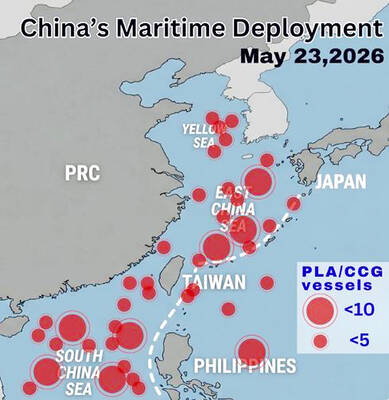
WARNING: China should stop engaging in actions that undermine regional peace and stability, as it would only build resentment among people across the Strait, the CGA said China has deployed more than 100 navy, coast guard and other vessels in waters from the Yellow Sea to the South China Sea and the western Pacific since US President Donald Trump and Chinese President Xi Jinping (習近平) met in Beijing, National Security Council Secretary-General Joseph Wu (吳釗燮) said yesterday. “In this part of the world, #China is the one & only PROBLEM wrecking the #StatusQuo & threatening regional peace & stability,” Wu wrote on X. In a separate post, he said Beijing was coercing Taiwan’s maritime domain, calling it illegal and provocative, after the Coast Guard Administration (CGA) expelled a


 RSS
RSS