


The largest cultural exchange ever between Taiwan and China opened in Beijing yesterday with an exhibition of avant garde Taiwan-ese art.
"Visions of Pluralism: Contemporary Art in Taiwan, 1988-1999" by 75 Taiwanese artists is being shown at Beijing's Museum of Modern Art despite months of heightened tension.
Around 30 of the artists have come to the capital to show their works, some of which evoke Western pop art. One piece by Tang Huang-chen places two televisions beaming the same images opposite at each other.
Despite the crisis which erupted in July over President Lee Teng-hui's (李登輝) statement that Taipei-Beijing relations were conducted on a "special state-to-state" basis, the opening ceremony for the exhibition was formal, with China's vice minister of culture Meng Xiaosi attending.
"This exhibition had been planned for a year, well before the two-states theory row," explained Victoria Lu, a Taiwanese art critic and the show's curator. "We didn't know if it would go ahead or not, but the Taiwanese authorities were very supportive."
Although there are no official relations between the two governments, half of the show's cost was met by public funds from Taipei, Lu said.
Lin Cheng-chih (
"Culture is a means of dialogue that everybody understands," she said.
Lin cancelled his planned visit to Beijing at the last minute because of the 921 earthquake and not for political reasons, Lu said.
Exhibit organizers have done little to mask the fact that, except for a short period following World War II, the island has been politically separated from the mainland since the Japanese colonized it in 1895.
"Over 100 years of separation have generated undeniable differences between Taiwan and China," said Lu. "Separation from the mainland has endowed Taiwan with a very unique character and destiny."
She continued: "1988 was the beginning of a new era, in that it was the first year that the development of art became free from political control following the end of martial law in 1987."
The exhibition, which lasts 12 days, has received only sparse coverage by the mainland press.
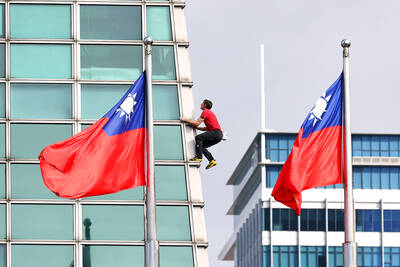
DAREDEVIL: Honnold said it had always been a dream of his to climb Taipei 101, while a Netflix producer said the skyscraper was ‘a real icon of this country’ US climber Alex Honnold yesterday took on Taiwan’s tallest building, becoming the first person to scale Taipei 101 without a rope, harness or safety net. Hundreds of spectators gathered at the base of the 101-story skyscraper to watch Honnold, 40, embark on his daredevil feat, which was also broadcast live on Netflix. Dressed in a red T-shirt and yellow custom-made climbing shoes, Honnold swiftly moved up the southeast face of the glass and steel building. At one point, he stepped onto a platform midway up to wave down at fans and onlookers who were taking photos. People watching from inside
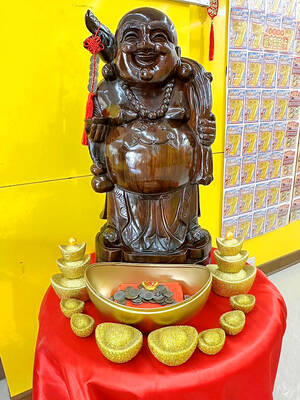
A Vietnamese migrant worker yesterday won NT$12 million (US$379,627) on a Lunar New Year scratch card in Kaohsiung as part of Taiwan Lottery Co’s (台灣彩券) “NT$12 Million Grand Fortune” (1200萬大吉利) game. The man was the first top-prize winner of the new game launched on Jan. 6 to mark the Lunar New Year. Three Vietnamese migrant workers visited a Taiwan Lottery shop on Xinyue Street in Kaohsiung’s Gangshan District (崗山), a store representative said. The player bought multiple tickets and, after winning nothing, held the final lottery ticket in one hand and rubbed the store’s statue of the Maitreya Buddha’s belly with the other,
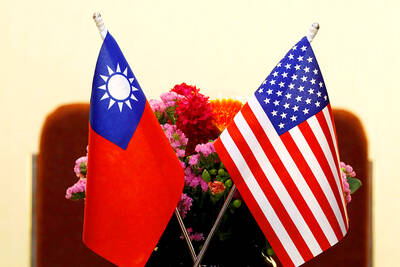
‘NATO-PLUS’: ‘Our strategic partners in the Indo-Pacific are facing increasing aggression by the Chinese Communist Party,’ US Representative Rob Wittman said The US House of Representatives on Monday released its version of the Consolidated Appropriations Act, which includes US$1.15 billion to support security cooperation with Taiwan. The omnibus act, covering US$1.2 trillion of spending, allocates US$1 billion for the Taiwan Security Cooperation Initiative, as well as US$150 million for the replacement of defense articles and reimbursement of defense services provided to Taiwan. The fund allocations were based on the US National Defense Authorization Act for fiscal 2026 that was passed by the US Congress last month and authorized up to US$1 billion to the US Defense Security Cooperation Agency in support of the

‘COMMITTED TO DETERRENCE’: Washington would stand by its allies, but it can only help as much as countries help themselves, Raymond Greene said The US is committed to deterrence in the first island chain, but it should not bear the burden alone, as “freedom is not free,” American Institute in Taiwan Director Raymond Greene said in a speech at the Institute for National Defense and Security Research’s “Strengthening Resilience: Defense as the Engine of Development” seminar in Taipei yesterday. In the speech, titled “Investing Together and a Secure and Prosperous Future,” Greene highlighted the contributions of US President Donald Trump’s administration to Taiwan’s defense efforts, including the establishment of supply chains for drones and autonomous systems, offers of security assistance and the expansion of


 RSS
RSS