


Typhoon Dan was downgraded to a tropical storm yesterday as it swept across the front-line island of Kinmen. Winds toppled power lines -- causing a blackout to the entire area -- and thousands of trees lining streets were uprooted.
Statistics issued by state-run Taipower indicated that nearly 70 percent of Kinmen's power lines were downed by trees.
Officials from the company said it could take as long as three days for power to be restored.
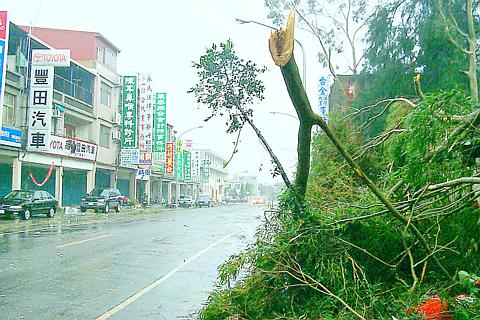
PHOTO: WU CHENG-TING, LIBERTY TIMES
Dan -- the most powerful typhoon of the season -- also caused damage to parts of southern Taiwan. In Kaohsiung city, powerful winds and waves burst a dike in the scenic tourist spot of Hsitzuwan (
Gale-force winds also swept through historic Tainan city, toppling an already earthquake-damaged dike at the mouth of Luerhmen River (鹿耳門溪).
On the island of Penghu, Dan toppled houses and sunk several fishing boats, forcing Makung airport to close for part of the day.
With heavy rains threatening further damage to quake-stricken areas, the Council of Agriculture yesterday released a new landslide warning. According to the report, there are at least 122 landslide sites located in disaster areas.
Officials from the council said rainwater flowing over landslides could turn them into gravel streams, endangering people living nearby.
As Dan made landfall on China's coast yesterday, the Central Weather Bureau lifted typhoon warnings for Taiwan last night.
Weather forecasters said Taiwan's weather system should stabilize within the next couple of days.


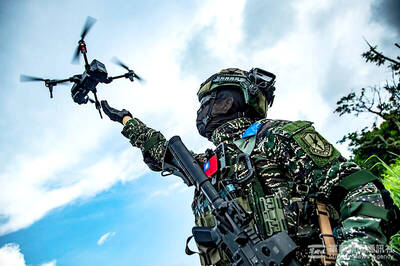
The National Chungshan Institute of Science and Technology yesterday showcased its locally developed variants of the Vision 60 robotic patrol dog, which it plans to deploy on the nation’s outlying territories in the South China Sea. The variants were produced under the Joint Lab project — created by the institute and domestic companies — and assembled with domestically produced motors, lenses and artificial intelligence (AI) systems alongside licensed tech from the US, Missile and Rocket Systems Research Division deputy director Jen Kuo-kang (任國光) told the media event at a military base in Taipei’s Dazhi (大直) area. Taiwan has built up its strengths
RESILIENCE: Taiwan plays a key role in semiconductors, energy, information infrastructure and advanced manufacturing, AIT Director Raymond Greene said Taiwan’s continued investment in deterrence and resilience remains vital, especially in uncrewed systems and other emerging technologies, American Institute in Taiwan (AIT) Director Raymond Greene said yesterday. Greene made the remarks at the annual National Strategic Summit on Supply Chain Resilience held by the Research Institute for Democracy, Society and Emerging Technology (DSET), a government-backed think tank. As Taiwan last year became the US’ fourth-largest trading partner and supply chain security is becoming more important, cooperation in emerging technologies continues to deepen between the two countries, he said. The US is committed to accelerating innovation, building key infrastructure, strengthening cooperation

RIGHT DIRECTION: Taiwan’s efforts to prevent forced labor include a proposal to ‘fully prohibit’ employers from withholding workers’ documents, an official said Taiwan is to establish a mechanism to restrict imports of goods linked to forced labor, the Executive Yuan said yesterday, after the US proposed imposing additional tariffs on Taiwanese goods over labor concerns. “The Ministry of Labor and the Ministry of Economic Affairs are to establish an interministerial review procedure,” Executive Yuan spokesperson Michelle Lee (李慧芝) said at a news briefing in Taipei. “The government is to use the Foreign Trade Act [貿易法] as the legal basis to restrict imports of goods produced with forced labor” and bring its supply chain governance more in line with international standards on human rights, resilience

NOT IMMEDIATE: Taiwan has a chance to appeal the proposed 10 percent tariff before it starts, while other countries face a 12.5 percent tariff from the trade office Taiwan is among 60 economies determined by the US to have failed to impose or enforce a ban on the importation of goods produced with forced labor, according to a notice released on Tuesday by the Office of the US Trade Representative (USTR), which proposed imposing an additional 10 percent or more tariff on them. The USTR in a statement said that following an investigation, it had determined under Section 301 of the Trade Act of 1974 that the failure of the 60 economies to impose and effectively enforce a prohibition on the importation of goods produced with forced labor is


 RSS
RSS