


Handing down a name over generations is a central part of the Japanese traditional theater art of Kabuki, and that ceremony gets celebrated at theaters and special events every few years.
Now, the ritual is taking place with the eighth Kikugoro, who is having that honor passed down from his 83-year-old father, the seventh Kikugoro, who in turn got that name from his father.
“Taking on the name is about taking on the spirit and responsibility that’s created and getting passed down over generations by those who came before us,” the younger Kikugoro, Kazuyasu Terajima, told reporters recently.
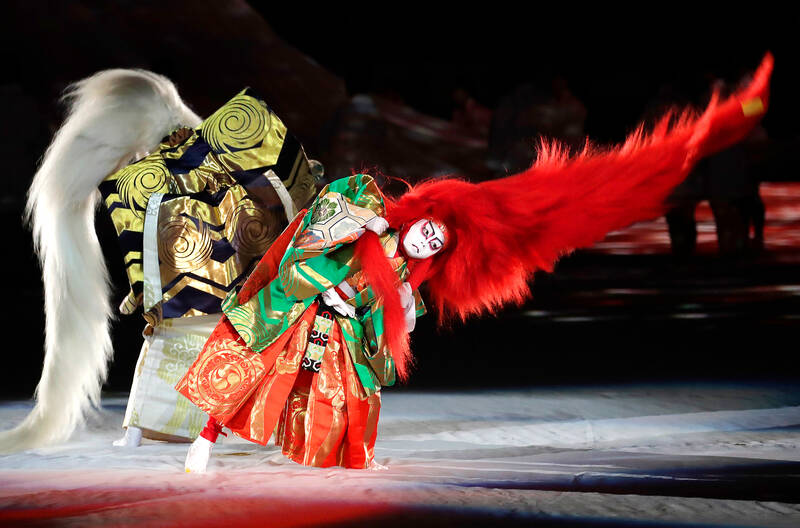
Photo: AP 照片:美聯社
Another famous family name in Kabuki is Danjuro, whose name succession for the 13th Danjuro happened in 2022.
A Japanese theatrical tradition that’s vibrant today
Kabuki, dating to the 1600s, is still very much alive in modern-day Japan. The hit film “Kokuho,” nominated for this year’s Oscars in makeup and hairstyling, is one proof of Kabuki’s continuing popularity, becoming the biggest grossing live-action movie for the home market in Japanese filmmaking history.
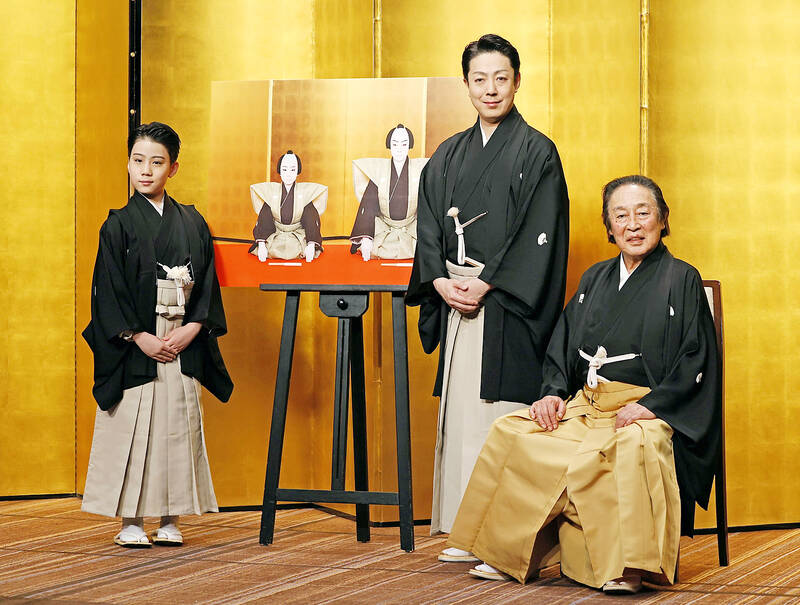
Photo: AP 照片:美聯社
Kabuki showcases gut-wrenching stories about brave samurai who assume a hidden identity to avenge an injustice, or a beautiful maiden who turns into a serpent, combining live music, dance and song with stylized acting — with all the roles played by men, wearing colorful costumes and plastered makeup.
The Kabuki actors specializing in women roles are called “onnagata,” while others like Kikugoro play both men and women.
What often strikes Westerners about Kabuki is the utter abandonment of any attempt to portray reality, as things might appear on the surface, or how people might behave naturally. The actors strike dramatic poses called “mie” in the middle of their lines to drive home the idea of courage or flight from pursuit. Experts refer that moment to conveying a picture, a moment often accentuated by the rhythmical clatter of two pieces of wood, which are like claves.
The actors’ lines are often delivered in singsong poetry. The live music is an integral part of the play in setting the scene, with thunderous giant drums evoking thunder or, when played more softly, gently falling snow. Tinkling bells might portray floating butterflies.
The backdrop is a revolving spectacular set, such as cherry trees showering pink paper petals. Pieces may have elements of acrobatics, such as an actor playing a fox, dancing with joy, suspended by wires from the ceiling.
One of the fun aspects of Kabuki is the costume and character changes that happen right on stage before the audience, transforming a human character into a demon, for instance, sometimes with the help of stagehands cloaked in anonymous black costuming called “kurogo.”
Kabuki echoes Shakespearean theater with universal themes
Yet the parallels with Shakespearean theater are stark. One popular play, “The Love Suicides at Sonezaki,” is about young lovers who choose to die together, a Romeo and Juliet of Kabuki.
The parallels are coincidental. Chikamatsu Monzaemon, who wrote the piece for Japan’s Bunraku puppet theater, lived during Japan’s 18th century isolationist Tokugawa period and is believed to have never read Shakespeare, who had penned the similar love story decades before Chikamatsu.
Kabuki training starts in childhood
Terajima was sitting next to his 12-year-old son Kazufumi, who in turn will take on the name he had before, Kikunosuke. It’s the name for the younger actor in that family, handed down over generations like the Kikugoro name.
Kikunosuke said he loves being a Kabuki actor, but like a normal kid, he also likes video games and the Japanese rock band Mrs. Green Apple.
It’s hard work, he said, which involves running every morning, watching his diet and going to bed early.
“It’s not only hard physically. It’s also pretty hard mentally, and I sometimes took it out on my parents,” he said with a smile, carrying himself with a controlled professional pose way beyond his years.
The name-succession ritual, called “shumei,” which began for the father and son last year in various performances throughout Japan, continues through this year.(AP)
在日本傳統表演藝術「歌舞伎」中,世代傳承藝名是一項核心傳統,「襲名」儀式每隔數年便會在劇院及特別活動中隆重舉行。
目前,第八代尾上菊五郎正進行襲名,繼承其83歲的父親第七代菊五郎的名號——此名號也是他自父親繼承而來。
第八代菊五郎本名為寺島和康,他近日向媒體表示:「承襲這個名號,意味承擔前人世代累積並傳承下來的精神與責任」。
另一個著名的歌舞伎世襲名號是「團十郎」,其第十三代襲名儀式於2022年舉行。
歷久彌新的日本傳統戲劇
歌舞伎起源於17世紀,在現代日本依然生氣蓬勃。入圍今年奧斯卡最佳化妝與髮型設計的賣座電影《國寶》,正是歌舞伎持續受到歡迎的明證,本片也是日本影史上本土市場票房最高的真人電影。
歌舞伎以情感強烈的故事聞名,例如隱姓埋名、為正義復仇的武士,或化身為蛇的美麗女子,融合現場音樂、舞蹈與歌唱,並搭配高度風格化的表演。所有角色皆由男性演出,他們服裝華麗、妝容濃厚。
專門飾演女性角色的演員稱為「女形」,而像菊五郎這樣的演員則可同時詮釋男女角色。
對許多西方觀眾而言,歌舞伎最令人印象深刻之處,在於其完全不追求寫實表現。演員常在台詞中段擺出誇張定格姿勢「見得」,以強化勇氣或逃亡等情緒。專家認為,這是一種將瞬間凝結為畫面的表現手法,通常伴隨著節奏分明的響板聲。
演員的台詞常帶有吟唱般的節奏,而現場音樂則是營造氛圍的重要元素。例如大鼓可模擬雷聲,輕柔敲擊則如飄落的雪花;鈴聲則可象徵飛舞的蝴蝶。
舞台設計也極為壯觀,例如可旋轉的場景,或櫻花樹飄落粉色紙花。部分表演甚至包含特技元素,如演員扮演狐狸時,以鋼絲吊掛於空中舞動。
歌舞伎的一大特色,是角色與服裝能在觀眾面前即時變換,例如從人類轉變為妖怪,常由身穿黑衣、刻意不引人注意的舞台人員「黑子」協助完成。
與莎士比亞戲劇呼應的普世主題
歌舞伎與莎士比亞戲劇雖然風格迥異,但它們在主題上卻有驚人的相似之處。經典劇目《曾根崎情死》描寫一對戀人選擇殉情,堪稱歌舞伎版的《羅密歐與茱麗葉》。
這種相似純屬巧合。該劇作者近松門左衛門活躍於日本江戶時代的鎖國時期,據信從未接觸過莎士比亞的作品,《羅密歐與茱麗葉》的創作年代比《曾根崎情死》早了數十年。
歌舞伎的訓練從童年開始
訪談時,寺島和康12歲的兒子寺島和史也坐在一旁。這名少年未來也將承襲家族傳統,繼承「菊之助」之名,這是該家族年輕演員的世襲稱號。
菊之助表示,他熱愛成為歌舞伎演員,但也像一般孩子一樣喜歡打電動,喜愛日本搖滾樂團Mrs. Green Apple。
他坦言,他得要下很多苦工,包括每天晨跑、控制飲食與早睡。
「不只是體力上的辛苦,心理上也相當有壓力,有時我會把情緒發洩在父母身上」,他笑著說,但舉止已展現出超齡的專業與沉穩。
「襲名」這項傳承儀式,自去年起,便透過父子兩人在日本各地的巡演展開,並將持續至今年。
(台北時報林俐凱編譯)

You might think knitting is only for grandmas, but surprisingly, many young people are embracing so-called “grandma hobbies.” On social media platforms, activities such as home cooking, embroidery and gardening are becoming popular among teenagers and young adults who are drawn to their relaxing and creative nature. “Grandma hobbies” typically refer to activities that are slow-paced, handmade and nostalgic. Common examples include knitting scarves, baking cookies, sewing clothes and growing plants. These hobbies were once part of everyday life for many women in previous generations, but today they provide an escape from the fast-paced digital world. The appeal

A: Isn’t the 2026 Coachella Valley Music and Arts Festival — a massive music event held every April — about to open in California? B: Yeah the festival is set to take place over two weekends, from April 10 to 12 and 17 to 19, US time. A: I heard this year’s main stage headliners include Sabrina Carpenter, Justin Bieber, Karol G and EDM DJ Anyma. B: The K-pop army is also making an appearance, with legendary group BigBang, SHINee member Taemin and girl group Katseye debuting for the first time. A: Isn’t Coachella also live-streamed on its YouTube
A: Several Japanese and South Korean acts, such as BigBang, are participating in this year’s Coachella Music Festival. Have any Mando-pop singers ever performed at Coachella? B: Yup, K-pop group GOT7’s Hong Kong member Jackson Wang, and Taiwanese band Sunset Rollercoaster, which primarily performs in English, attended the festival before. A: It’s a pity that we didn’t fly to Coachella. But in fact, Taipei has also gradually become an Asian music hub in recent years. B: That’s true. K-pop sensation Twice just held three concerts at the Taipei Dome, followed by Hong Kong singer G.E.M., who is going

Concertgoers know the rush all too well — the moment the first notes play, your heart races, and nothing else seems to matter. For many, the excitement doesn’t end when the lights come back on. Some fans try to relive the performance by listening to the same songs for days afterward. __1__ A few days after an amazing show, they begin to feel unexpectedly low. Psychologists have coined a term for this phenomenon: “post-concert depression,” or “PCD.” PCD is primarily related to hormone levels. When you’re at a concert, the excitement causes your brain to release feel-good chemicals like


 RSS
RSS