


A: After attending Taiwanese baseball superstar Chen Wei-yin’s retirement ceremony in Japan, why didn’t you stay longer for some fun?
B: Don’t you remember? We’re going to Blackpink member Jisoo’s fan meeting at Messe Taoyuan this Sunday.
A: Oh, that’s right. She’s the second Blackpink member visiting Taiwan as a solo artist after Lisa.

Photo: Liberty Times 照片:自由時報
B: Jisoo just released her EP “Amortage” on Valentine’s Day.
A: Blackpink will also release new songs and launch a world tour this summer.
A: 你去日本參加台灣強投陳偉殷的引退儀式後,怎麼沒留下來玩幾天?
B: 你忘啦?我們週日還要去「桃園會展中心」參加Blackpink成員Jisoo的見面會。
A: 啊對耶,她是繼Lisa後第二位單飛訪台的Blackpink成員。
B: Jisoo不久前才在情人節,推出個人迷你專輯《Amortage》。
A: Blackpink今年夏天也會推出新歌,還會啟動世界巡演呢!
(By Eddy Chang, Taipei Times/台北時報張迪)
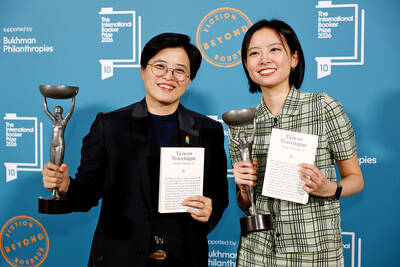
Taiwan Travelogue, the novel by Taiwanese author Yang Shuang-zi and translated into English by Lin King, won the prestigious International Booker Prize in London on May 19. It marks the first time a Taiwanese literary work has received the International Booker Prize, setting a historic milestone both for Taiwanese literature and for the award itself. Prior to this achievement, Taiwan had only once appeared on the Booker radar, when Taiwanese author Wu Ming-yi was longlisted for the Booker Prize in 2018 with The Stolen Bicycle. The International Booker Prize honors works of fiction translated into English and published in the UK or Ireland.
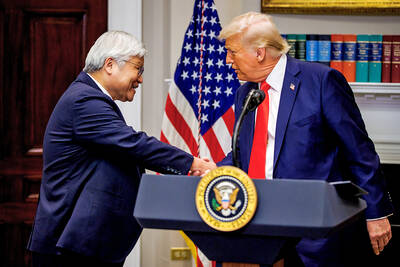
A: Time magazine recently released its list of “The 100 Most Influential People of 2026.” It’s categorized into six groups: Artists, Pioneers, Titans, Icons, Leaders and Innovators. B: TSMC chairman C.C. Wei made the list this year. Which category is he in? A: Wei is actually among the Pioneers, with figures including Disney CEO Josh D’Amaro and MrBeast — the first YouTuber ever to surpass 400 million subscribers. B: Led by Wei, Taiwan’s “silicon shield” TSMC is the sixth-largest company in the world. A: As Nvidia founder Jensen Huang wrote in his introduction, “C.C. Wei is truly one of the
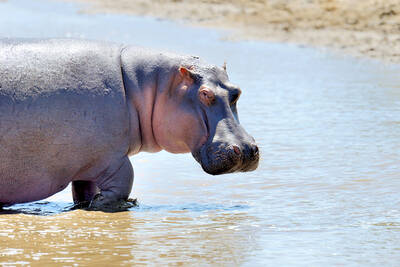
The animal kingdom is full of surprises that challenge our understanding of biology. From remarkable feeding mechanisms to extreme defense strategies, some creatures possess traits so unusual that they seem like pure fiction. Here are four fascinating examples that show nature’s endless creativity. The humble snail may appear simple, but its mouth tells a different story. Snails possess a ribbon-like tongue called a radula, densely covered with anywhere from 1,000 to 12,000 tiny teeth. This structure works like a cheese grater, allowing them to scrape and grind food with surprising efficiency. Far from being passive creatures, snails are actually
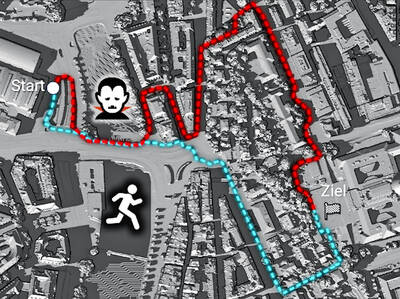
As climate change and urbanization push city temperatures higher, walking outdoors is becoming increasingly uncomfortable in many parts of the world, especially when prolonged time spent in sunlight is involved. As a result, outdoor lovers are now seeking cooler, shaded walking routes. However, most mainstream map apps still do not __1__ shaded footpaths. Enter routing.osm.ch — a Swiss web-based route planner that introduces a novel solution to this problem. Its “Vampire mode,” named after the legendary creatures’ fear of being __2__ natural light, was developed by a Swiss research team led by Professor Stefan Keller. The platform combines open data from


 RSS
RSS