


Parts of the United States are experiencing a rare natural phenomenon with the simultaneous emergence of two enormous adjacent broods of periodical cicadas.
The noisy bugs began in April to pop out of the ground in significant numbers in the southernmost locations of their geographical distribution. The total count of cicadas is forecast to exceed a trillion by the time it is all over in their northernmost locales.
These two broods — one concentrated in US Midwestern states and the other in the South and Midwest — emerge together only once every 221 years.

Photo: Reuters 照片:路透
WHAT IS A CICADA?
Cicadas are relatively large insects — 2.5-5 cm long — possessing sturdy bodies, bulging compound eyes and membranous wings. There are many different kinds of cicadas.
Using needle-like mouthparts, cicadas feed on plant juices, called xylem sap, drawn from the roots of deciduous trees and shrubs. They spend much of their life cycle — years on end — underground as nymphs feeding on roots and drinking xylem sap.
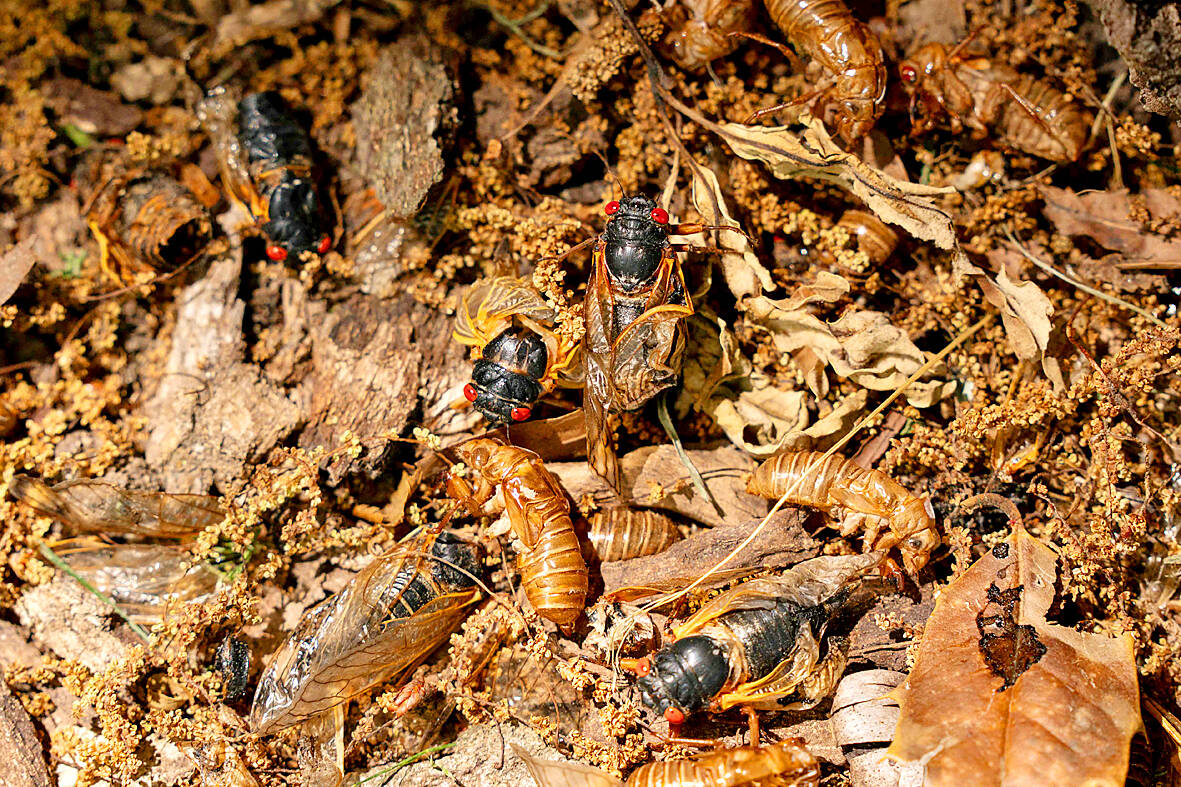
Photo: AFP 照片:法新社
After they emerge, adult males “sing” to attract females using special organs called tymbals on the first segment of the abdomen. The song pitch, tone, frequency and volume are specific to individual species. Cicadas live as adults for just a few weeks, then die after reproducing. Numerous birds and mammals eat cicadas.
HOW DO PERIODICAL AND ANNUAL CICADAS DIFFER?
With annual cicadas, some individuals emerge during any given year. They spend one to nine years underground as nymphs, varying by species, and do not have a synchronized emergence. Instead, they emerge on a staggered basis. Periodical cicadas have more specific and longer lengths of time spent underground as nymphs — generally 13 years or 17 years — and a synchronized emergence. That means that all members of a particular brood emerge the same year. All of the periodical cicadas sharing the same life cycle that emerge together in a given year are called a brood, although any one species may be part of different broods.
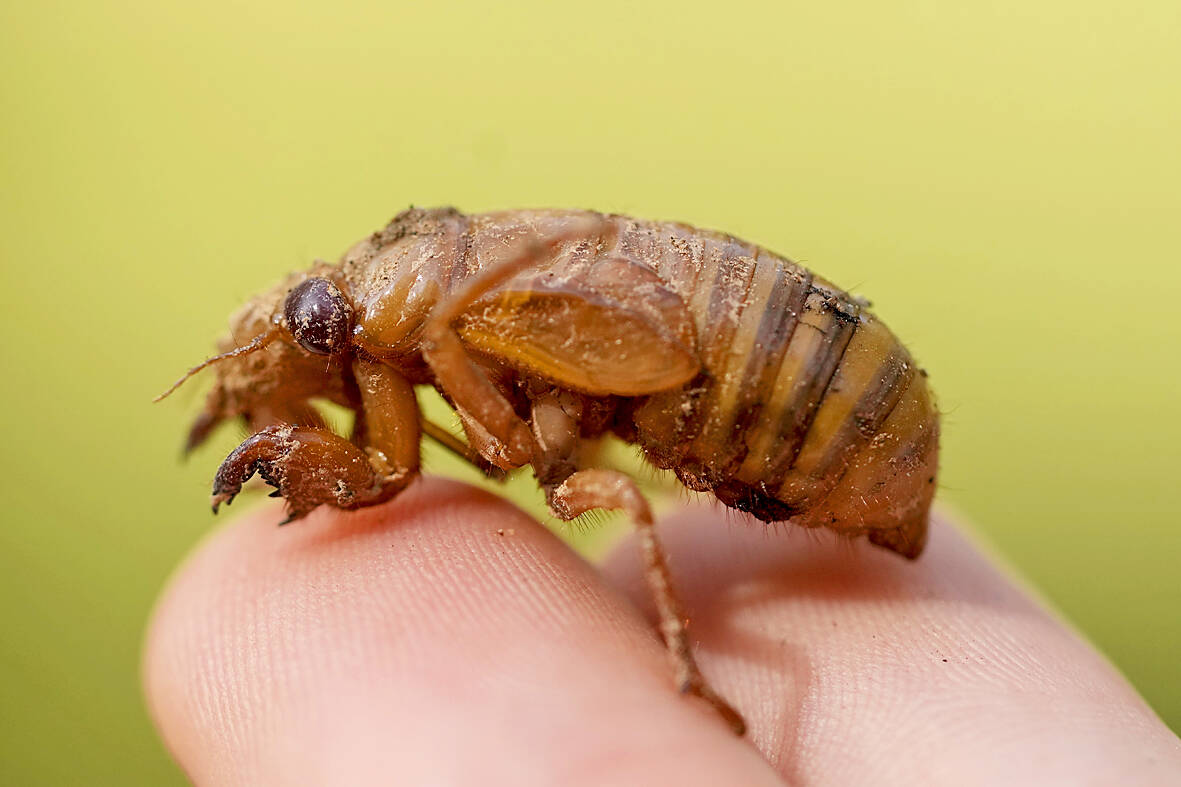
Photo: AP 照片:美聯社
There are more than 3,000 species of cicadas worldwide, but only nine are periodical, and seven of those — of the genus Magicicada — are found in North America. In India, a periodical species of the genus Chremistica emerges every four years, while in Fiji, a periodical species of the genus Raiataena emerges every eight years.
WHAT DO CICADAS DO WHEN THEY EMERGE?
The cicadas begin emerging, mainly at night, once the soil warms to about 17.8 degrees Celsius, according to George Washington University entomologist John Lill. These nymphs crawl up any hard surfaces — tree trunks, fences, vegetation — and molt into adult winged cicadas.
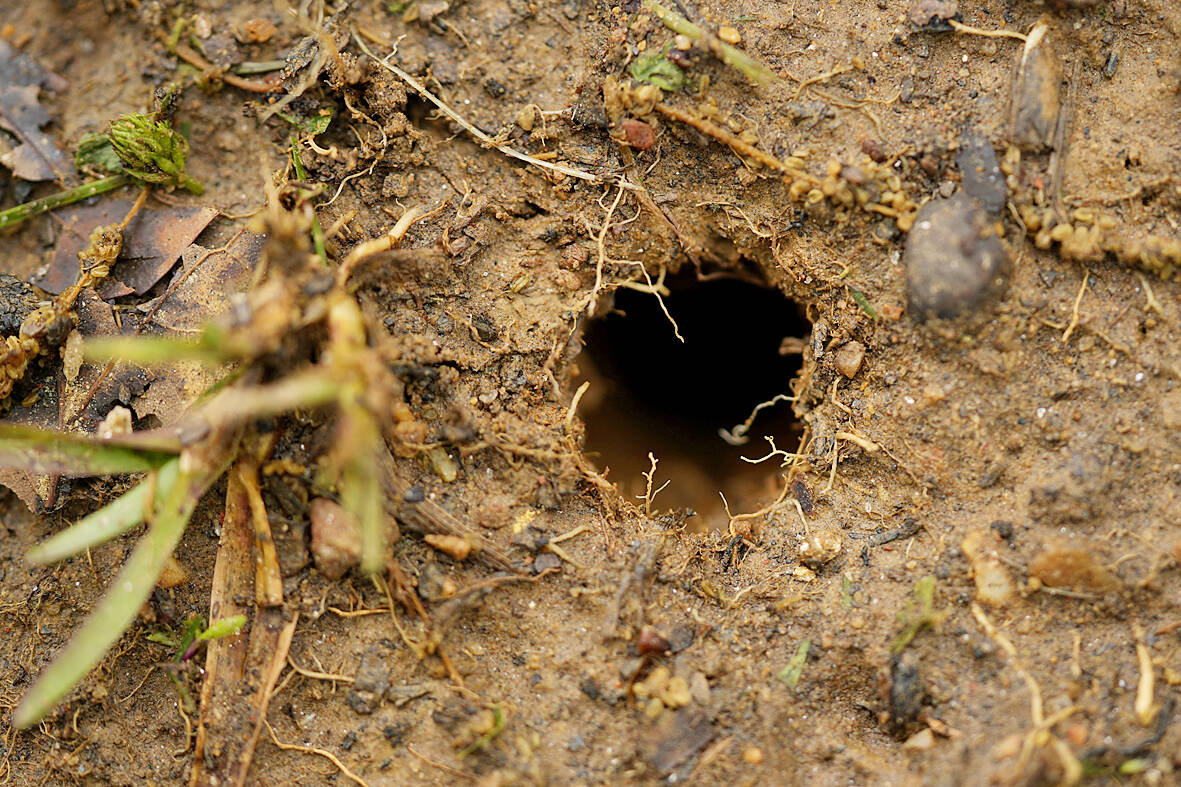
Photo: AP 照片:美聯社
After a few days, adults fly into the tree canopy, where males form loud “choruses,” calling to females by vibrating their tymbals. Males have rather hollow abdomens, serving as echo chambers to amplify their calls. Cicadas are among the loudest insects. Females that are attracted to a particular male’s call respond with wing flicks, which also make a sound. Pairs then mate.
Once mated, female cicadas seek pencil-sized branches of trees and shrubs in sunny locations to lay their eggs into slits they cut in branches, according to Lill. These eggs develop for about six to seven weeks, after which hatched nymphs drop to the ground and burrow to begin the next generation of periodical cicadas.
(Reuters)

Photo: Reuters 照片:路透
美國部分地區正經歷一種罕見的自然現象,兩大群相鄰的「週期蟬」同時出現。
這種吵鬧的蟲子4月開始在其地理分佈的最南端大量破土而出。預計它們在分佈地最北端全部出土後,蟬的總數將超過一兆。
這兩個群體——一個集中在美國中西部各州,另一個集中在南方與中西部—每221年才會同時出現一次。
蟬是什麼?
蟬是體型相對較大的昆蟲,長2.5至5公分,有堅硬的身體、凸出的複眼和薄膜狀翅膀。蟬的種類有很多。
蟬使用針狀口器以植物汁液為食,稱為木質部樹液,是從落葉喬木及灌木的根部吸取的。蟬一生中大部分時間(年復一年)都是以若蟲的形式生活在地下,以樹根為食,並飲用木質部樹液。
破土而出後,雄蟬會用腹部第一節稱為鼓膜的特殊器官「唱歌」來吸引雌性。歌曲的音高、音調、頻率和音量因其品種而異。蟬成年後只能存活數週,繁殖後就會死亡。許多鳥類和哺乳動物以蟬為食。
週期蟬和一年生蟬有何不同?
一年生蟬在任何一年都會出現。它們以若蟲的形式在地下生活1至9年,因品種而異,並且不會同時出現,而是交錯出現。
週期蟬的若蟲在地下度過的時間更固定、更長—通常為13年或17年—且會同時破土而出。這表示這群蟬的所有個體都會在同一年出現。所有具相同生命週期、在某一年同時出現的週期蟬被稱為一群(brood),雖然任何一種蟬都可能有不同群。
全世界有超過三千種蟬,但只有9種是週期蟬,其中7種為週期蟬屬(Magicicada),產於北美。印度一種薄翅蟬屬(Chremistic)的週期蟬每4年出現1次,而在斐濟,Raiataena屬的週期蟬每8年出現1次。
蟬破土時會做什麼?
喬治華盛頓大學昆蟲學家約翰‧里爾表示,一旦土壤變暖至約攝氏17.8度,蟬就會開始出現,主要是在夜間。這些若蟲會爬上任何堅硬的表面—樹幹、柵欄、草木上—並蛻變成有翅膀的成蟬。
數天後,成蟬飛入樹冠,雄蟬發出響亮的「合唱」,透過振動鼓膜來呼喚雌蟬。雄蟬有很中空的腹部,可當作迴聲室來放大其鳴叫。蟬是叫聲最大的昆蟲之一。被特定雄蟬叫聲所吸引的雌蟬會以拍打翅膀發出聲音來回應,配成對之後交配。
里爾表示,交配後,雌蟬會在陽光充足的地方尋找鉛筆大小的樹枝及灌木,在樹枝上切出縫隙,將卵產在裡面。這些卵發育約6到7週,然後孵化出來的若蟲落到地上並挖洞,開始下一代的週期蟬生涯。
(台北時報林俐凱編譯)
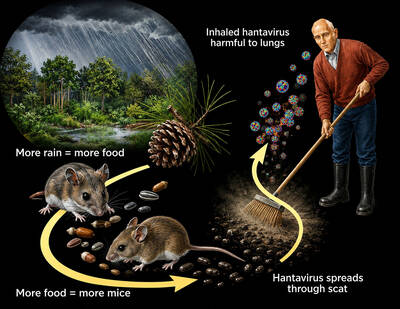
An outbreak aboard a cruise ship of a rare rodent-borne illness called hantavirus has left three passengers dead and sickened others, but global health officials say the risk to the general public remains low because the germ does not easily spread between people. “This is not the next COVID, but it is a serious infectious disease,” said Maria Van Kerkhove, director of epidemic and pandemic preparedness at the World Health Organization (WHO). “Most people will never be exposed to this.” The virus usually spreads when people inhale contaminated residue of rodent droppings. Hantaviruses have been around for centuries and are thought to

Have you ever wondered how people navigate the world when they can’t see a map? For individuals with visual impairments, conventional maps are nearly impossible to use. This is where tactile maps come in — essential tools that allow people to “see” the world through touch. A tactile map is specially designed with raised lines, textures, and symbols to represent geographical features such as roads, rivers, and buildings. Users explore it with their fingertips. However, these maps are not exclusively for people with visual disabilities. They serve as valuable multisensory learning tools that enhance spatial understanding for everyone, making

A: In early May, there were concerts by Icyball, Chyi Yu, Korea’s EXO and Japan’s Anisama, but I missed them all. What a shame. B: That’s OK. There are shows coming up by various artists, including Power Station, Accusefive, Japanese singer Mika Nakashima, Chinese-Icelandic jazzer Laufey, and even Singaporean diva Stefanie Sun. A: After a 12-year hiatus, Stefanie is finally returning to Taipei again. B: In late May, there will be more shows by Crowd Lu, WeiBird, Korea’s Donghae, 2AM, EXID, and Thailand’s BUS. A: The Thai boyband is so popular. It looks like “T-pop” is catching up with J-pop

Since 2005, the third Monday in January has come to be known as “Blue Monday.” In other words, that day is believed to be the most depressing day of the year. This concept seems logical at first. After all, Monday marks the start of the school or workweek after two days of rest and fun. Also, blue is a color that is often associated with sadness. Furthermore, in many parts of the world, January is a time when the weather is cold, rainy, and gloomy. But is there any scientific proof that this January day is truly sadder than any of


 RSS
RSS