


Taiwanese cuisine boasts a rich culture of thick soups, with various options available at street vendors or high-end restaurants. In English, this style of dish is typically called “thick soup.” Western cuisine typically uses flour, cream, or mashed vegetables to create a creamy consistency, while in Taiwan, thick soups are made by simply incorporating food starch into the soup and creating a smooth and silky texture. Tutuo fish in thick soup is such a soup with fried tutuo fish chunks, shiitake mushrooms, bamboo shoots, and wood ears.
台灣羹品飲食文化豐富,無論是巷口小店或是高檔餐廳,都有提供羹料理。羹在英文稱作「濃湯」,西式濃湯是以麵粉、鮮奶油、蔬菜泥等達到濃稠的口感,台灣的羹湯用太白粉即能做出濃稠絲滑的湯頭。土魠魚羹就是在勾芡的羹湯中加入炸土魠魚塊、香菇、竹筍、木耳等食材的料理。
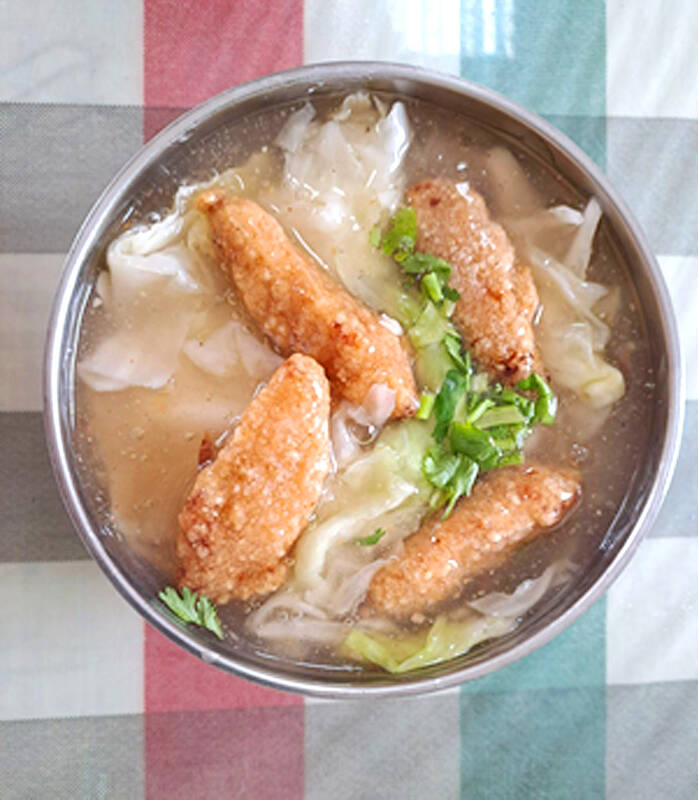
Photo: Bookman l 圖片:書林
boast (v.) 擁有(令人驕傲的事物)
consistency (n.) 濃稠度
chunk (n.) 厚塊,大塊
wood ear (n. ph.) 木耳
The star of this dish is tutuo fish which is first fried. The fish pieces are first marinated for several hours in a mixture of rice wine, five-spice powder, sugar, soy sauce, and other seasonings. Then, they are coated with sweet potato flour and deep-fried. The fried fish chunks are crispy on the outside and soft inside, making their soup stand out among various thick soup dishes.
土魠魚羹特別在於會將新鮮魚塊油炸,先用米酒、五香粉、糖、醬油等調味料醃製數小時,待入味後裹上地瓜粉下鍋油炸,炸過的土魠魚塊外酥內軟,因而從眾多羹品中脫穎而出,深受民眾喜愛。
marinate (v.) 醃,用調味汁浸泡
coat (v.) 覆蓋...的表面
However, if you want to taste authentic fried tutuo fish in thick soup, you may have to head south. Tutuo fish is a common name in Chinese for narrow-barred Spanish mackerel. The fish is mainly caught near Penghu, but people in Tainan have made its thick soup dish popular since the city is closer to the islands, making it easier to obtain the fish. Tutuo fish has many advantages, such as having a soft texture, few bones, and high protein, but in recent years, with smaller catches, the price of the tutuo fish has continued to rise. Many vendors now substitute similar fish for tutuo as cheaper alternatives, but the texture is relatively dry.
不過要吃貨真價實又好吃的土魠魚羹,或許得要往南走了。土魠魚為康氏馬加鰆的俗名,主要產地為澎湖,而後由台南人藉地利之便將其料理發揚光大。土魠魚有口感軟、魚刺少,蛋白質含量高等優點,但產量逐年減少,價格不斷攀升,也因此許多小吃攤用和土魠魚相似的便宜魚種來替換,但口感較乾柴不優。
authentic (adj.) 道地的
catch (n.) 捕獲量
Like milkfish, the common name “tutuo fish” is also believed to have been named after a general. In 1683, Shi Lang, a Qing Dynasty admiral, attacked Taiwan and ended the Zheng family’s control of the island. It is said that Shi Lang was fond of eating this fish, so people called this fish “admiral fish,” which sounds like “tidu fish” in Chinese. Over time, the pronunciation of the name evolved to “tutuo.”
土魠魚這個俗名的由來,據說也是一位將軍的緣故。1683年,清朝水師提督施琅攻打台灣,結束鄭氏的統治。因施琅是提督,據說他十分喜歡吃土魠魚,於是有了提督魚之稱,後來走音就變成土魠魚了。
admiral (n.) 海軍上將,提督
文章由書林出版公司提供:
www.bookman.com.tw

A: In the 2026 Time 100 list, besides TSMC chairman C.C. Wei in the Pioneers category, Blackpink’s Jennie also stands out in the Artists group. B: What about the Titans and Icons? A: The Titans include legendary fashion designer Ralph Lauren, Google CEO Sundar Pichai, and Intel CEO Tan Lip-bu. The Icons include actor Wagner Moura, Olympic gold figure skater Alysa Liu and singer Victoria Beckham. B: What about the Leaders and Innovators? I bet US President Donald Trump and Chinese President Xi Jinping are on the list. A: You got it. Other Leaders include Japanese PM Sanae

Put the Cart Before the Horse 本末倒置 Iris: I think I’m in love. Carl: What? Iris: We just have so much in common. We like all of the same things. Carl: Yes, but you’ve only chatted with him online. Iris: It doesn’t matter. I know we’ll end up getting married. Carl: I’m afraid you’re putting the cart before the horse. You should at least meet him first. Iris: OK, OK. I’ll do that. 艾瑞絲: 我想我戀愛了。 卡 爾: 什麼? 艾瑞絲: 我們就是有那麼多的共通點。我們喜歡的東西都一樣。 卡 爾: 是沒錯,不過妳和他只在網路上聊過天而已。 艾瑞絲: 那不重要。我知道我們最後一定會步入禮堂。 卡 爾: 妳恐怕是本末倒置了吧。妳至少應該先跟他見個面。 艾瑞絲: 好啦,好啦。我會的啦。 A tough cookie 強悍的人∕堅強的人 Tracy: I heard you went out with Iris last night. Justin: Yeah. We

1. 他非常討厭偽君子。 ˇ He has a deep hatred for hypocrites. χ He has a deep hatred to hypocrites. 註︰表示「對某人懷著愛、恨」等, 常用 have a love for/of, have a hatred for/of。 例如: We have a love for/of science. The working people have a hatred for/of all forms of exploitation. 2. 問題的答案其實不難找。 ˇ The answer to this question is not difficult to find. χ The answer of this question is not difficult to find. 註︰中文中的「的」在英語中不一定都用 of 來表示,有時須用 to。其他的例子如下: 我把房間的鑰匙弄丟了。 I lost the key to the room. 中間矗立著烈士紀念碑。 In the center stands the monument to the martyrs. 這部電影的續集你看過沒有? Have you seen the sequel to the movie? 3. 比起那家餐廳,他更喜歡這家。 ˇ He prefers this restaurant to that one. ˇ He likes

★ Bilingual Story is a fictionalized account. 雙語故事部分內容純屬虛構。 The mango looked perfect. It sat on the fruit stand like a small sunset, red on one side and gold on the other. “I’ll take this one,” said Daniel. The fruit seller shook her head. “Not that one.” Daniel was surprised. “Why not? It looks beautiful.” “Yes,” she said, “but beautiful is not always ready.” She picked up another mango and held it near his nose. “First, smell here.” Daniel smelled the top of the mango. It was sweet and warm. “Good mangoes have a smell,” she said. “Next, feel the weight.”


 RSS
RSS