


In this day and age, we’re so used to seeing “moving images” that we take them for granted. Whether it’s taking videos on our phones, watching cartoons or sending short GIF reactions via text, we can’t go anywhere without catching glimpses of moving images on screens. But just a few centuries ago, this notion didn’t exist at all. It wasn’t until one astonishing device was invented that pictures could come to life.
The device in question was called the phenakistiscope. This tongue-twisting name has the approximate meaning of “a target that deceives the eye” in Greek. Incredibly, it has two inventors — the idea for the phenakistiscope came simultaneously to Belgian physicist Joseph Plateau and Austrian mathematician Simon von Stampfer in 1832. Both men had been working with optical illusions and found the same easy but entertaining way to give the impression that a picture was moving.
The way a phenakistiscope works is surprisingly simple. A series of images is drawn on a cardboard disc and small slits are cut in between each image. The disc is attached to a handle and then set with the image side facing a mirror. When someone turns the handle rapidly and looks through the slits into the mirror, the images on the disc appear to move in a looping animation.
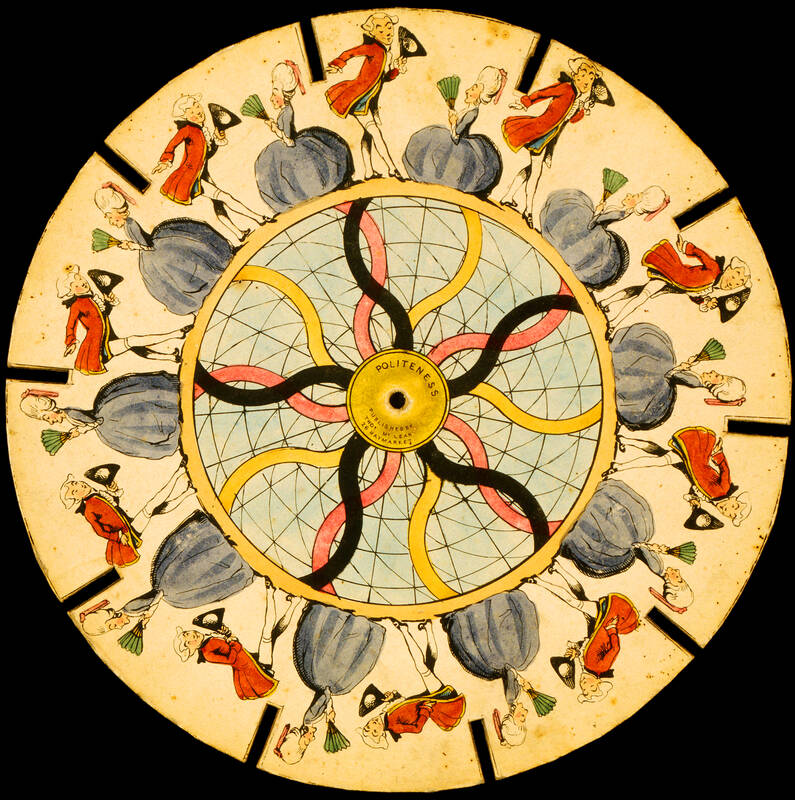
Photo courtesy of Flickr / 照片:Flickr 提供
The phenakistiscope seemed nothing less than magical, but its popularity was short-lived. It was soon replaced by more sophisticated moving picture devices like the zoetrope, and thereafter projection and film. However, this fascinating early animation device has experienced a revival in recent years.
Some online artists have been collecting and digitizing phenakistiscopes as rotating GIFs that show the charm of their art styles. In addition, people have been making their own versions as a fun and artistic hobby. Give it a try yourself and experience the magic of making your own moving pictures!
現在這個時代,我們太習慣看到「動態圖像」,以至於我們認為它們的存在是理所當然的。無論是在手機上錄製影片、看卡通,或是透過訊息發送簡短的圖像互換格式(GIF)回應,無論我們去到何處都能夠瞥見螢幕上的動態圖像。但才幾個世紀前,這種概念根本不存在。直到一項驚人的裝置被發明,這些圖像才得以栩栩如生地呈現。
這項談論中的裝置被稱為「費納奇鏡」。這個饒口的名稱在希臘語中大概的意思是︰「矇騙眼睛的目標物」。令人難以置信的是,它有兩位發明者—比利時物理學家約瑟夫‧普拉托,與奧地利數學家西蒙‧馮‧施坦普費爾同時於西元1832年冒出有關費納奇鏡的想法!這兩人都在研究視錯覺,並發現同一種簡單而有趣的方式,來給人圖像在移動的印象。
費納奇鏡的運作方式意外地簡單。一系列圖像被繪製在紙板圓盤上,且每幅圖像之間都被切出狹縫。將圓盤固定到手柄上並接著將圖像面朝鏡面設置。當有人快速轉動手柄並透過狹縫看向鏡面時,圓盤上的圖像看似在循環動畫中移動。
費納奇鏡似乎很神奇,但它僅短暫盛行過。不久後它就被更複雜精密的電影裝置所取代,例如西洋鏡,然後是投影和電影。然而,這種引人入勝的早期動畫裝置近年來經歷了復興。
有些網路藝術家持續收集費納奇鏡並將其數位化為轉動的GIF動圖檔以展示其藝術風格的魅力。此外,人們製作自己的版本作為一種有趣的藝術愛好。親自嘗試並體驗自製動態圖片的魔力吧!
MORE INFORMATION
phenakistiscope n. 費納奇鏡
GIF n. 圖像互換格式 (Graphics Interchange Format)
optical adj. 視覺的;光學的
cardboard n. 硬紙板
slit n. 裂縫
loop v. 循環;纏繞
thereafter adv. 之後;以後
digitize vt. 數位化
give birth to 誕生;激發
in this day and age 現今;當前
in question 談論中的
nothing less than 絲毫不遜色;不亞於
KEY VOCABULARY
1. animation n. 動畫
Originally, movie animation was done by hand, but now it’s mostly created on computers.
最初,電影動畫是手工完成的,但現在主要是在電腦上製成的。
2. take sth / sb for granted 將…視為理所當然
Carly missed her dad while he was in the hospital. She wouldn’t take him for granted once he came home. 卡莉在她父親住院時很想他。一旦父親返家,她不會將他視為理所當然的存在。
3. come to life 使生動;使有生機
The drawing was good before, but the color and detail you added really made it come to life!
之前的圖稿不錯,但是你添加的顏色和細節真的讓它變得栩栩如生!
4. approximate adj. 大概的;大致的
Coach, we want to order shirts for the whole team. The approximate cost is US$150.
教練,我們想為全隊訂購球衣。費用大概是美金一百五十元。
5. simultaneously adv. 同時
You shouldn’t play video games and do your homework simultaneously. 你不應該同時玩電動及寫作業。
6. illusion n. 錯覺;幻覺
The large mirror on the restaurant wall created the illusion of extra space.
那家餐廳牆上的大鏡子營造了有額外空間的錯覺。
7. sophisticated adj. 精密的;複雜的
Computers become more sophisticated every year; even as they shrink in size, they can do more and hold more memory. 電腦每年都變得更加精密;即使它們的尺寸縮小了,卻能夠執行更多功能並擁有更多記憶體。
8. projection n. 投影;投射
The projection on the screen allowed the speech to be seen by all 300 guests.
屏幕上的投影讓三百位嘉賓全都能看到這場演講。
9. rotate v. 轉動;運轉
A helicopter does not have wings, but blades that rotate to lift the aircraft off the ground. 直升機沒有機翼,而是靠轉動的螺旋槳將機身抬離地面。維羅妮卡是這個社區裡重要的企業家;因此她有很多權貴朋友。
學習音檔: https://magazine.english4u.net/Magdata/menu/0sr43
《空中美語》雜誌APP免費下載: https://www.english4u.net/apps/index.aspx
免費收聽當月《空中美語》雜誌課文朗讀及解析 !
文章由AMC空中美語授權使用: https://www.english4u.net

A: Taiwan legalized same-sex marriage on May 24, 2019, so this week marks the seventh anniversary of that milestone. By the end of 2024, a total of 32,126 LGBT couples had tied the knot. B: How many of them got married to foreign partners? A: In 2024, there were 504 cross-border same-sex marriages. By the end of that year, there were 130 cross-strait same-sex marriages between Taiwanese and Chinese — accounting for only about 0.4 percent of the total. B: I’ve heard that a seven-year marriage brings the “seven-year itch.” I bet some couples regret their decisions now. A:

A: While Taiwan is celebrating the 7th anniversary of legalizing same-sex marriage, a poll shows that the support rate for same-sex marriage rose sharply from 37.4 percent seven years ago to 69.9 percent last year. B: Actually, I’m a bit curious about the size of Taiwan’s LGBT population. A: I’m not sure. But if we take a Gallup poll in the US as an example, 9.3 percent of American adults identified as LGBT in 2024. B: Wow, is it because the Americans are relatively open? In many other countries, the figures hover around 5 percent. A: Based on this,

Taiwan Travelogue, the novel by Taiwanese author Yang Shuang-zi and translated into English by Lin King, won the prestigious International Booker Prize in London on May 19. It marks the first time a Taiwanese literary work has received the International Booker Prize, setting a historic milestone both for Taiwanese literature and for the award itself. Prior to this achievement, Taiwan had only once appeared on the Booker radar, when Taiwanese author Wu Ming-yi was longlisted for the Booker Prize in 2018 with The Stolen Bicycle. The International Booker Prize honors works of fiction translated into English and published in the UK or Ireland.

As climate change and urbanization push city temperatures higher, walking outdoors is becoming increasingly uncomfortable in many parts of the world, especially when prolonged time spent in sunlight is involved. As a result, outdoor lovers are now seeking cooler, shaded walking routes. However, most mainstream map apps still do not __1__ shaded footpaths. Enter routing.osm.ch — a Swiss web-based route planner that introduces a novel solution to this problem. Its “Vampire mode,” named after the legendary creatures’ fear of being __2__ natural light, was developed by a Swiss research team led by Professor Stefan Keller. The platform combines open data from


 RSS
RSS