


US Pesident Joe Biden signed into law a broad competition bill Tuesday last week that includes about US$52 billion to boost domestic semiconductor research and development, calling it a “once-in-a-generation investment in America itself.”
“We need to make these chips here in America to bring down everyday costs and create jobs,” said Biden at a signing ceremony for the CHIPS and Science Act on the White House South Lawn, joined by executives from US semiconductor firms and congressional leaders.
Biden said he had visited the US facility where Javelin missiles were made and said the bill would make the nation less reliant on other countries to provide the advanced chips needed for those weapons systems, as well as other products.
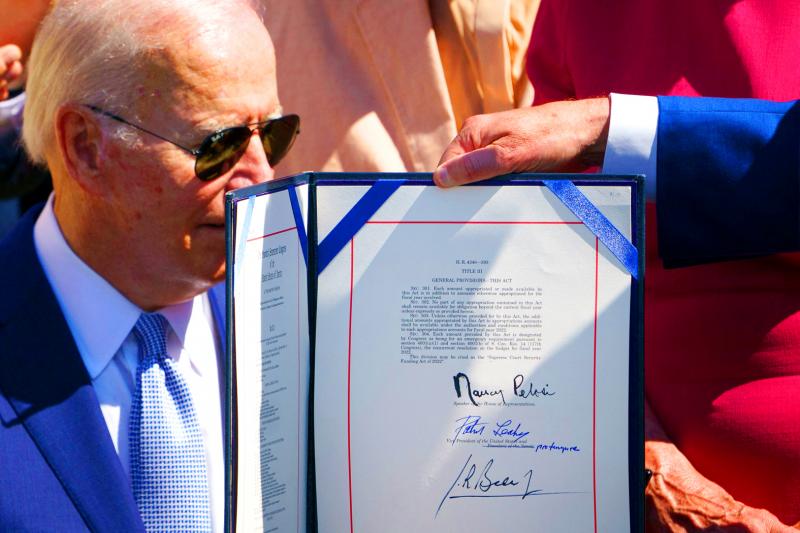
Photo: AFP 照片:法新社
“Unfortunately, we produce zero percent of these advanced chips and China is trying to move way ahead of us to manufacture these sophisticated chips as well,” said Biden.
“It’s no wonder the Chinese Communist Party actively lobbied US business against this bill. The United States must lead the world in the production of these advanced chips; this law will do exactly that.”
Chinese Foreign Ministry spokesman Wang Wenbin said the act showed “clear signs of protectionism” at a news briefing in Beijing on Wednesday last week. “This would disrupt international trade and distort global semiconductor supply chains,” he added. “China firmly opposes that.”
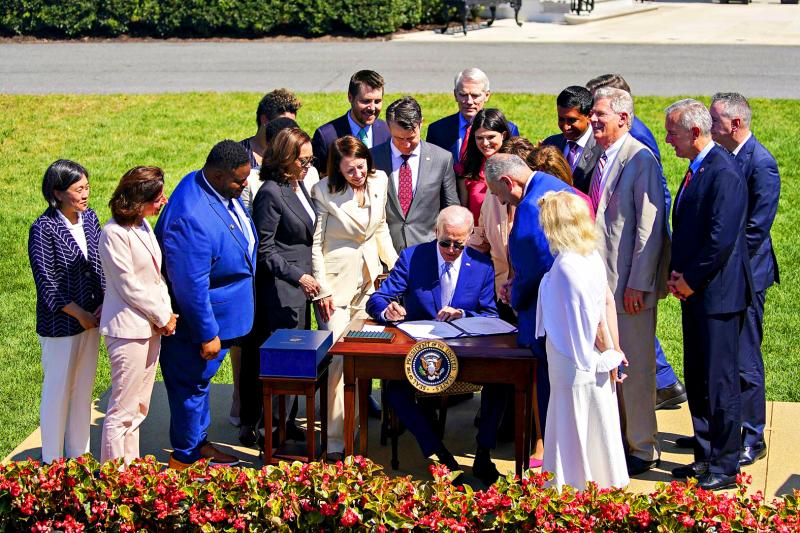
Photo: Bloomberg 照片:彭博社
Spurred by the bill, US semiconductor companies are planning billions of dollars in new investments. Ahead of the signing, the White House announced that Micron Technology Inc. will invest US$40 billion in memory-chip manufacturing and that Qualcomm Inc. is partnering with GlobalFoundries, which has a facility in New York state, in a US$4.2 billion agreement to manufacture chips.
Biden was joined at the signing by Senate Majority Leader Chuck Schumer and House Speaker Nancy Pelosi.
Overseas Reliance
The chips bill is at the center of the Biden administration’s effort to reduce dependence on Asian suppliers like Taiwan and South Korea, whose homegrown companies are leading the market, and to address supply-chain disruptions and resulting price hikes for certain goods containing semiconductors.
Biden’s team and lawmakers have stressed the national security implications of the bill, saying it was vital to competing with and countering China.
A large chunk of the federal grant is expected to go to Intel, Taiwan Semiconductor Manufacturing Co. (TSMC) and South Korea’s Samsung Electronics Co., all of which are now building new chip fabrication facilities worth tens of billions of dollars in the US.
US to Stop TSMC, Intel From Adding Advanced Chip Fabs in China
The bill also includes important caveats sought by Republicans and China hawks: Companies that receive the funding have to promise not to increase their production of advanced chips in China.
It was a condition made by lawmakers and the White House and was included in the measure over the objection of some chipmakers. Intel, in particular, was lobbying hard against the prohibitions. In late 2021, the American chipmaker wanted to increase production in China, but the plan was rejected by the Biden administration.
While China’s chipmaking champion Semiconductor Manufacturing International Corp. can make chips that are more advanced than 28 nanometers, its technology is still at least six years behind industry leader TSMC.
(Bloomberg)
美國總統喬‧拜登上週二簽署了一項大型競爭法案,其中包括約五百二十億美元預算以推動美國本土的半導體研發,並稱之為「對美國本身百年一遇的投資」。
「我們需要在美國本土製造晶片,以降低日常成本,並創造就業機會」,拜登在白宮南草坪舉行的「晶片與科學法案」簽署儀式中說道。美國半導體公司的高級主管與國會領導人也參加了簽署儀式。
拜登表示,他已拜訪在美國製造標槍防空飛彈的工廠,並表示該法案將使美國在製造這些武器系統及其他產品時,減少依賴他國供應所需的先進晶片。
拜登說:「不幸的是,對這些先進晶片,由我們生產的比例是百分之零,而中國正試圖超越我們,領先製造這些先進晶片」。
「難怪中國共產黨積極遊說美國企業反對這項法案。美國必須在這些先進晶片的生產上領先世界;這部法律將做到這一點」。
中國外交部發言人汪文斌上週三在北京的記者會中表示,該法案顯示出「明顯的保護主義跡象」。「這將擾亂國際貿易,並扭曲全球半導體供應鏈」,他補充道。「中國對此堅決反對」。
在該法案的激勵下,美國半導體公司正計劃進行數十億美元的新投資。在法案簽署前,白宮宣布美光科技公司將投資四百億美元進行記憶體晶片製造,高通公司正與在紐約州設有工廠的格羅方德合作,協議製造價值四十二億美元的晶片。
拜登與參議院多數黨領袖查克‧舒默,以及眾議院議長南希‧裴洛西共同參與了簽署儀式。
對國外的仰賴
拜登政府努力減少依賴台灣及韓國等亞洲供應商──其台、韓母公司在市場上居於領先地位。居於此政策之核心的晶片法案,也企圖解決供應鏈中斷及由此導致的某些內含半導體之商品價格上漲的問題。
拜登之團隊及立法者強調該法案對國家安全的意義,說這對與中國的競爭及對抗至關重要。
聯邦補助有一大部分預計將流向英特爾、台積電和南韓的三星電子公司,這些公司現在都在美國建造價值數百億美元的新設施以製造晶片。
美國將阻止台積電、英特爾在中國增設先進晶片廠
該法案還應共和黨人及主張對中國強硬的鷹派人士要求,載明:獲得資金的公司必須承諾不在中國增加先進晶片的產量。
這是立法者及白宮所提出的條件,即便有些晶片製造商反對──尤其是大力遊說反對這些禁令的英特爾──但仍被納入法案內容。二○二一年底,英特爾這家美國晶片製造商欲增加在中國的產量,但該計畫被拜登政府否決。
雖然中國晶片製造一哥中芯國際能製造較二十八奈米高階的晶片,但其技術仍落後業界領頭羊台積電至少六年。
(台北時報林俐凱編譯)
The closure of the Strait of Hormuz has forced policymakers in Asia to face questions over the security of other maritime chokepoints, including the Strait of Malacca, which is the world’s busiest waterway for international trade. WHAT IS THE MALACCA STRAIT? The 900km long Malacca Strait, bounded by Indonesia, Thailand, Malaysia and Singapore, provides the shortest sea route from East Asia to the Middle East and Europe. It carries nearly 22 percent of the world’s maritime trade, according to the Center for Strategic and International Studies (CSIS). This includes oil and gas shipments from the Middle East to the energy-hungry economies of China,

Cameras are everywhere — in our pockets, on our walls and even in space. They capture emotions, preserve history and reflect culture. Through these devices, photography is now essential to modern life, influencing how we perceive ourselves and the world. To understand the root of their power, let’s explore the camera’s remarkable journey. The story begins with the camera obscura, a dark room with a tiny hole. Light passing through the opening projected an inverted image on the opposite wall. Renaissance artists used this principle to paint accurate scenes. However, these images couldn’t be preserved as photographs. That changed

A: This year’s two most anticipated films have finally hit theaters in Taiwan. “Michael” premiered last Wednesday, while “The Devil Wears Prada 2” premiered this Wednesday ahead of its global release. B: Isn’t “Michael” the biopic about the late King of Pop Michael Jackson? A: Yup, it tells the story of Michael’s legendary life, from child star to global icon. And the role is in fact played by his nephew, Jaafar Jackson. B: Michael caused a sensation when touring Taiwan twice in 1993 and 1996. His classic hits, dance moves and music videos reshaped global pop culture at that time. A: I’m gonna

對話 Dialogue 華華:欸,你最近有沒有發現,路上很多人背的包包上還有一個透明的小包包? Huáhua: Èi, nǐ zuìjìn yǒu méiyǒu fāxiàn, lùshàng hěn duō rén bēi de bāobāo shàng hái yǒu yí ge tòumíng de xiǎo bāobāo? 清清:我上次去逛街,也注意到了。我看到好多人把吊飾、照片或娃娃什麼的放進小包裡,掛在包包上。那叫什麼啊? Qīngqīng: Wǒ shàngcì qù guàngjiē, yě zhùyì dào le. Wǒ kàndào hǎo duō rén bǎ diàoshì, zhàopiàn huò wáwa shénme de fàng jìn xiǎo bāo lǐ, guà zài bāobāo shàng. Nà jiào shénme a? 華華:聽說有兩種,一種叫「痛包」,一種叫「娃包」或「曬娃包」。 Huáhua: Tīngshuō yǒu liǎng zhǒng, yì zhǒng jiào “tòngbāo”, yì zhǒng jiào “wábāo” huò “shàiwábāo”. 清清:「痛包」這個說法我聽過,就是在包包上大量展示自己喜歡的東西。但「曬娃包」還是第一次聽到。為什麼叫「曬娃包」? Qīngqīng: “Tòngbāo” zhège shuōfǎ wǒ tīng guò, jiù shì zài bāobāo shàng dàliàng zhǎnshì zìjǐ xǐhuān de dōngxi. Dàn “shàiwábāo” háishì dì yí cì tīng dào. Wèishéme jiào “shàiwábāo”? 華華:因為很多人會把自己喜歡的娃娃放進透明包裡,帶出去拍照,曬給大家看。 Huáhua: Yīnwèi hěn


 RSS
RSS