


Discussing clothing is something of a taboo in classical music, for performers as much as critics. “Most musicians don’t feel like they can talk about it,” says Jocelyn Lightfoot, managing director of the London Chamber Orchestra. There is the entrenched idea that classical musicians are supposed to be heard and not seen. In this performance ideal, the performer’s personality — expressed through his or her choice of clothing — is excised, deferring to “the music itself”.
Those musicians who step outside the norm in their clothing choices have, accordingly, been subject to severe criticism. But at least part of the controversy surrounding artists like violinist Nigel Kennedy, with his jeans and spiky hair, is that they remind us that live music is a visual medium. We don’t just hear — we see musicians performing.
For women, the stakes of their clothing choices are considerably higher because women are more frequently sexualized than their male counterparts. While Kennedy’s informal clothes were criticized by some as “ludicrous,” the furore around pianist Yuja Wang betrays this double standard. As much ink has been spilt over Wang’s hemlines as her playing – and with a couple of exceptions, commentary has focused on how “short and tight” her dresses are.
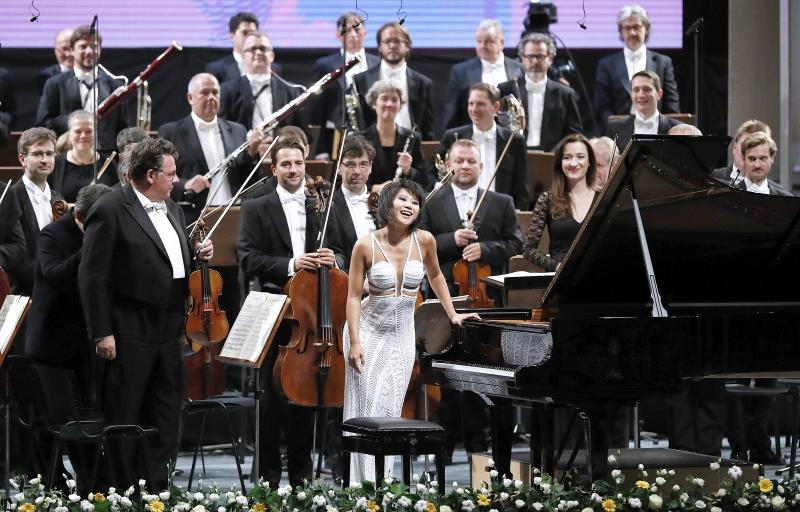
Photo: EPA-EFE 照片:歐新社
The problem isn’t that critics are talking about Wang’s clothes. It’s that by viewing everything she wears through a sexualized lens, they’re presenting her as a sexual object first and an artist second. There is no room in this worldview for women’s clothes to be both an artistic and personal choice.
Perhaps part of the issue is that fashion lies outside the traditional classical critic’s toolkit.
The inability to talk about Wang’s clothing in a sensitive and respectful way reveals damaging and longstanding assumptions around women and their dress on the classical stage. The notion that what we see might “distract from” music, rather than shape our experience of it, stems from a centuries-old division of body and mind, physicality and rationality, that claims classical music as purely cerebral stuff. The body has no place here. And this idea is gendered. Rationality and the mind have historically been coded masculine, sensuality and the body feminine, with the result that women and their bodies have been marginalized within classical music.
The denial of Wang’s agency also feeds into racist stereotypes around the submissiveness and inexpressiveness of both women and classical musicians of Asian descent — stereotypes that Wang’s clothing choices actively disrupt.
We need to find ways of talking about women’s clothes that respect them as artistic choices, and integral to performance. Dress is becoming more important as questions around diversity and inclusion are pushed to the forefront of institutions’ agendas. The London Chamber Orchestra, for example, has recently removed the dress code for its players. Dispensing with the heavily gendered expectations of black tie is partly, Lightfoot says, to celebrate the individuality of the orchestra’s players and build an inclusive space for musicians whose “way of expressing themselves physically doesn’t fit with that classical music stereotype.” But it’s also to create a “mirror between the audience and orchestra,” reaching out to those “who don’t feel welcome in a concert hall.”
Moreover, social media has made classical music “so much more visual” says Maxine Kwok, a violinist in the London Symphony Orchestra. Orchestras and soloists alike are now attuned to the branding possibilities it offers, from sharing clips of concerts to photographs of rehearsals in jeans and jumpers. And this can, perhaps, be a way of making musicians more accessible.
(The Guardian)
在古典音樂中,討論衣著有點像是禁忌,對演奏家和評論家來說皆然。「大多數音樂家不覺得他們可以談論服裝」,倫敦室內樂團總經理喬斯林‧萊特富說道。有種根深蒂固的觀念認為,古典音樂家應該是被聽見的,而不是被看見。在這種演奏典範概念中,演奏者的個性──透過其所選擇的服裝來表達──是被除去的,而服從於「音樂本身」。
因此,那些在衣著選擇上超出常規的音樂家受到了嚴厲的批評。但關於一些藝人的爭議──例如小提琴家奈吉爾‧甘迺迪的牛仔褲和刺蝟頭──起碼有一部分是因為它提醒了我們現場音樂是一種視覺媒介。我們不只是聽見──而且還看見音樂家演奏。
對女性而言,她們選擇服裝所承擔的風險要高得多,因為女性比男性更常被性感化。雖然甘迺迪的休閒裝被一些人批評為「荒唐可笑」,但圍繞鋼琴家王羽佳的軒然大波則不符此雙重標準。花在她演奏與花在她裙擺上的筆墨一樣多──除了幾次例外,評論焦點都集中在討論她的連衣裙是多麼「短又緊」。
問題不在於評論家談論王羽佳的衣服。而是透過性感化的鏡頭檢視她的種種穿著後,王羽佳先被呈現為性客體,其次才是藝術家。在這種世界觀中,女性的衣著沒有既是藝術上的選擇又是個人選擇的空間。
或許問題的一部分在於,時尚不在傳統古典音樂批評家的工具箱中。
無法以審慎與尊重的方式談論王羽佳的衣著,顯示出長期以來對古典音樂舞台上之女性及其著裝具傷害性的設想。我們所看到的可能會「分散」音樂的注意力,而不是塑造我們對音樂的體驗,這種觀念源於數百年來對身體與心智、肉體與理性之劃分,這種劃分聲稱古典音樂是純粹屬於大腦的。身體在這裡沒有一席之地。這個想法是性別化的。理性與心智歷來被編碼為男性的、陽剛的,感官與身體則為女性的、陰柔的,造成了女性及其身體在古典音樂中被邊緣化。
王羽佳經紀公司的否認,也助長了對女性及亞裔古典音樂家之種族主義刻板印象,認為其順從、缺乏表現力──王羽佳所選擇的服裝則積極打破這些刻板印象。
我們必須找到談論女性衣著的方式,尊重服裝為其藝術選擇,且是表演的一部分。隨著多元性及包容性的問題被推到機構政策最前沿,服裝議題也變得越來越重要。例如,倫敦室內樂團最近取消了演奏者的著裝要求。萊特富表示,摒棄對黑色領帶的嚴重性別期望,部分原因是為了頌揚管弦樂團演奏者的個性,並為那些「身體上表達自己的方式不符合古典音樂刻板印象」的音樂家建立一個包容的空間;但這也是在建立一面「聽眾與管弦樂團之間的鏡子」,向那些「自覺在音樂廳裡不受歡迎的人」伸出歡迎之手。
此外,倫敦交響樂團小提琴手Maxine Kwok表示,社群媒體讓古典音樂「更加視覺化」。管弦樂團與獨奏家現在都已適應社群媒體在塑造品牌上的可能性,從分享音樂會片段到排練時穿牛仔褲及套頭衫的照片皆屬之。這或許可成為讓音樂家更平易近人的一種方式。
(台北時報林俐凱編譯)

Many consumers are guilty of filling drawers or closets with old laptops, cellphones, fitness trackers and other electronic devices once they are no longer needed. It’s hard to know where to recycle such items, or it seems costly and inconvenient to do so. The world generates millions of tons of electronic waste — also called e-waste — each year. According to the UN’s most recent estimate, people worldwide produced 62 million metric tons of e-waste in 2022, and only about 22 percent of it was properly recycled. The US’ Environmental Protection Agency estimates that less than a quarter of e-waste is

You’re sitting in class when a classmate asks to borrow a pencil. It seems like a small favor, so you agree without hesitation. The following week, the same classmate asks to share your notes. Later, they request help with a group project. You agree each time — after all, you helped out the first time — but before you know it, it has become automatic. This scenario demonstrates the “foot-in-the-door technique,” a psychological concept that shows how agreeing to small, acceptable demands makes it easier to accept larger ones later on. The name for this strategy comes from door-to-door
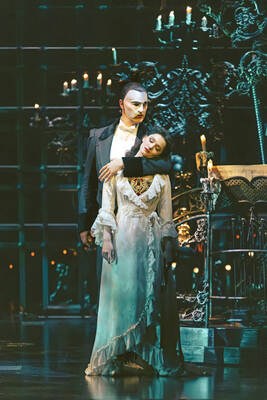
A: The four-day Tomb Sweeping Day long weekend begins Friday and will run until Monday. Are you going to sweep your ancestors’ tombs? B: I did in advance last weekend, so I can go to Kaohsiung to see the musical “The Phantom of the Opera.” A: Wow, is “Phantom” touring Taiwan again? It debuted in 1986, so this year marks the 40th anniversary of the show. B: And it’s not just touring Kaohsiung starting March 31, but also Taipei starting April 21 and Taichung starting May 26. A: “Phantom” is one of the world’s Four Major Musicals. I’ve seen all of them, except “Les

Dos & Don’ts — 想想看,這句話英語該怎麼說? 1. 我們很早到達電影院。 ˇ We arrived at the theater very early. χ We arrived the theater very early. 註︰arrive 為不及物動詞,後面如果有受詞要用 at 或 in。例如:They arrived in Taipei yesterday.。一般大地方,如國家、省、大城市等前面用 in,凡小地方城鎮、學校等則用 at。 2. 開車半小時以後,我們到達了海灘。 ˇ After half an hour’s drive, we got to the beach. χ After half an hour’s drive, we got the beach. 註︰come, go, get(來、去、到達)某地時,在表示地點的名詞前面應該用 to,如 go to school, go to Taipei, come to Shanghai 等。如果這些動詞後面所跟的是 here, there, home 等副詞,則不用 to。 3. 明天我會回辦公室。 ˇ I will be back in the office tomorrow. χ I will be back to office tomorrow. 註︰to be back 一語裡的 back 是副詞,不是介詞,所以後面要用 at (the market) 或 in (the office)。 假如假期結束,要回學校上課了則可說: ? Kids will be back


 RSS
RSS