


Shocks to supply chains are engulfing a wider swath of the global economy as the pandemic rages on, threatening to stifle Asia’s trade-led recovery just as soaring freight rates make it harder for businesses to weather another year like 2020.
Shortages of consumer goods like paper towels and work-from-home gear early in the COVID-19 crisis have given way to parts shortfalls in one of the most globally integrated of industries: auto manufacturing.
Compounding the industrial imbalances are transport woes plaguing consumer and healthcare sectors still dealing with a dearth of available shipping containers to move components and finished products out of China, Taiwan, South Korea and Asia’s other export powers.
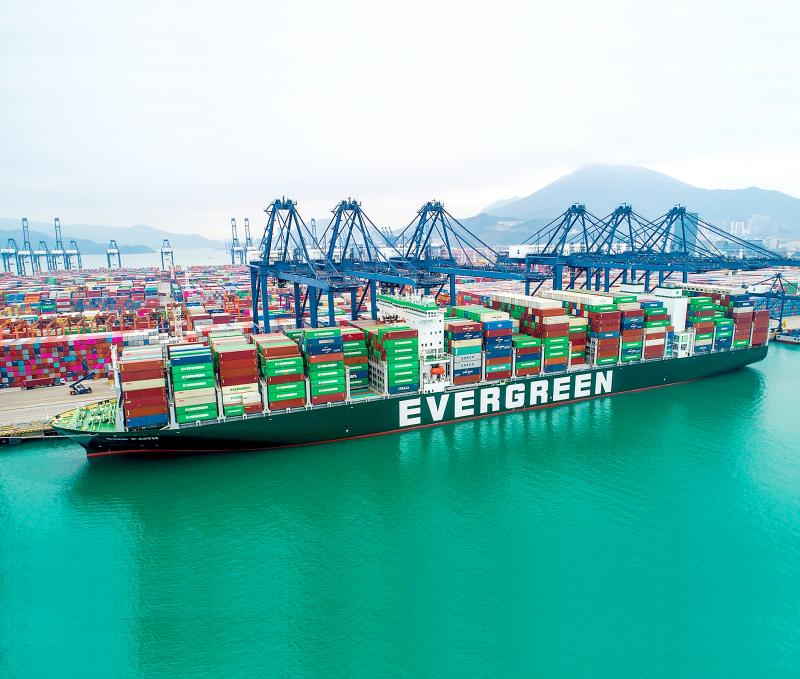
Photo courtesy of Evergreen Marine Corp. 照片:長榮海運提供
Nerijus Poskus, vice president for global ocean at San Francisco-based freight forwarder Flexport Inc, reckons the world needs the equivalent of 500,000 more 20-foot containers — roughly enough to fill 25 of the largest ships in operation — to satisfy the current demand. In the meantime, standard container rates on transpacific routes are quadruple what they were a year ago. And that is before equipment surcharges and premiums for guaranteed loading are added.
“Anyone paying the freight bills in 2020 though knows the true cost of shipping is much higher than even the recently increased rates,” Poskus said. “We expect that to only increase in 2021.”
The unstoppable rise in container shipping costs is borne out by December figures recently announced by Taiwan’s three major shipping companies — Evergreen Marine Corp, Yang Ming Marine Transport Corp and Wan Hai Lines Ltd — which saw a record-breaking year-on-year surge of revenue at 58.8 percent, 35.19 percent and 75.71 percent respectively.
(Bloomberg, with staff writer)
疫情肆虐,衝擊供應鏈,全球經濟受創幅度加巨;高昂的運費,讓企業更難再熬過如二○二○年般艱難的一年,以貿易為主導之亞洲經濟,復甦之路恐窒礙難行。
武漢肺炎(新型冠狀病毒病,COVID-19)危機初期的紙巾與在家工作用品等消費品之短缺,已轉為汽車製造業的零件短缺──造車業為全球整合程度最高的工業之一。
消費與醫療保健業所面臨之運輸困難,使工業的失衡狀況加劇──由於貨櫃短缺,零組件及製成品很難由中國、台灣、韓國及亞洲其他出口大國運出。
總部設於舊金山的運輸公司「飛協博」全球海洋副總裁奈瑞尤斯‧帕司克斯估計,若要滿足當前需求,全世界需要再增加五十萬個二十呎貨櫃──大約可裝滿二十五艘目前最大的船舶。而且現在跨太平洋航線的標準貨櫃運價是一年前的四倍,這還不包括設備附加費及保證裝載的額外費用。
「雖然在二○二○年支付運費的人都知道,真正的運輸成本甚至比最近上漲的運費還要高」,帕司克斯表示。「我們預計在二○二一年只會繼續上漲」。
貨櫃海運運價一路走高,勢不可擋,台灣貨櫃三雄──長榮、陽明、萬海──近日公布二○二○年十二月營收,分別年增百分之五十八點八、百分之三十五點一九、百分之七十五點七一,皆同步創下歷史新高。
(台北時報林俐凱編譯)
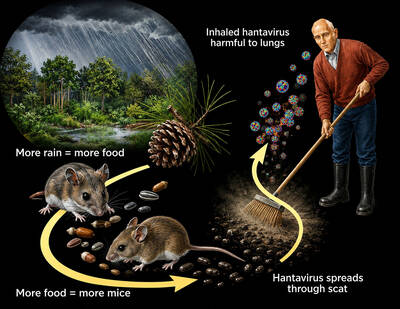
An outbreak aboard a cruise ship of a rare rodent-borne illness called hantavirus has left three passengers dead and sickened others, but global health officials say the risk to the general public remains low because the germ does not easily spread between people. “This is not the next COVID, but it is a serious infectious disease,” said Maria Van Kerkhove, director of epidemic and pandemic preparedness at the World Health Organization (WHO). “Most people will never be exposed to this.” The virus usually spreads when people inhale contaminated residue of rodent droppings. Hantaviruses have been around for centuries and are thought to

Have you ever wondered how people navigate the world when they can’t see a map? For individuals with visual impairments, conventional maps are nearly impossible to use. This is where tactile maps come in — essential tools that allow people to “see” the world through touch. A tactile map is specially designed with raised lines, textures, and symbols to represent geographical features such as roads, rivers, and buildings. Users explore it with their fingertips. However, these maps are not exclusively for people with visual disabilities. They serve as valuable multisensory learning tools that enhance spatial understanding for everyone, making

A: In early May, there were concerts by Icyball, Chyi Yu, Korea’s EXO and Japan’s Anisama, but I missed them all. What a shame. B: That’s OK. There are shows coming up by various artists, including Power Station, Accusefive, Japanese singer Mika Nakashima, Chinese-Icelandic jazzer Laufey, and even Singaporean diva Stefanie Sun. A: After a 12-year hiatus, Stefanie is finally returning to Taipei again. B: In late May, there will be more shows by Crowd Lu, WeiBird, Korea’s Donghae, 2AM, EXID, and Thailand’s BUS. A: The Thai boyband is so popular. It looks like “T-pop” is catching up with J-pop

對話 Dialogue 清清:這個週末就是母親節了,你們打算怎麼過? Qīngqing: Zhè ge zhōumò jiù shì mǔqīn jié le, nǐmen dǎsuàn zěnme guò? 華華:有啊,我們家通常會去餐廳吃飯,不過很難訂位。 Huáhua: Yǒu a, wǒmen jiā tōngcháng huì qù cāntīng chīfàn, búguò hěn nán dìngwèi. 清清:而且那天的餐廳都比較貴。 Qīngqing: Érqiě nà tiān de cāntīng dōu bǐjiào guì. 華華:所以也有人選擇在家吃,比較輕鬆。 Huáhua: Suǒyǐ yě yǒu rén xuǎnzé zài jiā chī, bǐjiào qīngsōng. 清清:聽起來不錯,在家也可以慢慢聊天。 Qīngqing: Tīng qǐlái búcuò, zài jiā yě kěyǐ màn man liáotiān. 華華:對啊,而且不用趕時間,氣氛也比較自在。 Huáhua: Duì a, érqiě bù yòng gǎn shíjiān, qìfēn yě bǐjiào zìzài. 清清:那你們會送禮物嗎? Qīngqing: Nà nǐmen huì sòng lǐwù ma? 華華:會,不過每次都不知道要送什麼。 Huáhua: Huì, búguò měi cì dōu bù zhīdào yào sòng shénme. 清清:我媽都說「不用買」,可是收到還是很開心。 Qīngqing: Wǒ mā dōu shuō “bú yòng mǎi”, kěshì shōudào háishì hěn kāixīn. 華華:真的,我覺得陪她一起吃飯、聊天最重要。 Huáhua: Zhēn de, wǒ juéde péi tā


 RSS
RSS