


A cousin of the starfish that resides in the coral reefs of the Caribbean and Gulf of Mexico lacks eyes, but can still see, according to scientists who studied this creature that expands the boundaries of the sense of sight in the animal kingdom.
Researchers said on Jan. 2 that the red brittle star, called Ophiocoma wendtii, is only the second creature known to be able to see without having eyes — known as extraocular vision — joining a single species of sea urchin.
It possesses this exotic capability thanks to light-sensing cells, called photoreceptors, covering its body and pigment cells, called chromatophores, that move during the day to facilitate the animal’s dramatic color change from a deep reddish-brown in daytime to a stripy beige at nighttime.
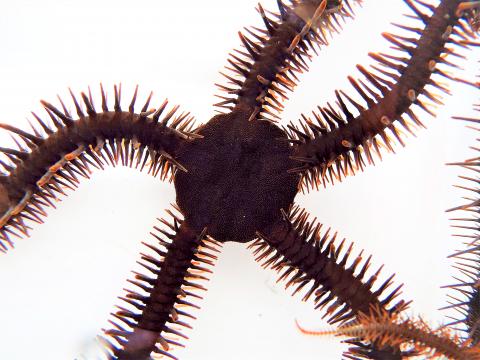
Photo: Reuters
照片:路透
Brittle stars, with five radiating arms extending from a central disk, are related to starfish (also called sea stars), sea cucumbers, sea urchins and others in a group of marine invertebrates called echinoderms. They have a nervous system but no brain.
The red brittle star — up to about 35cm from arm tip to arm tip — lives in bright and complex habitats, with high predation threats from reef fish. It stays hidden during daytime — making the ability to spot a safe place to hide critical — and comes out at night to feed on detritus.
Its photoreceptors are surrounded during daytime by chromatophores that narrow the field of the light being detected, making each photoreceptor like the pixel of a computer image that, when combined with other pixels, makes a whole image. The visual system does not work at night, when the chromatophores contract.
“If our conclusions about the chromatophores are correct, this is a beautiful example of innovation in evolution,” said Lauren Sumner-Rooney, a research fellow at Oxford University Museum of Natural History who led the study published in the journal Current Biology.
Laboratory experiments indicated the brittle stars have rudimentary vision. Placed in a circular arena, they moved toward walls that were white with a black bar, suggestive of a daytime hiding place.
Another scenario showed they were not simply detecting brightness versus darkness. When they were presented with gray walls making it so no part of the arena was lighter or darker overall, they still moved toward the black stripe, which was centered on a white stripe so as to reflect the same amount of light as the gray.
“It’s such an alien concept for us, as very visually driven animals, to conceive of how an animal might see its habitat without eyes, but now we know of two examples,” Sumner-Rooney added.
(Reuters)
有一種海星的近親棲息在加勒比海和墨西哥灣的珊瑚礁中。研究這種生物的科學家指出,它們沒有眼睛,卻仍然可以看得到東西,拓展動物界中視覺的界限。
研究人員於一月二日表示,該物種俗稱紅色陽燧足(或稱蛇尾類),學名為Ophiocoma wendtii,是目前所知第二種可以不用眼睛看東西──此能力稱為「眼外視力」──的生物。第一種被發現具有眼外視力的生物是一種海膽類。
紅色陽燧足擁有這種奇特的能力,可歸功於覆蓋身體表面、稱為「光受器」的感光細胞,以及稱作「色素體」的色素細胞。色素細胞在一天當中移動,促使動物發生戲劇性的身體顏色改變,從白天的深紅褐色轉變成夜間的條紋淺褐色。
陽燧足從中央盤伸出五隻呈輻射狀向外發散的腕足,它們和海星、海參、海膽等動物具有親緣關係,屬於稱作「棘皮動物」的海洋無脊椎動物族群。這些動物具有神經系統,但是沒有大腦。
紅色陽燧足最大可長到約三十五公分(從一隻腕足尖端量到另一隻腕足尖端),生活在明亮而環境複雜的棲息地,身處珊瑚礁魚類的高度掠食威脅下。它在白天保持隱匿──也因此使得找到安全地點躲藏的能力非常重要──晚上才會出來,以海洋中的碎屑為食。
紅色陽燧足的光受器在白天被色素體包圍,使得探測到的光範圍縮小。這時,光受器就像是一個電腦圖檔的像素,與其他像素結合時,就會生成一個完整的圖像。色素體到了晚上會收縮,所以視覺系統晚間不會運作。
這篇研究刊登於期刊《當代生物學》,主持研究的哈佛大學自然史博物館研究員蘿倫‧桑姆納─魯尼指出:「如果我們對色素體做出的結論是正確的,這就是演化創新的美麗範例。」
實驗室中的實驗顯示,這類陽燧足擁有基本程度的視力。將它們放在大型的圓形容器中,它們會朝向有黑色塊的白色牆壁處移動,讓人聯想到它們白天隱匿地點的樣貌。
另一個實驗情境顯示,陽燧足並非單純察覺明亮對比黑暗的差異。在同樣的圓形空間,改用灰色牆壁,使得整塊活動區域沒有部分地方比較明亮或是比較黑暗的情況下,牆壁上有一塊白色粗條紋,正中間有一道黑色條紋。在黑白兩色反射光線相等的情況下,它們還是會向黑色條紋處移動。
桑姆納─魯尼補充表示:「對於我們人類,身為一種極度視覺取向的動物,想像其他動物如何不用眼睛觀看它們的棲息地,這是很陌生的概念,不過我們現在已經知道兩種範例了。」
(台北時報章厚明譯)
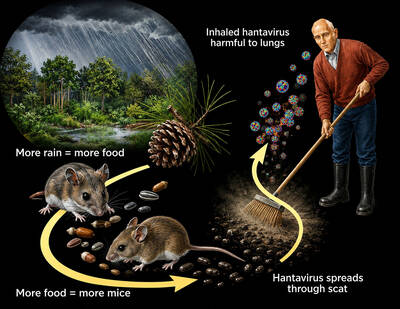
An outbreak aboard a cruise ship of a rare rodent-borne illness called hantavirus has left three passengers dead and sickened others, but global health officials say the risk to the general public remains low because the germ does not easily spread between people. “This is not the next COVID, but it is a serious infectious disease,” said Maria Van Kerkhove, director of epidemic and pandemic preparedness at the World Health Organization (WHO). “Most people will never be exposed to this.” The virus usually spreads when people inhale contaminated residue of rodent droppings. Hantaviruses have been around for centuries and are thought to

Have you ever wondered how people navigate the world when they can’t see a map? For individuals with visual impairments, conventional maps are nearly impossible to use. This is where tactile maps come in — essential tools that allow people to “see” the world through touch. A tactile map is specially designed with raised lines, textures, and symbols to represent geographical features such as roads, rivers, and buildings. Users explore it with their fingertips. However, these maps are not exclusively for people with visual disabilities. They serve as valuable multisensory learning tools that enhance spatial understanding for everyone, making

1. 他病了三天。 ˇ He has been sick for three days. χ He has been sick since three days. 註︰這裡現在完成時態 have / has been 表示從過去某一時日到現在的一段時間存在的行為或狀態,與它連用的時間副詞應為 「for +若干時」,如 for a year, for three hours 等,意思是歷時多少。 2. 他自從星期三以來都很忙。 ˇ He has been busy since Wednesday. χ He has been busy from Wednesday. 註︰「自從……以來」,該用 since。說從某一天(某一時刻)到某一天(某一時刻)才用 from,如 from Monday till Friday。 3. 房間角落裡散放著一些零星物件。 ˇ There were some odds and ends lying in the corner of the room. χ There were some odds and ends lying at the corner of the room. 註︰「在房間角落裡」該用介詞 in。例如: He stood in the corner. There is a lamp in the corner of the room. at the corner 指房子外部的拐角。例如: A little boy

A: In early May, there were concerts by Icyball, Chyi Yu, Korea’s EXO and Japan’s Anisama, but I missed them all. What a shame. B: That’s OK. There are shows coming up by various artists, including Power Station, Accusefive, Japanese singer Mika Nakashima, Chinese-Icelandic jazzer Laufey, and even Singaporean diva Stefanie Sun. A: After a 12-year hiatus, Stefanie is finally returning to Taipei again. B: In late May, there will be more shows by Crowd Lu, WeiBird, Korea’s Donghae, 2AM, EXID, and Thailand’s BUS. A: The Thai boyband is so popular. It looks like “T-pop” is catching up with J-pop


 RSS
RSS