


Who needs the philosopher’s stone when you can turn betel nut leaves into tableware? As part of a rural regeneration initiative, people in the Guangming Community of Nantou County’s Jiji Township have recently started taking the discarded leaves from local betel nut and banana trees and, using a self-designed thermal press machine, have been making environmentally friendly tableware. This has helped them turn agricultural waste, which would ordinarily have been thrown away, into something useful and which can be of benefit to the community. The hope is that, in the future, when they have been able to refine the tableware a little, they will be able to sell it commercially, to boost the community economy and bring some more money into the village, and to develop a local specialty.
According to Yang Chen-lien, chairman of the Guangming Community Development Association, processing betel nut and banana leaves follows essentially the same principle as processing bamboo and lotus leaves, and simply entails washing and drying them in the sun, giving a natural and environmentally friendly material for making the tableware.
Since there are plenty of betel nut and banana plantations around Jiji Township, in the past there was no alternative but to mulch the large leaves from the trees down into fertilizer: there was no other way to put them to good use. Nowadays, with increasing ecological awareness, people are avoiding disposable tableware, which is wasteful of resources. This initiative also allows for the agricultural waste from betel nut trees to be given the chance of a new life.
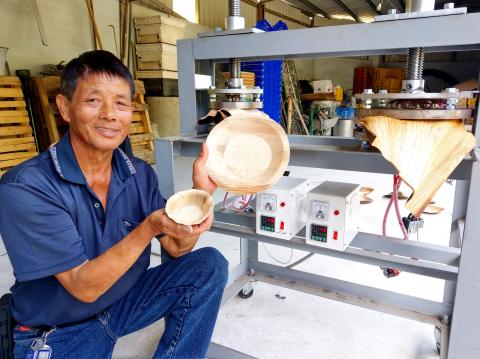
Photo: Liu Pin-chuan, Liberty Times
照片:自由時報記者劉濱銓
Yang says that the community has made its own thermal press machine for the green tableware, and after the betel nut leaves have been washed and sun dried they can then be pressed to make them into betel nut leaf tableware including bowls and plates. The products are practical and require no additional chemical processing, and have a very simple, natural aesthetic.
In addition to the tableware, the community has also fashioned metal frame templates so that the betel nut leaves can be cut into fan shapes. When visitors come to Jiji they can see the kind of items of everyday use that people would have used in the old days. Hopefully, in the future, the quality of this betel nut leaf tableware will have been improved and turned into a local industry, for the benefit of the community and the environment.
(Translated by Paul Cooper)
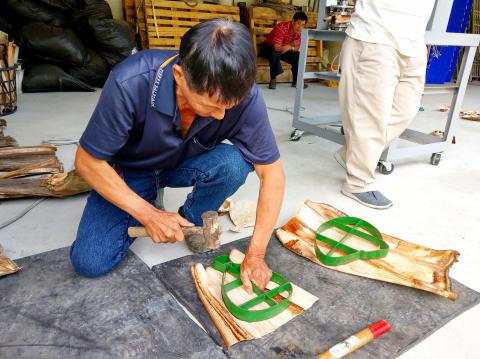
Photo: Liu Pin-chuan, Liberty Times
照片:自由時報記者劉濱銓
點石成金,檳榔葉變身碗盤餐具。南投縣集集鎮廣明社區民眾,近期透過農村再生計畫,將當地種植檳榔、香蕉所棄置的大型樹葉,透過自行設計的熱壓機器,製作成環保碗盤餐具,把過去當成垃圾的農業廢棄物,化腐朽為神奇,成為社區體驗一大亮點,未來將精進檳榔葉碗盤餐具質感,盼成為在地商品販售,增加社區營造與農村收入,也能成為在地特色產業。
廣明社區發展協會理事長楊振聯表示,把檳榔葉、香蕉葉當成餐具,其實道理跟粽葉、荷葉一樣,只要洗淨、曬乾,就能成為非常天然且環保的餐具材料。
由於集集鎮有非常多的檳榔園與香蕉園,過去廢棄的大型樹葉只能任憑在果園腐爛當肥料,未能好好利用,但現今環保意識抬頭,消耗資源的免洗餐具大家都避免使用,也給了檳榔葉等農業廢棄物重生的機會。
楊振聯則說,目前社區已自立打造一台環保餐具熱壓機器,只要將檳榔葉洗淨、曬乾,就能壓製成檳榔葉碗、盤等餐具,且成品樸實,沒有其他化學加工,非常有反璞歸真的純粹感。
除了餐具外,社區也打造鐵製模具,藉由敲打就能將檳榔葉裁切成扇子,讓遊客來到集集,也能體驗阿公阿嬤年代的古早生活用品,未來則希望檳榔葉碗盤品質能更成熟,發展成在地農村產業,為社區發展與環保盡分心力。
(自由時報)
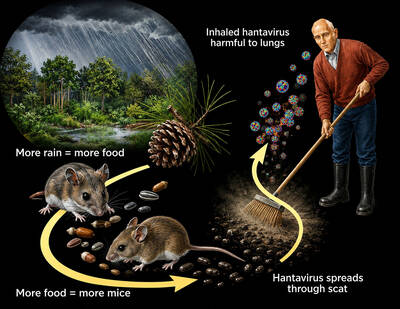
An outbreak aboard a cruise ship of a rare rodent-borne illness called hantavirus has left three passengers dead and sickened others, but global health officials say the risk to the general public remains low because the germ does not easily spread between people. “This is not the next COVID, but it is a serious infectious disease,” said Maria Van Kerkhove, director of epidemic and pandemic preparedness at the World Health Organization (WHO). “Most people will never be exposed to this.” The virus usually spreads when people inhale contaminated residue of rodent droppings. Hantaviruses have been around for centuries and are thought to
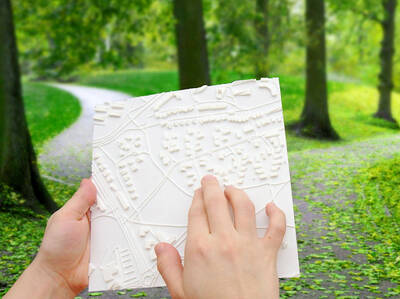
Have you ever wondered how people navigate the world when they can’t see a map? For individuals with visual impairments, conventional maps are nearly impossible to use. This is where tactile maps come in — essential tools that allow people to “see” the world through touch. A tactile map is specially designed with raised lines, textures, and symbols to represent geographical features such as roads, rivers, and buildings. Users explore it with their fingertips. However, these maps are not exclusively for people with visual disabilities. They serve as valuable multisensory learning tools that enhance spatial understanding for everyone, making

1. 他病了三天。 ˇ He has been sick for three days. χ He has been sick since three days. 註︰這裡現在完成時態 have / has been 表示從過去某一時日到現在的一段時間存在的行為或狀態,與它連用的時間副詞應為 「for +若干時」,如 for a year, for three hours 等,意思是歷時多少。 2. 他自從星期三以來都很忙。 ˇ He has been busy since Wednesday. χ He has been busy from Wednesday. 註︰「自從……以來」,該用 since。說從某一天(某一時刻)到某一天(某一時刻)才用 from,如 from Monday till Friday。 3. 房間角落裡散放著一些零星物件。 ˇ There were some odds and ends lying in the corner of the room. χ There were some odds and ends lying at the corner of the room. 註︰「在房間角落裡」該用介詞 in。例如: He stood in the corner. There is a lamp in the corner of the room. at the corner 指房子外部的拐角。例如: A little boy

A: In early May, there were concerts by Icyball, Chyi Yu, Korea’s EXO and Japan’s Anisama, but I missed them all. What a shame. B: That’s OK. There are shows coming up by various artists, including Power Station, Accusefive, Japanese singer Mika Nakashima, Chinese-Icelandic jazzer Laufey, and even Singaporean diva Stefanie Sun. A: After a 12-year hiatus, Stefanie is finally returning to Taipei again. B: In late May, there will be more shows by Crowd Lu, WeiBird, Korea’s Donghae, 2AM, EXID, and Thailand’s BUS. A: The Thai boyband is so popular. It looks like “T-pop” is catching up with J-pop


 RSS
RSS