


When the new moon coincides with a Monday, the small Indian town of Jejuri in western Maharashtra state sparkles with gold.
During the Bhandara Festival, or the Festival of Turmeric, which falls on Feb. 4, June 3 and Oct. 28 this year, devotees worship Lord Khandoba and celebrate his victory over the demons Mani and Malla.
There are more than 600 Khandoba temples across the states of Maharashtra, Telangana, Andhra Pradesh and northern and central Karnataka. However, as many as 600,000 devotees come especially to Jejuri to cover the town — and each other — in golden swirls of turmeric, a mild, earthy spice that in its powdered form is a vital component of Indian cuisine.
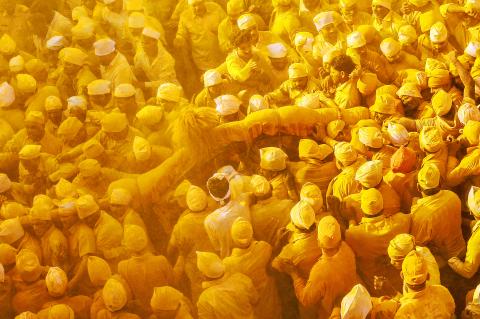
Photo: EPA
照片:歐新社
There are several explanations for the choice of this spice to celebrate Khandoba. The most common is the belief that Khandoba is a descendant of the sun god Surya and is often depicted with four arms holding bowls of turmeric that symbolize sunlight. In other interpretations, turmeric represents the gold that worshippers pray to Khandoba to receive.
During the festival, people show their devotion with ritual songs to Khandoba and make wishes. Then men take the statue of Khandoba from the temple and carry it to the river for a traditional bath as crowds try to touch the idol for a blessing.
(AP)
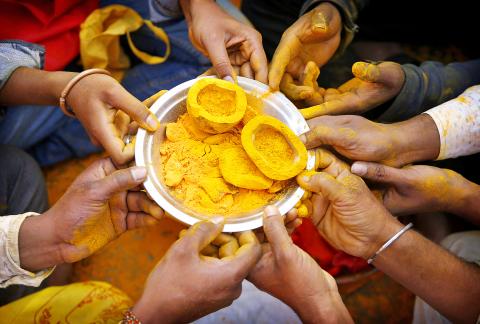
Photo: AP
照片:美聯社
每當新月出現在星期一,印度馬哈拉什特拉邦西部的小鎮傑久里,滿城盡是一片金黃。
今年的班達拉節落在二月四日、六月三日,以及十月二十八日。信徒在班達拉節敬拜勘都巴神,慶祝祂戰勝了兩個惡魔馬尼和馬拉。
印度馬哈拉什特拉邦、泰倫加納特邦、安得拉邦,以及卡納塔克邦北部及中部,共有六百多座勘都巴寺廟。然而,多達六十萬的信徒卻特別來到傑久里,用大量金黃色的薑黃粉灑遍全鎮──也互相丟灑。薑黃是一種溫和、有草根味的香料,薑黃粉是印度料理中不可或缺的重要成分。
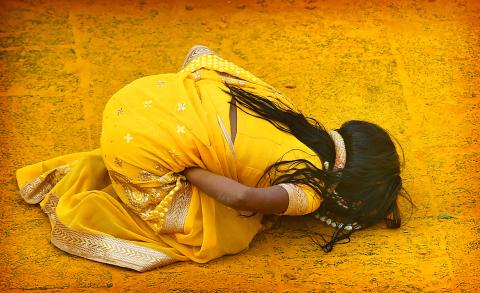
Photo: AP
照片:美聯社
之所以選擇薑黃這香料來敬拜勘都巴神,有好幾種解釋。最常見的說法是認為,勘都巴神是太陽神蘇利耶的後代,常被描繪成有四隻手臂,各持著碗,碗裡裝有象徵陽光的薑黃。其他說法則是認為,薑黃代表信徒祈求勘都巴神能夠賜予的黃金。
班達拉節期間,眾人唱敬拜歌並許願,表達對堪都巴神的虔敬。之後男子們將堪都巴神像由寺廟中迎出,抬到河邊進行沐浴的傳統儀式,途中群眾爭相觸摸神像,以祈求好運。
(台北時報林俐凱譯)
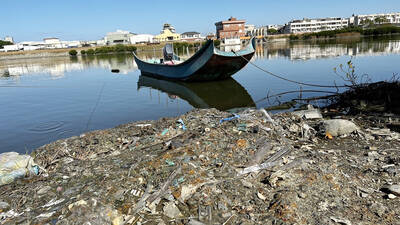
Many consumers are guilty of filling drawers or closets with old laptops, cellphones, fitness trackers and other electronic devices once they are no longer needed. It’s hard to know where to recycle such items, or it seems costly and inconvenient to do so. The world generates millions of tons of electronic waste — also called e-waste — each year. According to the UN’s most recent estimate, people worldwide produced 62 million metric tons of e-waste in 2022, and only about 22 percent of it was properly recycled. The US’ Environmental Protection Agency estimates that less than a quarter of e-waste is

You’re sitting in class when a classmate asks to borrow a pencil. It seems like a small favor, so you agree without hesitation. The following week, the same classmate asks to share your notes. Later, they request help with a group project. You agree each time — after all, you helped out the first time — but before you know it, it has become automatic. This scenario demonstrates the “foot-in-the-door technique,” a psychological concept that shows how agreeing to small, acceptable demands makes it easier to accept larger ones later on. The name for this strategy comes from door-to-door

A: The four-day Tomb Sweeping Day long weekend begins Friday and will run until Monday. Are you going to sweep your ancestors’ tombs? B: I did in advance last weekend, so I can go to Kaohsiung to see the musical “The Phantom of the Opera.” A: Wow, is “Phantom” touring Taiwan again? It debuted in 1986, so this year marks the 40th anniversary of the show. B: And it’s not just touring Kaohsiung starting March 31, but also Taipei starting April 21 and Taichung starting May 26. A: “Phantom” is one of the world’s Four Major Musicals. I’ve seen all of them, except “Les

對話 Dialogue 清清:這禮拜又有連假了,這次一共放四天。 Qīngqing: Zhè lǐbài yòu yǒu liánjià le, zhè cì yígòng fàng sì tiān. 華華:你是要過兒童節還是清明節? Huáhua: Nǐ shì yào guò Értóng jié háishì Qīngmíng jié? 清清:都要過啊!不管幾歲,都要有童心,才能永遠都年輕,知道嗎? Qīngqing: Dōu yào guò a! Bùguǎn jǐ suì, dōu yào yǒu tóngxīn, cái néng yǒngyuǎn dōu niánqīng, zhīdào ma? 華華:好啦!能當個長不大的孩子也好,就不會有那麼多煩惱了。 Huáhua: Hǎo la! Néng dāng ge zhǎngbúdà de háizi yě hǎo, jiù bú huì yǒu nàme duō fánnǎo le. 清清:還好春天有這兩個節假日,常常可以變成連假休息一下。 Qīngqing: Háihǎo chūntiān yǒu zhè liǎng ge jiéjiàrì, chángcháng kěyǐ biànchéng liánjià xiūxi yíxià. 華華:對啊!上禮拜我已經先跟家人去掃墓了,就怕清明節當天人太多。 Huáhua: Duì a! Shàng lǐbài wǒ yǐjīng xiān gēn jiārén qù sǎomù le, jiù pà Qīngmíng jié dāngtiān rén tài duō. 清清:親人雖然過世了,但有清明節掃墓的習俗,讓我們在不同的世界還是能「聚」一下、說說話,真的很有意義。 Qīngqing: Qīnrén suīrán guòshì le, dàn yǒu Qīngmíng jié


 RSS
RSS