


Sun bears, the smallest of the world’s eight bear species, are generally solitary animals. They are content to spend most of their time alone outside mating season, foraging for fruit, rodents, birds and insects in Southeast Asian tropical forests. However, scientists said on March 21, they also possess an unexpected social skill that puts them in elite company alongside humans and some of our close evolutionary cousins: the ability to mimic another bear’s facial expressions in a subtle type of communication.
Researchers studied 22 sun bears in spontaneous social play at the Bornean Sun Bear Conservation Centre in Malaysia in outdoor forest enclosures. These enclosures were big enough to let the animals decide whether to interact or avoid each other all day. The bears exactly mimicked facial expressions they saw other bears produce during social play. They copied with high precision not only the type of expression but also specific muscular movements such as raising their noses and wrinkling the bridge of their muzzles.
Other than people, facial mimicry has been observed in gorillas, orangutans, two monkey species and domesticated dogs. Until now, only gorillas had been observed showing a degree of precision comparable to the complex facial mimicry of people. The sun bears proved equally as sophisticated as the gorillas and comparable to people, the study found.
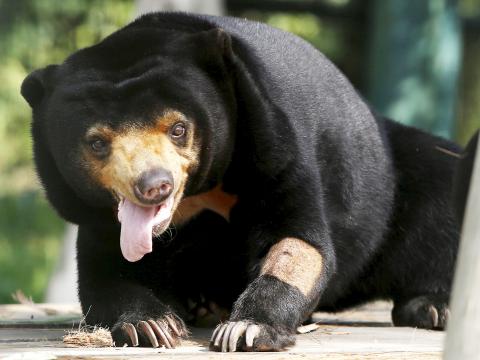
Photo: Reuters
照片:路透
The findings were surprising not only because sun bears are usually solitary, but also because they are not closely related to humans. “It seems that some forms of communication are much more widely shared amongst mammalian species than we previously thought,” said Derry Taylor, a comparative psychology doctoral student at the University of Portsmouth in England and lead author of the study published in the journal Scientific Reports.
Sun bears, with a black coat and a white or golden patch on the chest, are stocky arboreal omnivores reaching about 1.4m long and 65kg. Though they favor solitude in the wild, the bears in the study often engaged in gentle play, with slow grappling actions, and, less often, rough play, with faster actions and behaviors such as hitting and biting. A key difference in the two distinct expressions that the bears mimicked was that one did not display the upper incisor teeth while the other did.
It remains uncertain what messages the bears were conveying to one another, but the mimicry might signal a readiness to transition from gentle to rougher play, Taylor said.
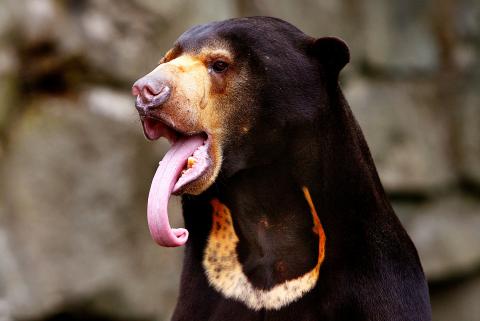
Photo: Reuters
照片:路透
(Reuters)
馬來熊是世界上八種熊類動物中體型最小的一種,一般而言屬於獨居動物,在交配季以外的大部分時間喜歡獨處,在東南亞的熱帶森林中自己尋覓水果、齧齒目動物、鳥類以及昆蟲為食。不過,科學家於三月二十一日指出,馬來熊其實擁有讓人跌破眼鏡的社交技能,讓牠們躍升動物界的「菁英階級」,跟人類以及人類的演化近親平起平坐。這項能力就是模仿另一隻熊的臉部表情,是一種細微的溝通方式。
科學家對馬來西亞婆羅洲馬來熊保育中心裡面的二十二隻馬來熊進行研究,觀察牠們在戶外森林展示區中參與自發性群體遊戲,而展示區的空間夠大,能讓牠們自己決定要和其他熊互動,或是一整天都要彼此迴避。在群體遊戲中,科學家發現,牠們會精確地模仿牠們看到其他熊做出的臉部表情,而且模仿程度相當精準,不僅重現出表情類型,還會包括特定的肌肉活動,例如拱起鼻子,以及皺起口鼻部位的肌肉。
除了人類以外,科學家已在大猩猩、紅毛猩猩、兩種猴子,以及馴養的狗狗身上觀察到臉部表情的模仿行為。到目前為止,只有大猩猩模仿的精準程度能夠比擬人類複雜的表情模仿技巧。不過,這份研究發現,馬來熊證明牠們的模仿能力跟大猩猩一樣複雜而精巧,足以和人類相比。
這份研究讓人驚奇的地方,並不只是因為馬來熊通常都是獨來獨往,而是牠們跟人類並沒有密切的物種關係。這篇研究的主要作者為英國普茨茅斯大學的比較心理學博士生德瑞‧泰勒,他指出:「哺乳動物物種間共同享有的某些溝通形式,似乎比我們先前認為的還要來得廣泛許多。」這篇研究發表於期刊《科學報告》上。
馬來熊身覆黑色毛皮,胸口有一塊白色或金色的斑紋,牠們是健壯結實的樹棲型雜食性動物,身長可達一‧四公尺,體重可達六十五公斤。雖然牠們在野外較喜歡獨處,不過實驗中的熊經常參與溫和的遊戲行為,會有緩慢的扭打動作,有時也會出現較少見的粗魯遊戲行為,會有較快的打架和咬等動作和反應。在牠們模仿的兩種不同表情中,關鍵性的差異在於其中一種表情沒有露出上門牙,另外一種則有。
目前仍不清楚馬來熊想要藉此向彼此傳達什麼訊息,不過泰勒表示,模仿行為可能傳達出牠們已預備好,隨時可以從溫和的遊戲行為轉換成較粗暴的遊戲模式。
(台北時報章厚明譯)
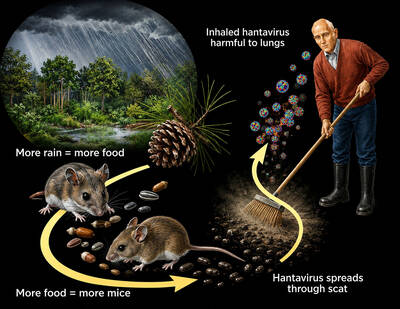
An outbreak aboard a cruise ship of a rare rodent-borne illness called hantavirus has left three passengers dead and sickened others, but global health officials say the risk to the general public remains low because the germ does not easily spread between people. “This is not the next COVID, but it is a serious infectious disease,” said Maria Van Kerkhove, director of epidemic and pandemic preparedness at the World Health Organization (WHO). “Most people will never be exposed to this.” The virus usually spreads when people inhale contaminated residue of rodent droppings. Hantaviruses have been around for centuries and are thought to
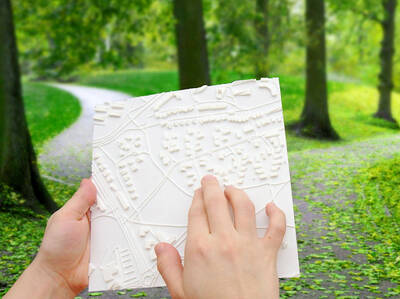
Have you ever wondered how people navigate the world when they can’t see a map? For individuals with visual impairments, conventional maps are nearly impossible to use. This is where tactile maps come in — essential tools that allow people to “see” the world through touch. A tactile map is specially designed with raised lines, textures, and symbols to represent geographical features such as roads, rivers, and buildings. Users explore it with their fingertips. However, these maps are not exclusively for people with visual disabilities. They serve as valuable multisensory learning tools that enhance spatial understanding for everyone, making

1. 他病了三天。 ˇ He has been sick for three days. χ He has been sick since three days. 註︰這裡現在完成時態 have / has been 表示從過去某一時日到現在的一段時間存在的行為或狀態,與它連用的時間副詞應為 「for +若干時」,如 for a year, for three hours 等,意思是歷時多少。 2. 他自從星期三以來都很忙。 ˇ He has been busy since Wednesday. χ He has been busy from Wednesday. 註︰「自從……以來」,該用 since。說從某一天(某一時刻)到某一天(某一時刻)才用 from,如 from Monday till Friday。 3. 房間角落裡散放著一些零星物件。 ˇ There were some odds and ends lying in the corner of the room. χ There were some odds and ends lying at the corner of the room. 註︰「在房間角落裡」該用介詞 in。例如: He stood in the corner. There is a lamp in the corner of the room. at the corner 指房子外部的拐角。例如: A little boy
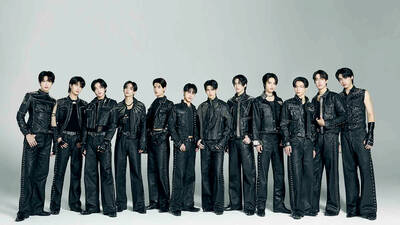
A: In early May, there were concerts by Icyball, Chyi Yu, Korea’s EXO and Japan’s Anisama, but I missed them all. What a shame. B: That’s OK. There are shows coming up by various artists, including Power Station, Accusefive, Japanese singer Mika Nakashima, Chinese-Icelandic jazzer Laufey, and even Singaporean diva Stefanie Sun. A: After a 12-year hiatus, Stefanie is finally returning to Taipei again. B: In late May, there will be more shows by Crowd Lu, WeiBird, Korea’s Donghae, 2AM, EXID, and Thailand’s BUS. A: The Thai boyband is so popular. It looks like “T-pop” is catching up with J-pop


 RSS
RSS