


National Central University (NCU) has set aside an annual budget for regular treatment to deal with the “pine wood nematode” worm invasion that attacks the 1,500 pine trees on the campus. As part of this treatment, the trees are given an intravenous drip, with the medicine being injected into their trunks.
According to the university, the worms, transmitted into the branches of the trees by insects, cause the leaves to wilt and die. Agricultural experts advise the use of a “trunk injection,” which infuses the medicine into the trunk, and from there throughout the entire tree. This process can take three to four months for the agent to take effect.
Last year, some of the coral trees — which are indigenous to Taiwan — along the streets in Taichung were harmed by Quadrastichus erythrinae, an exotic wasp species. National Chung Hsing University’s (NCHU) Plant Teaching Hospital launched a rescue operation, opting for trunk injections instead of the traditional spraying approach. As a result, 133 dying trees were brought back to life.
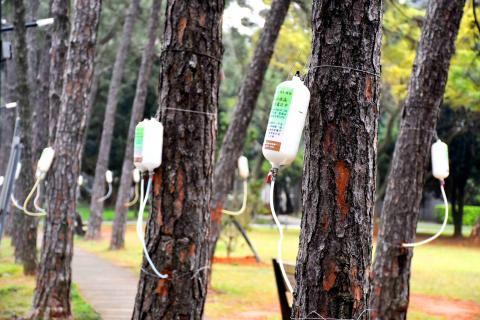
Photo: Lee Jung-ping, Liberty Times
照片:自由時報記者李容萍
Plant Teaching Hospital director Tang Li-cheng said that, in the past, spraying was the only option available, but the chemicals stayed on the surface of the leaves and would not penetrate into the diseased tissue. As a result, the treatment was mostly ineffective.
The “plant doctors” at the hospital now use a more precise, targeted method, applying trunk injections to infuse the medicine into the trunk through a borehole. After this, through capillary action, the medication is transported to the infected leaves by water absorbed by the tree. Tang compared it to treating a sick person: applying ointment on the skin has limited effect, while injecting the drug into the blood vessels allows it to be absorbed more efficiently.
Tang says that two doses are sufficient for a whole year for trees with a diameter an adult can put their arms around. In addition, the treatment is inexpensive and does not carry the risks associated with pesticide spraying, such as harming non-targeted plants or creatures, or even people out for a stroll in the park.
(Translated by Lin Lee-kai, Taipei Times)
中央大學為了搶救校內約一千五百棵松樹免於「松材線蟲」入侵,每年編列預算,定期將藥劑加壓灌注入樹幹內,猶如為松樹「打點滴」。
中大表示,昆蟲傳播將松材線蟲帶入松樹的枝幹上,導致樹葉萎淍枯死,目前農業學者的建議是利用「樹幹注射法」,將藥劑加壓灌注入樹幹,讓藥劑運行全株運行,至少要三至四個月才能讓藥劑在松樹內發酵。
去年台中市部份行道樹「台灣原生種刺桐」出現受外來種刺桐釉小蜂危害,中興大學植物教學醫院也展開搶救大作戰,用樹幹注射法取代傳統噴藥,讓一百三十三棵奄奄一息的病樹起死回生,重現盎然綠意。
興大植物醫院院長唐立正指出,以往的防治或治療方式均採噴藥去病,但藥劑只留在樹葉表面,根本未能深入病害組織,因此防治成效有限。
興大植物醫院植物醫師「對症下藥」,採樹幹注射法,把治療藥物施打進入鑽孔的樹幹,隨著樹木自體吸收水份後的毛細現象,讓藥劑慢慢被吸收到病灶葉片治療。唐立正說,這就像是人體內生病,以往只在皮膚表面塗藥,效果有限,於是改以針劑注射藥劑到血管,漸被人體吸收達到治療效果。
唐立正指出,一般成人可圈抱的樹木,約施打兩劑即可維持近一年的藥效,成本低廉,更不像噴灑殺蟲劑一樣可能會波及其他植物或生物,甚至危害前往公園活動的民眾。
(中央社)
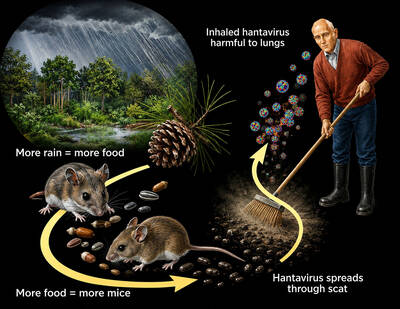
An outbreak aboard a cruise ship of a rare rodent-borne illness called hantavirus has left three passengers dead and sickened others, but global health officials say the risk to the general public remains low because the germ does not easily spread between people. “This is not the next COVID, but it is a serious infectious disease,” said Maria Van Kerkhove, director of epidemic and pandemic preparedness at the World Health Organization (WHO). “Most people will never be exposed to this.” The virus usually spreads when people inhale contaminated residue of rodent droppings. Hantaviruses have been around for centuries and are thought to

Have you ever wondered how people navigate the world when they can’t see a map? For individuals with visual impairments, conventional maps are nearly impossible to use. This is where tactile maps come in — essential tools that allow people to “see” the world through touch. A tactile map is specially designed with raised lines, textures, and symbols to represent geographical features such as roads, rivers, and buildings. Users explore it with their fingertips. However, these maps are not exclusively for people with visual disabilities. They serve as valuable multisensory learning tools that enhance spatial understanding for everyone, making

1. 他病了三天。 ˇ He has been sick for three days. χ He has been sick since three days. 註︰這裡現在完成時態 have / has been 表示從過去某一時日到現在的一段時間存在的行為或狀態,與它連用的時間副詞應為 「for +若干時」,如 for a year, for three hours 等,意思是歷時多少。 2. 他自從星期三以來都很忙。 ˇ He has been busy since Wednesday. χ He has been busy from Wednesday. 註︰「自從……以來」,該用 since。說從某一天(某一時刻)到某一天(某一時刻)才用 from,如 from Monday till Friday。 3. 房間角落裡散放著一些零星物件。 ˇ There were some odds and ends lying in the corner of the room. χ There were some odds and ends lying at the corner of the room. 註︰「在房間角落裡」該用介詞 in。例如: He stood in the corner. There is a lamp in the corner of the room. at the corner 指房子外部的拐角。例如: A little boy

A: In early May, there were concerts by Icyball, Chyi Yu, Korea’s EXO and Japan’s Anisama, but I missed them all. What a shame. B: That’s OK. There are shows coming up by various artists, including Power Station, Accusefive, Japanese singer Mika Nakashima, Chinese-Icelandic jazzer Laufey, and even Singaporean diva Stefanie Sun. A: After a 12-year hiatus, Stefanie is finally returning to Taipei again. B: In late May, there will be more shows by Crowd Lu, WeiBird, Korea’s Donghae, 2AM, EXID, and Thailand’s BUS. A: The Thai boyband is so popular. It looks like “T-pop” is catching up with J-pop


 RSS
RSS