


A proposed 100km particle accelerator under Geneva has joined an international quest to develop the successor to the Large Hadron Collider (LHC) to help unlock humankind’s knowledge of matter.
The existing collider, which started up in 2008, smashes protons together in a 27km circuit beneath the Swiss-French border. It helped scientists discover the long-sought Higgs boson — a particle that supplied the missing piece of the standard model of physics by explaining why objects have mass.
The Future Circular Collider (FCC), proposed by more than 150 universities and science institutes, would be a huge tubular circuit almost four times as long, with 10 times more power than the LHC at CERN, the European center for nuclear physics.
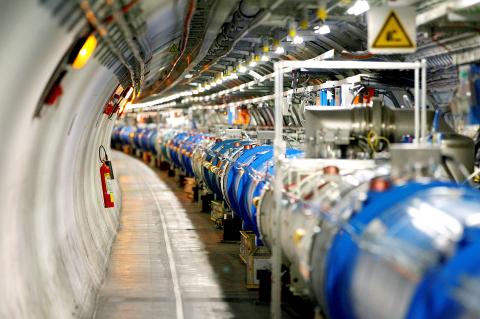
Photo: Reuters
照片:路透
The proposal came out of the European Strategy for Particle Physics, which recommended that design and feasibility studies be conducted in order for Europe “to be in a position to propose an ambitious post-LHC accelerator project at CERN by the time of the next strategy update.”
But the decision on whether to go ahead with the FCC — incurring an initial 9 billion euro (US$10.3 billion) bill for participating governments plus a later 15 billion euro upgrade — is effectively part of an international race to host the LHC’s successor, with China, Japan, the United States and Europe all interested. “Any big machine for the future will be a global machine,” said Arnaud Marsollier, head of media relations at CERN. “No one expects to have two 100km colliders built in the next 20 years, so if one is built in China, maybe Europe will do something else.”
The LHC is expected to keep running until around 2036-2040, by which time it will have done its job collecting data, but it might also be possible to upgrade it by increasing the energy of collisions, which would require major investment.
China has floated plans for its own 100km collider, but has not yet confirmed it will go ahead. Japan is expected to take a decision on a linear collider in March, which could play into a potential choice by European countries in 2020 about whether to back the FCC or another proposal for CERN, the Compact Linear Collider.
For physicists, the location may be less important than the science opportunities offered by a new collider, allowing them to peer into the debris left when subatomic particles smash together and shatter into even smaller pieces, some of which may answer fundamental questions about the universe. But science mega-projects attract talent and can generate unforeseen spin-offs — including the invention of the World Wide Web at CERN, which has become a global center for physicists, despite the high cost of living around Geneva.
The discovery of the Higgs boson in 2012 earned Peter Higgs and Francois Englert the 2013 Nobel Prize in physics. They had predicted half a century earlier that it would one day be discovered.
(Reuters)
計畫建造於日內瓦地底的一台粒子加速器,圓周達一百公里長,近日加入國際尋求發展「大型強子對撞機」後繼機組的行列,以協助揭開人類對於物質的理解。
目前的「大型強子對撞機」啟用於二○○八年,位於瑞士和法國邊界底下,讓質子在周長二十七公里的環形隧道中對撞。這項實驗幫助科學家發現尋覓已久的「希格斯玻色子」──這個粒子解釋為何物體會具有質量,填補了物理學標準模型理論中缺少的一塊拼圖。
由超過一百五十所大學與科學機構提議的「未來環形對撞機」將會是一座巨大的管狀環形隧道,幾乎是位於歐洲核子研究組織的「大型強子對撞機」四倍長,撞擊力道更達到後者的十倍。歐洲核子研究組織是歐洲的原子核物理學研究中心。
這份提案源自於「歐洲粒子物理學戰略」,該戰略建議科學家著手設計並進行可行性研究,讓歐洲「能夠在下一次戰略更新時,在歐洲核子研究組織提出一項雄心勃勃的後大型強子對撞機加速器計畫」。
不過,是否要著手進行「未來環形對撞機」的決定──初期款項將會對參與政府造成九十億歐元(一百○三億美元)的支出,往後還要支付另外一百五十億歐元進行更新──其實是一場國際競賽的一部分,為的是爭取在自己國家設置「大型強子對撞機」的後繼機種,包括中國、日本、美國,以及歐洲各國都紛紛對此表示興趣。歐洲核子研究組織的媒體關係主管阿諾‧馬索列表示:「為未來建造的任何大型設備都將會是全球性的設備。」他也指出:「沒有人期望在未來二十年內同時建造兩台圓周一百公里的碰撞器,所以如果中國興建了一台,歐洲也許就會投入別的任務。」
「大型強子對撞機」預計將持續運行至二○三六年到二○四○年之間,屆時機器蒐集數據的工作將告完成,但也可能藉由增加碰撞能量來進行更新,此舉將需要大額投資。
中國已提出建造自己的一百公里對撞機計劃,但是目前尚未證實是否會進行。日本則預期在今年三月決定是否建造線性對撞機,可能會影響歐洲國家將在二○二○年做出的選擇:是支持「未來環形對撞機」,還是支持歐洲核子研究組織的另一個提議──建造「緊湊型線性對撞機」。
對物理學家而言,新對撞機的地點也許沒有機器本身提供的科學研究機會來得重要,畢竟它能讓科學家一窺「次原子粒子」互相撞擊、粉碎為更小的碎片後剩下的殘骸,它們也許能夠為宇宙的根本問題提供解答。然而,科學界的巨大計畫不但吸引人才,也可能創造出預料之外的衍生產品──例如全球資訊網路系統就是發明自歐洲核子研究組織。儘管日內瓦當地物價高昂,歐洲核子研究組織仍然成為物理學家的全球中心。
物理學家彼得‧希格斯和法蘭梭瓦‧恩勒特在二○一二年發現「希格斯玻色子」,因此獲得二○一三年的諾貝爾物理獎。他們在半世紀前就曾經預測指出,這個粒子總有一天會被找出來。
(台北時報章厚明譯)
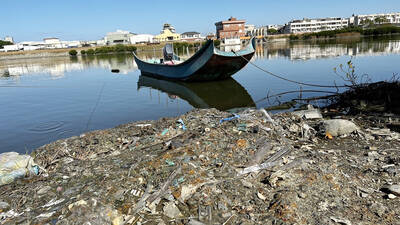
Many consumers are guilty of filling drawers or closets with old laptops, cellphones, fitness trackers and other electronic devices once they are no longer needed. It’s hard to know where to recycle such items, or it seems costly and inconvenient to do so. The world generates millions of tons of electronic waste — also called e-waste — each year. According to the UN’s most recent estimate, people worldwide produced 62 million metric tons of e-waste in 2022, and only about 22 percent of it was properly recycled. The US’ Environmental Protection Agency estimates that less than a quarter of e-waste is
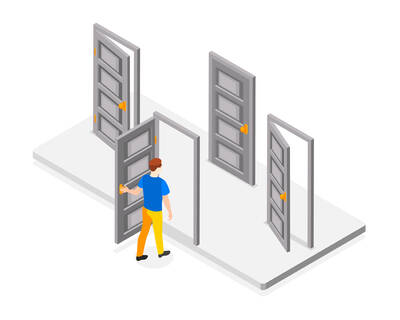
You’re sitting in class when a classmate asks to borrow a pencil. It seems like a small favor, so you agree without hesitation. The following week, the same classmate asks to share your notes. Later, they request help with a group project. You agree each time — after all, you helped out the first time — but before you know it, it has become automatic. This scenario demonstrates the “foot-in-the-door technique,” a psychological concept that shows how agreeing to small, acceptable demands makes it easier to accept larger ones later on. The name for this strategy comes from door-to-door

A: The four-day Tomb Sweeping Day long weekend begins Friday and will run until Monday. Are you going to sweep your ancestors’ tombs? B: I did in advance last weekend, so I can go to Kaohsiung to see the musical “The Phantom of the Opera.” A: Wow, is “Phantom” touring Taiwan again? It debuted in 1986, so this year marks the 40th anniversary of the show. B: And it’s not just touring Kaohsiung starting March 31, but also Taipei starting April 21 and Taichung starting May 26. A: “Phantom” is one of the world’s Four Major Musicals. I’ve seen all of them, except “Les

Dos & Don’ts — 想想看,這句話英語該怎麼說? 1. 我們很早到達電影院。 ˇ We arrived at the theater very early. χ We arrived the theater very early. 註︰arrive 為不及物動詞,後面如果有受詞要用 at 或 in。例如:They arrived in Taipei yesterday.。一般大地方,如國家、省、大城市等前面用 in,凡小地方城鎮、學校等則用 at。 2. 開車半小時以後,我們到達了海灘。 ˇ After half an hour’s drive, we got to the beach. χ After half an hour’s drive, we got the beach. 註︰come, go, get(來、去、到達)某地時,在表示地點的名詞前面應該用 to,如 go to school, go to Taipei, come to Shanghai 等。如果這些動詞後面所跟的是 here, there, home 等副詞,則不用 to。 3. 明天我會回辦公室。 ˇ I will be back in the office tomorrow. χ I will be back to office tomorrow. 註︰to be back 一語裡的 back 是副詞,不是介詞,所以後面要用 at (the market) 或 in (the office)。 假如假期結束,要回學校上課了則可說: ? Kids will be back


 RSS
RSS