


Chinese Practice
一氣呵成
(yi2 qi4 he1 cheng2)
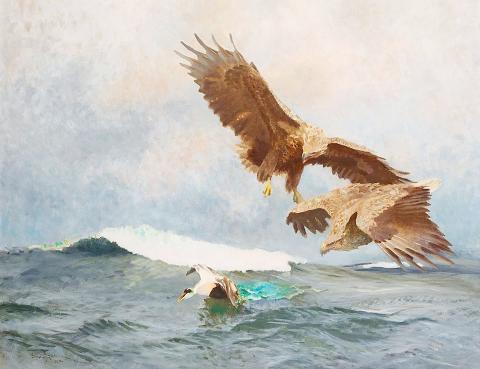
Photo: Wikimedia Commons
照片:維基共享資源
to do something smoothly, in a single move
本週的「活用成語」單元跟兩位詩人有關,這兩位詩人在其所屬語言文化中皆最受尊崇──對後世極具影響力、被稱為「詩聖」的唐代詩人杜甫(西元七一二~七七○年),以及英格蘭劇作家威廉‧莎士比亞(西元一五六四~一六一六年)。
杜甫以其歷史觀照、對老百姓的關懷,以及對詩歌技巧的創新、對傳統詩歌形式例如律詩的掌握,而享有盛名。以下的例子是題為〈登高〉的一首七言律詩,作於杜甫晚年,描述他健康狀況不佳的景況:
風急天高猿嘯哀,渚清沙白鳥飛迴。
無邊落木蕭蕭下,不盡長江袞袞來。
萬里悲秋常作客,百年多病獨登臺。
艱難苦恨繁霜鬢,潦倒新停濁酒杯。
杜甫的詩作在他有生之年及死後不久,並未受到廣泛重視,他的才華到了後世才被充份肯定。杜甫身後約八百年,明末學者、作家和藏書家胡應麟(西元一五五一~一六○二年)在其詩歌評論集《詩藪》中,便論及杜甫的〈登高〉一詩。
胡應麟在《詩藪》中盛讚此詩,評其為一傑作、對應完美,每行字句都符合詩律、氣勢流暢,但讀來不覺其刻意的工巧,只有在回頭分析其結構、節奏和押韻時,才會意識到每一字都應對地恰到好處。胡應麟說,只有杜甫才能夠寫出這樣的詩句:杜甫所達到的境界不但前無古人,而且後無來者。胡應麟形容杜甫的〈登高〉為「一意貫串,一氣呵成」,意思是其情思貫穿整首詩、毫無間隙,並且「像一口氣一樣流暢」。胡應麟這句話便是成語「一氣呵成」的由來,意為流暢地用一個動作完成某事。此語最初是用來形容文筆,但後來可用於描述任何工作。
與「一氣呵成」相對應的英文成語是「in one fell swoop」(或「at one fell swoop」)。這是那種很多母語人士會使用、知其含義,但卻不完全理解其字句確切本意的成語。「in one fell swoop」意味以快速、一次完成的行動做好某事。我們知道「swoop」(猛撲)這個字,指鳥為捕捉獵物而突然往下飛的動作;「fell」一字在此語中的意義,跟其現今的含義有所不同。在十三世紀,「fell」意為凶狠、殘忍或可怕;它可指邪惡或惡毒,例如「a fell purpose」(邪惡的目的);或指非常有破壞性或致命性,如「a fell disease」(致命的疾病)。「fell」字的這個意義,便是「felon」(重罪犯)這個字的字根。
莎士比亞在其一六○五年的劇作《馬克白》中,使用──或者是自創了此語,劇中馬克道夫聽聞他全家包括僕人都被謀殺了,說道:
All my pretty ones? (我那寶貝的一切?)
Did you say all? O hell-kite! All? (你是說全部嗎?被那猛禽!全部?)
What, all my pretty chickens and their dam (什麼!我可愛的雞雛和牠們的母親)
At one fell swoop? (全被那猛禽一擊奪命了?)
「hell-kite」指的是一種猛禽,例如紅鳶(red kite),這在都鐸王朝時期的英格蘭很常見。莎翁以猛撲下去的猛禽為意象,來描繪受馬克白指使的凶殘暴徒,殺戮馬克道夫的「pretty chickens」(可愛的雞)。
在《馬克白》中,「in one fell swoop」這句話含有殺無赦的那種無情的效率之意;但現今此語單純意指以單一、有效的行動執行某事,「fell」這個字已與其原意無涉。
(台北時報林俐凱譯)
體操選手跨步、彈跳、翻騰、落地一氣呵成,純熟流暢的動作完美無瑕,贏得如雷的掌聲。
(The gymnast’s stride, leap, somersault and landing were executed seamlessly, in a single flowing, flawless movement, receiving rapturous applause.)
英文練習
in/at one fell swoop
This week’s Using Idioms concerns two poets, among the most lauded within their respective languages: the hugely — posthumously — influential Tang Dynasty “sage-poet” Du Fu (712 – 770) and the English playwright William Shakespeare (1564 – 1616).
Du Fu is acknowledged for his historical themes and his compassion for common people, as well as for his technical innovations and his mastery of traditional poetic forms, such as the lushi “regulated poems.” Below is an example of a qiyan lushi, a regulated poem with each line consisting of seven syllables in the Chinese. A late poem, it refers to his failing health in his later years. It is titled denggao (Ascending the High Terrace).
With biting winds and soaring skies, the apes wail,
And high over the clean, white sandbar birds circle.
Into the distance, desolate trees stand bare of leaves
As the endless Yangtze rolls on by.
Countless miles I have come in this dreary fall,
Ailing now, I ascend this terrace alone.
Weakened by hardships and long, long years,
My temples have turned a frosty white,
And of late I forgo my cup of unstrained wine.
Du Fu’s poems did not receive wide renown during his lifetime or initially following his death: his talent was only fully appreciated later on. About 800 years after Du Fu’s death, the late Ming dynasty scholar, writer and bibliophile Hu Yinglin (1551–1602) wrote about denggao in his treatise on poetry shisou (Thickets of Criticism).
In his book, Hu praises the poem, saying that it is so well-written and perfectly balanced, with each line following the prescribed rules, that it flows beautifully, and that it is only later, when the reader goes back and analyses its structure, rhythm and rhyming scheme that they realize how well it has been executed. As far as Hu was concerned, only Du Fu could have penned such a verse: not only has nobody preceding him achieved such heights, but anyone subsequently would be hard pushed to do so, either. He described the poem as 一意貫串,一氣呵成, meaning that the emotive content pervaded the entire piece, with no distraction, and that it flowed “as in a single breath.” That last phrase gives us the Chinese idiom 一氣呵成, “to do something smoothly, in a single move,” originally applied to writing, but subsequently applied to any endeavor.
A corresponding English phrase is “in/at one fell swoop.” This is the kind of phrase that many native speakers will use, understanding its meaning, without fully appreciating the exact nature of its constituent parts. “In one fell swoop” means to do something in a rapid, single action, to completion of a task. The word “swoop” is recognizable as the sudden descent of a bird flying down to capture its prey; the word “fell,” in the meaning pertinent here, is no longer in use in modern English. In the 13th century it would have meant fierce, cruel or terrible; sinister or malevolent, as in “a fell purpose”; or very destructive or deadly, as in “a fell disease.” It is in this sense that it is the root of the word “felon.”
Shakespeare used — and perhaps coined — the phrase in his 1605 play Macbeth, in which Macduff, on hearing his entire family and servants have been murdered, says
All my pretty ones?
Did you say all? O hell-kite! All?
What, all my pretty chickens and their dam
At one fell swoop?
The phrase “hell-kite” refers to a hunting bird, like the Red Kite, which was common in Tudor England, using the imagery of Macbeth’s ruthless thugs as a bird of prey swooping down to kill Macduff’s “pretty chickens.”
In Macbeth, the phrase carries a sense of ruthless efficiency in the execution of a deadly act; nowadays, “in one fell swoop” simply means that the act is carried out in a single, efficient move. The word “fell” in the phrase has lost its original meaning.
(Paul Cooper, Taipei Times)
If we arrange the cleaner, the removal firm, the electrician and the new furniture deliveries on the same day, we can get the moving done in one fell swoop.
(如果我們把清潔工、搬家公司、電工、新家具配送的時間都安排在同一天,就可以把搬家一口氣搞定。)
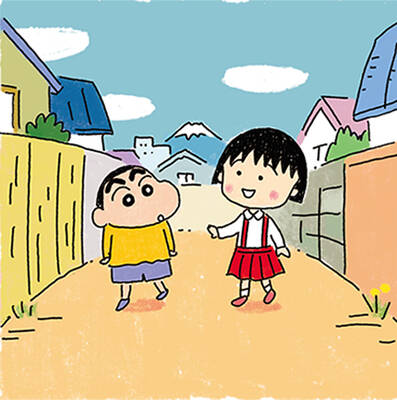
A: Popular humorous Japanese manga series “Chibi Maruko-chan” and “Crayon Shin-chan” will collaborate for their respective 40th and 35th anniversaries, publishing three crossover stories in April. B: Both were made into TV animation series, becoming huge hits in Asia. What are the crossover stories about? A: The first story features Shin-chan and his family visiting Maruko-chan’s hometown, Shizuoka City, where they run into each other. B: Wow, that sounds interesting. And then? A: The follow-ups feature Maruko-chan and her family visiting Shin-chan’s hometown, Kasukabe City. I bet the interactions between the two families will be funny. A: 熱門日本漫畫《櫻桃小丸子》、《蠟筆小新》4月將合作,為紀念小丸子40週年與小新35週年,推出三篇跨界聯動漫畫! B:
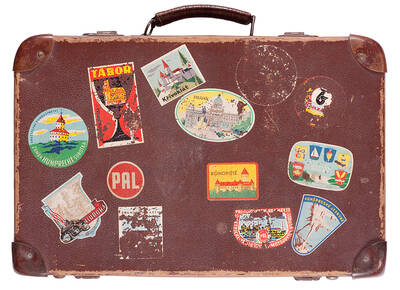
Travel fever is back, and it’s contagious. After years of being kept home during the COVID-19 pandemic, people are once again eager to explore the world. Rather than just book any trip, travelers are getting smarter about how they scratch that travel itch. Microcation Defined as four days or fewer and over 160km away from home, the microcation perfectly matches the post-pandemic mindset. After long periods of remaining indoors, people are making up for lost time by taking short, frequent getaways throughout the year. These brief trips avoid the work-life imbalance that comes with long absences. With only a few days away, one’s

Many consumers are guilty of filling drawers or closets with old laptops, cellphones, fitness trackers and other electronic devices once they are no longer needed. It’s hard to know where to recycle such items, or it seems costly and inconvenient to do so. The world generates millions of tons of electronic waste — also called e-waste — each year. According to the UN’s most recent estimate, people worldwide produced 62 million metric tons of e-waste in 2022, and only about 22 percent of it was properly recycled. The US’ Environmental Protection Agency estimates that less than a quarter of e-waste is

Dos & Don’ts — 想想看,這句話英語該怎麼說? 1. 我們很早到達電影院。 ˇ We arrived at the theater very early. χ We arrived the theater very early. 註︰arrive 為不及物動詞,後面如果有受詞要用 at 或 in。例如:They arrived in Taipei yesterday.。一般大地方,如國家、省、大城市等前面用 in,凡小地方城鎮、學校等則用 at。 2. 開車半小時以後,我們到達了海灘。 ˇ After half an hour’s drive, we got to the beach. χ After half an hour’s drive, we got the beach. 註︰come, go, get(來、去、到達)某地時,在表示地點的名詞前面應該用 to,如 go to school, go to Taipei, come to Shanghai 等。如果這些動詞後面所跟的是 here, there, home 等副詞,則不用 to。 3. 明天我會回辦公室。 ˇ I will be back in the office tomorrow. χ I will be back to office tomorrow. 註︰to be back 一語裡的 back 是副詞,不是介詞,所以後面要用 at (the market) 或 in (the office)。 假如假期結束,要回學校上課了則可說: ? Kids will be back


 RSS
RSS