


What is African swine fever?
African swine fever (ASF) is a highly contagious viral pig disease. The most common symptoms of the virus in its acute form are a high temperature and loss of appetite; other symptoms include vomiting, diarrhea, and difficulty with breathing and standing. There is no treatment for the disease, some versions can have a 100 percent mortality rate in certain circumstances. It is not the same as swine flu.
How does it spread?
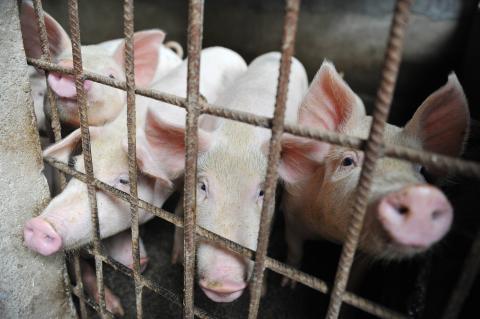
Photo: AP
照片:美聯社
ASF can be transmitted through direct contact with infected animals. Wild boar have been identified by some national governments as one of several possible culprits for the recent spread. It can also spread via insects such as ticks.
But the virus can also survive several months in processed meat, and several years in frozen carcasses, so meat products are a particular concern for cross-border transmission. It is believed that the disease was initially brought from east Africa to Georgia by contaminated pig products. Last month, a packet of sausages confiscated at a Japanese airport from a traveler arriving from China were found to contain the virus. Similar discoveries have been made in South Korea, according to reports.
What happens when it is found?
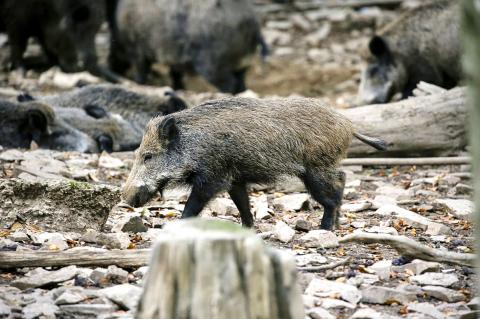
Photo: EPA
照片:歐新社
Cases must be reported to the authorities. In most countries, this will trigger quarantine measures and a cull of the affected herd. However, there is anxiety among experts that in some cases farmers — or even whole countries — may cover up or delay reporting the illness. In May, for example, Belarus was accused of covering up ASF among its pigs. The Belarus government denied the claims.
Can it be caught by humans?
Humans cannot contract ASF. However the head of the Russian epidemiology service, chief state sanitary doctor Gennady Onishchenko, has warned that pig physiology is close to human physiology, and that future mutations of the virus may therefore become dangerous to human beings too.

Photo: AFP
照片:法新社
Why are people worrying about it now?
For many years ASF was found mainly in Africa, although there was an outbreak in Europe in the 1950s which took several decades to eradicate. In 2007, however, the virus was detected in Georgia, and despite co-ordinated efforts it has since spread widely, initially through eastern Europe and Russia, and more recently into western Europe, when wild boar in Belgium were found to have the disease. The virus has now jumped to China, home to half the world’s domestic pigs, and appears to be proliferating rapidly. According to one report there have been 41 outbreaks since the first notification in early August.
Are there any vaccines or cures on the horizon?
The Roslin Institute is looking at gene editing to make pigs resistant to ASF. An international coalition of scientists is urgently investigating vaccines.
(The Guardian)
什麼是非洲豬瘟?
非洲豬瘟(ASF)是由病毒引起的一種高度傳染性的豬隻疫病。最常見的急性症狀是發高熱和食慾不振,其他症狀包括嘔吐、腹瀉、呼吸困難和無法站立。此病無藥可醫,有些疾病變體在某些情況下可能有百分之百的死亡率。非洲豬瘟與豬流感並不相同。
非洲豬瘟是如何傳播的?
非洲豬瘟可透過與受感染動物的直接接觸傳播,有些國家的政府已檢驗出野豬可能是最近疫情蔓延的罪魁禍首之一,它也可透過壁蝨等昆蟲傳播。
但是,這種病毒在加工肉品中可存活數個月,在冷凍的畜體中更可存活數年,因此病毒的跨境傳播,肉類產品是尤需注意的問題。據信非洲豬瘟最初是隨著受感染的豬肉產品,由東非帶到喬治亞的。上個月,一名旅客由中國抵達日本機場後被沒收的香腸,就被發現含有這種病毒。據報導,韓國也發現有類似情況。
若發現疫情,該怎麼做?
必須向有關當局報告。多數國家會啟動檢疫隔離措施,並撲殺受感染的畜群。然而專家卻擔心,有時養豬戶──甚至整個國家──可能會隱瞞疫情或延遲通報。例如在五月時,白俄羅斯被指控隱瞞其境內豬隻感染非洲豬瘟的疫情。白俄羅斯政府對此說法加以否認。
人類會被感染嗎?
人類並不會感染非洲豬瘟。然而,俄羅斯國家防疫總醫師甘納迪‧歐尼希成柯警告,豬和人類在生理學上很相近,因此病毒未來的突變也可能會對人類構成危險。
為何現在人們要擔心呢?
多年來,非洲豬瘟主要是在非洲發現,雖然歐洲在一九五○年代曾爆發過疫情,花了數十年才完全消滅。然而,在二○○七年,該病毒在喬治亞現蹤,儘管各方合力掃蕩,但疫情仍開始擴大,最初透過東歐和俄羅斯,最近進入了西歐──比利時發現有野豬感染非洲豬瘟。這種病毒現已傳到中國──世界上有一半數量的家豬是在中國飼養的,且似乎正迅速擴散。根據一份報告指出,自今年八月初第一次通報以來,已有四十一次疫情爆發。
將來會有疫苗或治療方法嗎?
羅斯林研究所正在研究基因編輯,以使豬隻對非洲豬瘟具有抵抗力。一個國際科學家聯盟正進行疫苗的緊急研究。
(台北時報林俐凱編譯)

Many consumers are guilty of filling drawers or closets with old laptops, cellphones, fitness trackers and other electronic devices once they are no longer needed. It’s hard to know where to recycle such items, or it seems costly and inconvenient to do so. The world generates millions of tons of electronic waste — also called e-waste — each year. According to the UN’s most recent estimate, people worldwide produced 62 million metric tons of e-waste in 2022, and only about 22 percent of it was properly recycled. The US’ Environmental Protection Agency estimates that less than a quarter of e-waste is

You’re sitting in class when a classmate asks to borrow a pencil. It seems like a small favor, so you agree without hesitation. The following week, the same classmate asks to share your notes. Later, they request help with a group project. You agree each time — after all, you helped out the first time — but before you know it, it has become automatic. This scenario demonstrates the “foot-in-the-door technique,” a psychological concept that shows how agreeing to small, acceptable demands makes it easier to accept larger ones later on. The name for this strategy comes from door-to-door

A: The four-day Tomb Sweeping Day long weekend begins Friday and will run until Monday. Are you going to sweep your ancestors’ tombs? B: I did in advance last weekend, so I can go to Kaohsiung to see the musical “The Phantom of the Opera.” A: Wow, is “Phantom” touring Taiwan again? It debuted in 1986, so this year marks the 40th anniversary of the show. B: And it’s not just touring Kaohsiung starting March 31, but also Taipei starting April 21 and Taichung starting May 26. A: “Phantom” is one of the world’s Four Major Musicals. I’ve seen all of them, except “Les

Dos & Don’ts — 想想看,這句話英語該怎麼說? 1. 我們很早到達電影院。 ˇ We arrived at the theater very early. χ We arrived the theater very early. 註︰arrive 為不及物動詞,後面如果有受詞要用 at 或 in。例如:They arrived in Taipei yesterday.。一般大地方,如國家、省、大城市等前面用 in,凡小地方城鎮、學校等則用 at。 2. 開車半小時以後,我們到達了海灘。 ˇ After half an hour’s drive, we got to the beach. χ After half an hour’s drive, we got the beach. 註︰come, go, get(來、去、到達)某地時,在表示地點的名詞前面應該用 to,如 go to school, go to Taipei, come to Shanghai 等。如果這些動詞後面所跟的是 here, there, home 等副詞,則不用 to。 3. 明天我會回辦公室。 ˇ I will be back in the office tomorrow. χ I will be back to office tomorrow. 註︰to be back 一語裡的 back 是副詞,不是介詞,所以後面要用 at (the market) 或 in (the office)。 假如假期結束,要回學校上課了則可說: ? Kids will be back


 RSS
RSS