


Fireflies, commonly known as “hue kim goo” (fire gold lady) in Taiwanese, can usually be seen starting after the end of the Ching Ming Festival. Mid-April to late-May is the time in the year that we get to see the most fireflies — often in the mountains and farms across Taiwan.
There are more than 2,000 species of fireflies known to exist around the world, of which more than 60 species can be found in Taiwan. Fireflies live only in places with clean water and low light pollution: there needs to be the right surrounding ecological environment with clean river water.
Grass in woodland areas tends to contain many snails, which are the favorite food of firefly larvae. In March and April, adult fireflies will emerge and fly out in the evening to attract mates.
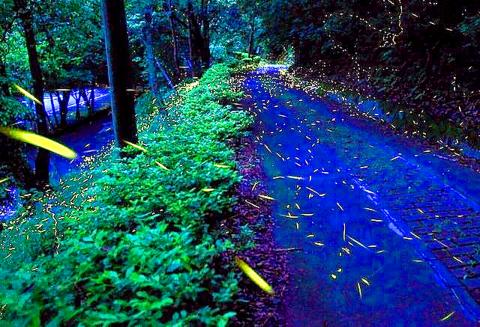
Photo courtesy of Nantou Forest District Office, Forestry Bureau
照片:林務局南投林管處提供
Increasing urban development and the use of pesticides have severely damaged their ecological environment so that seeing fireflies has become something of a luxury.
The glow from a firefly
Adult fireflies emit light through a light emitter in their abdomen. The glow from the light emitter is composed of a combination of light-emitting cells at the end of the abdomen. Upon contact with oxygen, a reduction-oxidation reaction (redox) occurs to produce light.
Each species of firefly emits light of different color and frequency. For example, a Taiwan Pyrocoelia analis glows with continuous yellow-green light, while the Aquatica ficta Olivier emits twinkling yellow light.
The firefly’s light flashes at a specific rhythm — it is the language they use to communicate with others, as well as a means for males to attract females to mate.
The glow behavior of fireflies also has additional functions including attracting, alerting and intimidating predators, providing illumination and camouflage.
Firefly viewing spots
Taipei City: Daan Forest Park, Ronxing Garden Park, Cui Lake in Muzha District
New Taipei City: Wen Sun Farm in Xindian District, Homei Trail and 53 other locations
Taoyuan City: Xiao Jing Ling Firefly Resort in Guishan District
Hsinchu County: Xinghai Firefly Area at Dongwo River in Neiwan Village
Miaoli County: Springcreek Hostel in Zhuolan Township, West Lake Resortopia in Sanyi Township, Firefly Farm in Tongxiao Township
Taichung City: Dongshih Forest Garden, Sijiaolin Coffee Farm
Nantou County: Four major firefly habitats (Sun Moon Lake, Aowanda, Guosing Township, and Chulu), Sun Link Sea Forest Recreation Area
Chiayi County: Meishan, Jhuci, Alisha, Jhongpu Townships
Tainan City: Meiling in Nanxi District, Guanshan in Nanhua District, Hsinhua Forest Farm
Kaohsiung City: Namasia District
Firefly observation tips
Flashlights should be covered with red cellophane to avoid harming the fireflies.
Never catch fireflies with your hands, as they will die if they are disturbed or touched.
The best time to observe fireflies is between 6pm and 8:30 pm.
(Translated by Lin Lee-kai)
螢火蟲在台灣俗稱「火金姑」,出現的時間點約在清明節過後;四月中旬至五月下旬左右,是螢火蟲最多的時候,台灣各地山間和農場常可見到它們的蹤影。
全世界目前已知有兩千多種螢火蟲,台灣已發現有六十多種。螢火蟲只生長在水源清澈、光害少的地方,周遭要有乾淨的溪流及生態環境。
樹林下的草叢環境蝸牛多,是螢火蟲幼蟲最愛的食物,每到三、四月成蟲羽化,夜間便飛出求偶。
由於都市化與使用農藥的程度越來越深,使環境生態遭受嚴重破壞,對現代人來說,要看到螢火蟲已成為一種奢侈。
螢火蟲的光
螢火蟲成蟲藉由腹部末端的發光器發光,發光器是由發光細胞等結構組合而成,和氧作用後產生氧化還原反應,而產生亮光。
每種螢火蟲發光的顏色與和頻率都不同,如台灣窗螢發著持續的黃綠色光,而黃緣螢則是發閃爍的黃色光。
螢火蟲的光閃爍著特定的節奏,是螢火蟲用來交換彼此訊息的語言,也是雄蟲利用亮光,找尋雌蟲交尾的工具。
此外,螢火蟲的發光行為還有誘集、警戒、恫嚇捕食者、照明、偽裝等功能。
賞螢景點
台北市:大安森林公園、榮星花園、木柵萃湖
新北市:新店文山農場、和美山步道等五十五處賞螢景點
桃園市:龜山區小精靈螢火蟲館
新竹縣:內灣東窩星海螢區
苗栗縣:卓蘭鎮岩川森林民宿、三義鄉西湖渡假村、通霄鎮飛螢山莊
台中市:東勢林場、四角林咖啡莊園
南投縣:日月潭、奧萬大、國姓、竹鹿四大賞螢區、杉林溪
嘉義縣:梅山、竹崎、阿里山、中埔鄉
台南市:楠西梅嶺、南化關山、新化林場
高雄市:那瑪夏
賞螢小提醒
夜晚使用手電筒要加上紅色玻璃紙,才不會對螢火蟲產生光害。
千萬不要用手抓螢火蟲,因為螢火蟲只要受驚嚇或被觸摸就會死亡。
賞螢最佳時間約為晚上六點~八點半之間。
(台北時報林俐凱整理)
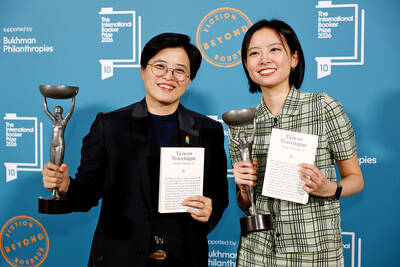
Taiwan Travelogue, the novel by Taiwanese author Yang Shuang-zi and translated into English by Lin King, won the prestigious International Booker Prize in London on May 19. It marks the first time a Taiwanese literary work has received the International Booker Prize, setting a historic milestone both for Taiwanese literature and for the award itself. Prior to this achievement, Taiwan had only once appeared on the Booker radar, when Taiwanese author Wu Ming-yi was longlisted for the Booker Prize in 2018 with The Stolen Bicycle. The International Booker Prize honors works of fiction translated into English and published in the UK or Ireland.
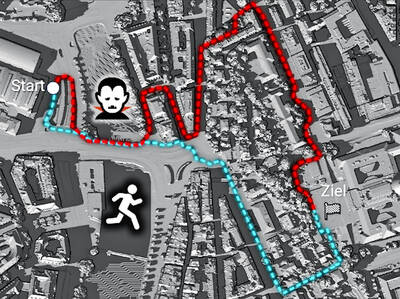
As climate change and urbanization push city temperatures higher, walking outdoors is becoming increasingly uncomfortable in many parts of the world, especially when prolonged time spent in sunlight is involved. As a result, outdoor lovers are now seeking cooler, shaded walking routes. However, most mainstream map apps still do not __1__ shaded footpaths. Enter routing.osm.ch — a Swiss web-based route planner that introduces a novel solution to this problem. Its “Vampire mode,” named after the legendary creatures’ fear of being __2__ natural light, was developed by a Swiss research team led by Professor Stefan Keller. The platform combines open data from

Cities around the world are testing “robotaxis,” hoping that autonomous vehicles will ease traffic and reduce emissions. However, recent analyses suggest these expectations may be overly optimistic. According to consulting firm Kearney, robotaxis could actually make congestion worse rather than better. Because self-driving rides are expected to be cheaper and more convenient than traditional taxis, more people may choose them over walking, biking, or using public transportation. This shift would put more cars on already crowded roads. Another concern is “deadheading,” which refers to robotaxis traveling without passengers between rides. Since autonomous fleets need to reposition themselves throughout the day, these

1. 該協會於全球九十個國家擁有逾一百萬名會員。 ˇ The association consists of over 1 million members in 90 countries. χ The association consists in over 1 million members in 90 countries. 註:consist of 是「由……組成」,而consist in是「在於」、「就是」,比較下列句子: Our department consists of three sections. Success consists in perseverance. Happiness consists in doing one’s duty. 2. 我們的任何錯誤將來都可能帶來麻煩。 ˇ Any mistakes on our part now may lead to problems later on. χ Any mistakes on our part now may lead into problems later on. 註:說「導致」、「引起」用lead to,如to lead to trouble,to lead to disaster,to lead to problems,to lead to something unpleasant等。表示「向某物內部的動向」可用into,如go into a room,to come into a building,to get into trouble等。 3. 這本書是E.M.福斯特的作品,不是喬治.歐威爾。 ˇ This book was written by E. M. Foster, not


 RSS
RSS