


Earth has so far gone through five mass extinction events — scientists are worried we’re on course to trigger a sixth — and the deadliest one happened 252 million years ago at the end of the Permian geologic period. In this event, coined “the Great Dying,” over 90 perent of marine species and 70 percent of terrestrial vertebrate species went extinct. It took about 10 million years for life on Earth to recover from this catastrophic event.
Scientists have proposed a number of possible culprits responsible for this mass extinction, including an asteroid impact, mercury poisoning, a collapse of the ozone layer, and acid rain. Heavy volcanic activity in Siberia was suspected to play a key role in the end-Permian event.
Recently, geologist Dr Benjamin Burger identified a rock layer in Utah that he believed might have formed during the Permian and subsequent Triassic period that could shed light on the cause of the Great Dying.
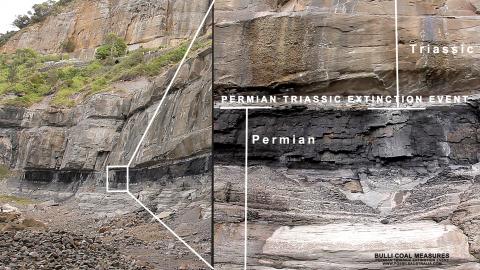
Photo: Screen grab from Youtube
照片:擷圖自Youtube
The culprit: burning coal
Burger collected and analyzed samples from the rock layer. Levels of various metals in the rock samples were critical in identifying the culprit of this mass extinction event. As in end-Permian samples collected from other locations around the world, Burger didn’t find the kinds of rare metals that are associated with asteroid impacts. There simply isn’t evidence that an asteroid struck at the right time to cause the Great Dying.
However, Burger did find high levels of mercury and lead in his samples, coinciding with the end of the Permian period. Mercury has also been identified in end-Permian samples from other sites. Lead and mercury aren’t associated with volcanic ash, but they are a byproduct of burning coal. Burger also identified a shift from heavier carbon-13 to lighter carbon-12; the latter results from burning fossil fuels.
The Permian was the end of the Carboniferous period, which means “coal-bearing.” Many large coal deposits were created in the Carboniferous. Previous research has shown that the Permian mass extinction event didn’t coincide with the start of the Siberian volcanic eruptions and lava flows, but rather 300,000 years later. That’s when the lava began to inject as sheets of magma underground, where Burger’s data suggests it ignited coal deposits.
The coal ignition triggered the series of events that led to Earth’s worst mass extinction. Its sulfur emissions created the acid rain that killed forests. Its carbon emissions acidified the oceans and warmed the planet, killing most marine life. The dead bodies fed bacteria that produced toxic hydrogen sulfide gas, which in turn killed off more species. The warming of the oceans produced a large methane release, which accelerated global warming faster yet. As Burger put it:
“Things went from bad to worse, and you can now begin to understand how life nearly died out. Global warming, acid oceans, anoxia, not to mention a toxic atmosphere. We are lucky to be alive at all.”
Eerie similarities to today
These are some of the similarities between the climate change that nearly wiped out life on Earth 252 million years ago and the climate change today. Both appear to have largely been caused by burning coal.
It’s enough to make you think; maybe coal isn’t so beautiful and clean after all.
(The Guardian)
地球迄今已經歷了五次生物大滅絕──最嚴重的一次發生在兩億五千兩百萬年前的二疊紀末期;而現在,科學家擔心我們正在引發第六次大滅絕。二疊紀末期的大滅絕又叫做「大滅亡」,有超過百分之九十的海洋物種和百分之七十的陸生脊椎動物物種滅絕。地球上的生命花了大約一千萬年,才從這次災難中恢復過來。
科學家已提出一些可能造成這次大滅絕的原因,包括小行星撞擊、汞中毒、臭氧層崩壞,以及酸雨。科學家懷疑西伯利亞活躍的火山活動,是造成二疊紀末大滅絕的關鍵原因。
地質學家班哲明‧伯格博士最近在美國猶他州找到一個岩層,他認為可能是在二疊紀及其後的三疊紀時期形成的,這岩層可讓人一窺這次大滅絕的成因。
罪魁禍首:燃煤
伯格收集並分析岩層中的樣本,岩石樣本中各種金屬的含量對確認這次大滅絕的成因至關重要。如同在世界各地所採集的二疊紀末期樣本,伯格也沒有在這些岩石樣本中發現跟小行星撞擊有關聯的稀有金屬。沒有證據顯示在符合的時間內有小行星撞擊而造成這次大滅絕。
然而,伯格發現在二疊紀末期的岩石樣本中,有高含量的汞和鉛。在其他地方的二疊紀末樣本中也發現了汞。鉛和汞跟火山灰沒有關係,但它們是燃燒煤的副產品。伯格還檢驗出了由較重的碳十三轉向較輕的碳十二的變化,碳十二是燃燒化石燃料所形成的。
二疊紀是接續在石炭紀之後的地質年代。石炭紀這名稱的意思是「蘊含煤」,許多大型的煤礦礦藏都是在石炭紀形成的。過去的研究顯示,二疊紀發生大滅絕的時間並不吻合西伯利亞火山開始爆發和噴發熔岩流的時間,而是與其後三十萬年的時間相吻合──那時熔岩開始流入地下,伯格的數據顯示,岩漿注入了地下的岩層,引燃了地底的煤層。
引燃的煤引發了一連串事件,造成了地球最嚴重的大滅絕。燃燒煤所排放的硫形成了酸雨,造成森林死亡;所排放的碳使海洋酸化、使地球變暖,大部分的海洋生物因而死亡。死亡生物的屍體孳生大量會產生有毒硫化氫氣體的細菌,又消滅了更多的物種。變暖的海洋產生了大量的甲烷,更加快了全球變暖的速度。正同伯格所言:
「情況變得越來越糟糕,你現在就可以理解生命是如何滅絕的了。全球變暖、酸性海洋、缺氧,更不用說有毒的大氣層。我們何其有幸能夠活著!」
與今日可怕的雷同處
以上是兩億五千兩百萬年前幾乎消滅地球上生命的氣候變化,與今天的氣候變化之間有著相似處。這兩者似乎主要都是由燃煤所造成的。
這足以讓你思考,煤畢竟可能不是那麼美好與乾淨。
(台北時報林俐凱編譯)

You might think knitting is only for grandmas, but surprisingly, many young people are embracing so-called “grandma hobbies.” On social media platforms, activities such as home cooking, embroidery and gardening are becoming popular among teenagers and young adults who are drawn to their relaxing and creative nature. “Grandma hobbies” typically refer to activities that are slow-paced, handmade and nostalgic. Common examples include knitting scarves, baking cookies, sewing clothes and growing plants. These hobbies were once part of everyday life for many women in previous generations, but today they provide an escape from the fast-paced digital world. The appeal

A: Isn’t the 2026 Coachella Valley Music and Arts Festival — a massive music event held every April — about to open in California? B: Yeah the festival is set to take place over two weekends, from April 10 to 12 and 17 to 19, US time. A: I heard this year’s main stage headliners include Sabrina Carpenter, Justin Bieber, Karol G and EDM DJ Anyma. B: The K-pop army is also making an appearance, with legendary group BigBang, SHINee member Taemin and girl group Katseye debuting for the first time. A: Isn’t Coachella also live-streamed on its YouTube

A: Several Japanese and South Korean acts, such as BigBang, are participating in this year’s Coachella Music Festival. Have any Mando-pop singers ever performed at Coachella? B: Yup, K-pop group GOT7’s Hong Kong member Jackson Wang, and Taiwanese band Sunset Rollercoaster, which primarily performs in English, attended the festival before. A: It’s a pity that we didn’t fly to Coachella. But in fact, Taipei has also gradually become an Asian music hub in recent years. B: That’s true. K-pop sensation Twice just held three concerts at the Taipei Dome, followed by Hong Kong singer G.E.M., who is going

Concertgoers know the rush all too well — the moment the first notes play, your heart races, and nothing else seems to matter. For many, the excitement doesn’t end when the lights come back on. Some fans try to relive the performance by listening to the same songs for days afterward. __1__ A few days after an amazing show, they begin to feel unexpectedly low. Psychologists have coined a term for this phenomenon: “post-concert depression,” or “PCD.” PCD is primarily related to hormone levels. When you’re at a concert, the excitement causes your brain to release feel-good chemicals like


 RSS
RSS