


Jianshih Township office in Hsinchu County has installed a new hiking trail deep within a mountain forest valley at the famous local scenic spot Frog Rock. The walk includes a waterfall-viewing trail which features an approximately 6 meter-long glass viewing platform. However, although construction work is not yet finished, a large number of visitors to the area have forced their way into the construction site past construction hoardings to take a look around.
Jianshih Township office secretary Yeh Chang-cheng says inspection work is still ongoing and during this period the contractor is still in charge of managing the site. Yeh says the only solution is to improve access controls to the site and says he has already asked the contractor to erect warning signs and to advise tourists not to enter. Yeh added that if visitors to the area persist in forcing their way into the site and their actions lead to safety concerns or an altercation, the contractor will report trespassers to the police.
Jianshih Township office has called on visitors to put safety first and refrain from entering a dangerous construction site. The office says it expects the trail will be ready to accept visitors by mid-December and welcomes members of the public to visit once work is complete.
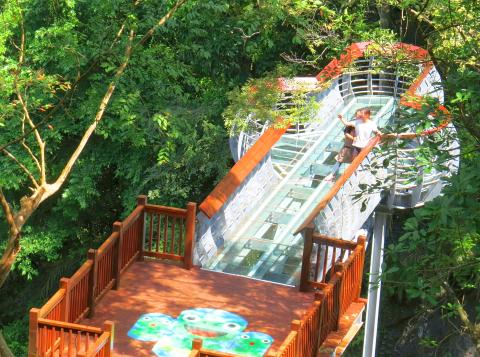
Photo: Tsai Meng-shang, Liberty Times
照片:自由時報記者蔡孟尚
Jianshih Township Mayor Yun Tien-pao says he secured approximately NT$30 million of funding from central government to build the new trail, most of which uses a wooden boardwalk design. The walk is divided into two main sections: a waterfall-viewing trail and an ecological trail. The bulbous viewing platform at the end of the waterfall-viewing walk, which is shaped like a three-leaf clover and uses a suspended steel girder and glass design, takes its inspiration from viewing areas at popular scenic spots in other parts of the country. When standing on the platform, visitors will be able to look up in the direction of Frog Rock and take in the spectacular iridescent waterfall, while looking down through the clear glass they will get a clear view of the valley below.
(LIBERTY TIMES, TRANSLATED BY EDWARD JONES)
新竹縣尖石鄉公所在知名景點「青蛙石」新設深入山林溪谷的步道,其中賞瀑步道的盡頭是段長約六公尺的玻璃觀景平台,還沒完工就有不少遊客自行從施工圍籬鑽入工區參觀。
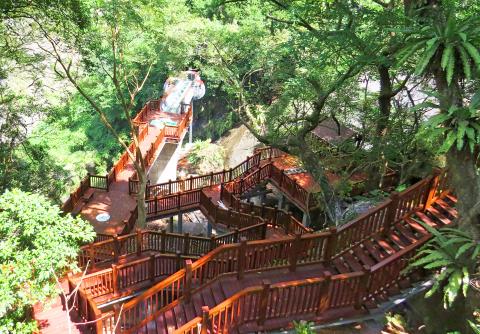
Photo: Tsai Meng-shang, Liberty Times
照片:自由時報記者蔡孟尚
尖石鄉公所秘書葉長城說,工程還沒完工驗收,施工期間工地由包商管理,只能加強工區進出管制,已請包商豎立警告牌並勸導,若有遊客執意硬闖,有安全顧慮或衍生糾紛時,包商將報警處理。
鄉公所呼籲安全第一,千萬不要冒險進入工區,這條步道預計在十二月中旬就會開放,屆時歡迎大家來欣賞體驗。
尖石鄉長雲天寶說,向中央爭取約三千萬元施作的這條步道,大多是以木棧道的方式鋪設,分成賞瀑步道和生態步道兩大部分,其中賞瀑步道的盡頭規劃一個雙圓弧形的賞景平台,參考國內相關景點的流行作法,採用鋼梁懸空鋪設玻璃的設計,遊客站在這個平台上,抬頭往青蛙石方向可以看到壯觀的彩虹瀑布,低頭可以從透明玻璃清楚看到底下的那羅溪谷。
(自由時報記者蔡孟尚)
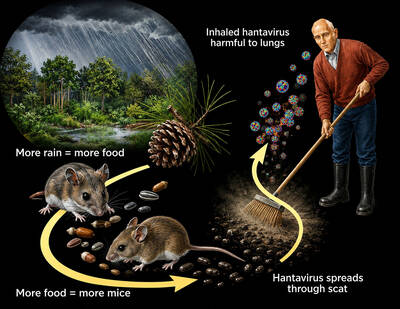
An outbreak aboard a cruise ship of a rare rodent-borne illness called hantavirus has left three passengers dead and sickened others, but global health officials say the risk to the general public remains low because the germ does not easily spread between people. “This is not the next COVID, but it is a serious infectious disease,” said Maria Van Kerkhove, director of epidemic and pandemic preparedness at the World Health Organization (WHO). “Most people will never be exposed to this.” The virus usually spreads when people inhale contaminated residue of rodent droppings. Hantaviruses have been around for centuries and are thought to

Have you ever wondered how people navigate the world when they can’t see a map? For individuals with visual impairments, conventional maps are nearly impossible to use. This is where tactile maps come in — essential tools that allow people to “see” the world through touch. A tactile map is specially designed with raised lines, textures, and symbols to represent geographical features such as roads, rivers, and buildings. Users explore it with their fingertips. However, these maps are not exclusively for people with visual disabilities. They serve as valuable multisensory learning tools that enhance spatial understanding for everyone, making

1. 他病了三天。 ˇ He has been sick for three days. χ He has been sick since three days. 註︰這裡現在完成時態 have / has been 表示從過去某一時日到現在的一段時間存在的行為或狀態,與它連用的時間副詞應為 「for +若干時」,如 for a year, for three hours 等,意思是歷時多少。 2. 他自從星期三以來都很忙。 ˇ He has been busy since Wednesday. χ He has been busy from Wednesday. 註︰「自從……以來」,該用 since。說從某一天(某一時刻)到某一天(某一時刻)才用 from,如 from Monday till Friday。 3. 房間角落裡散放著一些零星物件。 ˇ There were some odds and ends lying in the corner of the room. χ There were some odds and ends lying at the corner of the room. 註︰「在房間角落裡」該用介詞 in。例如: He stood in the corner. There is a lamp in the corner of the room. at the corner 指房子外部的拐角。例如: A little boy

A: In early May, there were concerts by Icyball, Chyi Yu, Korea’s EXO and Japan’s Anisama, but I missed them all. What a shame. B: That’s OK. There are shows coming up by various artists, including Power Station, Accusefive, Japanese singer Mika Nakashima, Chinese-Icelandic jazzer Laufey, and even Singaporean diva Stefanie Sun. A: After a 12-year hiatus, Stefanie is finally returning to Taipei again. B: In late May, there will be more shows by Crowd Lu, WeiBird, Korea’s Donghae, 2AM, EXID, and Thailand’s BUS. A: The Thai boyband is so popular. It looks like “T-pop” is catching up with J-pop


 RSS
RSS