


The peculiar structure of the Chinese brush, with its supple hairs arranged in an inverted cone, means a single brush is incredibly versatile, and can produce points, lines and planes. This characteristic makes the brush equally useful for painting and calligraphy, with painting techniques largely being an extension of calligraphic brush techniques. This is the basis for Zhang Yanyuan’s idea of the shared origin of painting and calligraphy.
In last month’s Bilingual Arts we introduced the cunfa (texture stoke) technique used for depicting the surface texture of boulders. We now turn to how continuous lines were used in figurative mural painting, as an additional expression of the shared origin of painting and calligraphy.
The detail of the mural Vimalakirti debating Manjusri shown here, dating to around the High Tang period (mid 8th century AD), is located in Dunhuang Mogao Cave 103. Scholars believe this painting to be stylistically very similar to works attributable to Wu Daozi. During his lifetime, Wu painted countless numbers of Buddhist and Taoist murals, and was given the name “painting sage.” Unfortunately, extant works attributable to his hand are few and far between.
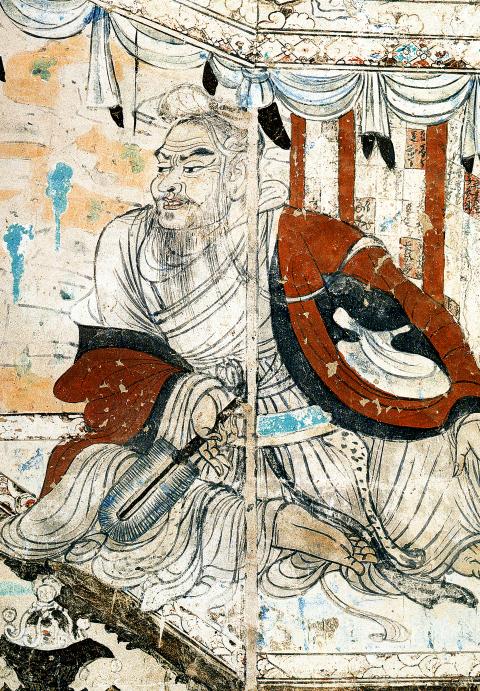
Photo: Wikimedia Commons
圖:維基共享資源
Wu Daozi excelled in the control of the brush tip. He was known for his ability to depict variations in thickness of line over the twists and turns of the folds of clothing, enabling him to represent clothes and lengths of material flapping and billowing in the wind. This technique was accorded its own term — wudai dangfeng— “Wu’s ribbons billowing in the wind.” Zhang Yanyu declared that Wu was skilled in all six painting principles.
In the mural, Vimalakirti, in ill health, is leaning forward in his canopy, listening attentively to the discoursing Manjusri. The painting shows a mature brush technique in depicting line, the artist employing variation to describe details of Vimalakirti’s facial features and clothing. The brushwork on the forehead, brow and corners of the eyes perfectly render his animated expression, even as his eyelids droop, a result of his ill health. With the use of variation in line, now languid, now urgent, the artist has been able to accurately depict the muscular structure and juxtaposition of light and shadow with line.
(Translated by Paul Cooper)
由於毛筆的特殊結構——呈倒圓錐體、富柔軟度的筆毛,可以由同一隻毛筆作出點、線、面,且變化繁多,因而毛筆同時為書法及繪畫的工具,而繪畫的技巧也多以書法之筆法衍伸出,基於此,而有張彥遠的「書畫同源」之說。
上月雙語藝術單元中,我們介紹了營造出山石體積的皴法;本單元我們將觀察連綿的線條如何羅織出人物像,作為「書畫同源」另一例。
此《維摩詰像》約作於盛唐(西元八世紀半),為敦煌莫高窟第一○三洞中之壁畫局部,學者咸認該壁畫近似史載吳道子之畫風。吳道子一生作過無數佛教、道教壁畫,且有「畫聖」之稱,但現已無可靠的吳道子真跡流傳。
吳道子善用筆鋒之變化,同一線條隨著衣紋之折疊,給予粗細不等轉折之表現,這種方法,更能表達出衣帶飛動轉折之狀態,而有「吳帶當風」之美名。張彥遠更評吳道子的畫「六法俱全」。
畫中維摩詰帶病倚坐帳內,傾身專注於和文殊菩薩的激辯中。此圖展現出圓熟的線描表象,以各種線條來描繪維摩詰顏面、衣飾等細節,包括其額頭、眉間、眼角等處因表情牽動而生的面紋,以及因病而鬆垂的眼瞼褶紋。
經由線條緩急起伏的變化,此圖完全用線條精確地說明物象之肌理結構以及光影向背。
(台北時報林俐凱)
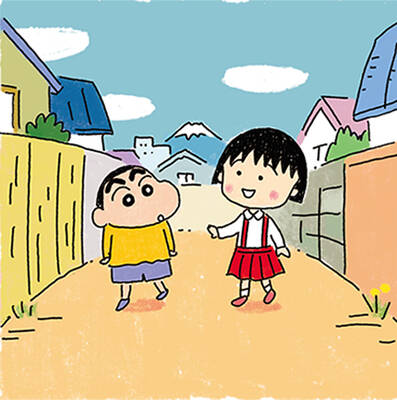
A: Popular humorous Japanese manga series “Chibi Maruko-chan” and “Crayon Shin-chan” will collaborate for their respective 40th and 35th anniversaries, publishing three crossover stories in April. B: Both were made into TV animation series, becoming huge hits in Asia. What are the crossover stories about? A: The first story features Shin-chan and his family visiting Maruko-chan’s hometown, Shizuoka City, where they run into each other. B: Wow, that sounds interesting. And then? A: The follow-ups feature Maruko-chan and her family visiting Shin-chan’s hometown, Kasukabe City. I bet the interactions between the two families will be funny. A: 熱門日本漫畫《櫻桃小丸子》、《蠟筆小新》4月將合作,為紀念小丸子40週年與小新35週年,推出三篇跨界聯動漫畫! B:
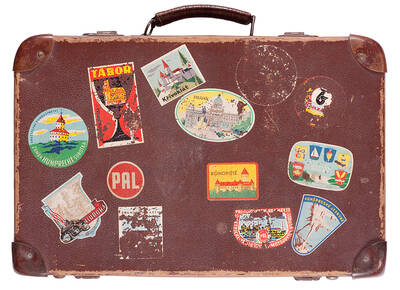
Travel fever is back, and it’s contagious. After years of being kept home during the COVID-19 pandemic, people are once again eager to explore the world. Rather than just book any trip, travelers are getting smarter about how they scratch that travel itch. Microcation Defined as four days or fewer and over 160km away from home, the microcation perfectly matches the post-pandemic mindset. After long periods of remaining indoors, people are making up for lost time by taking short, frequent getaways throughout the year. These brief trips avoid the work-life imbalance that comes with long absences. With only a few days away, one’s
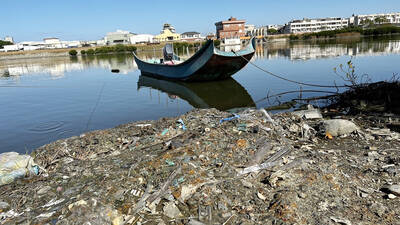
Many consumers are guilty of filling drawers or closets with old laptops, cellphones, fitness trackers and other electronic devices once they are no longer needed. It’s hard to know where to recycle such items, or it seems costly and inconvenient to do so. The world generates millions of tons of electronic waste — also called e-waste — each year. According to the UN’s most recent estimate, people worldwide produced 62 million metric tons of e-waste in 2022, and only about 22 percent of it was properly recycled. The US’ Environmental Protection Agency estimates that less than a quarter of e-waste is

Dos & Don’ts — 想想看,這句話英語該怎麼說? 1. 我們很早到達電影院。 ˇ We arrived at the theater very early. χ We arrived the theater very early. 註︰arrive 為不及物動詞,後面如果有受詞要用 at 或 in。例如:They arrived in Taipei yesterday.。一般大地方,如國家、省、大城市等前面用 in,凡小地方城鎮、學校等則用 at。 2. 開車半小時以後,我們到達了海灘。 ˇ After half an hour’s drive, we got to the beach. χ After half an hour’s drive, we got the beach. 註︰come, go, get(來、去、到達)某地時,在表示地點的名詞前面應該用 to,如 go to school, go to Taipei, come to Shanghai 等。如果這些動詞後面所跟的是 here, there, home 等副詞,則不用 to。 3. 明天我會回辦公室。 ˇ I will be back in the office tomorrow. χ I will be back to office tomorrow. 註︰to be back 一語裡的 back 是副詞,不是介詞,所以後面要用 at (the market) 或 in (the office)。 假如假期結束,要回學校上課了則可說: ? Kids will be back


 RSS
RSS