


The phrase bird-brain may be used to describe someone being silly, but this is not the case for ravens. Long admired for their intelligence, ravens are now known to be able to plan ahead, a skill previously thought to belong only to humans and great apes, said a study last Thursday.
Researchers put the birds through a series of tests and learned that ravens could remember key information for a future task, said the report in the journal Science.
Until now, some corvids — the family of birds that includes ravens — have shown the ability to plan beyond the present, for example by hiding food for later.

Photo: AP
照片:美聯社
But the latest experiments revealed that ravens can wisely forego an immediate reward in order to get a better one in the future.
In one of the tests, ravens were trained to use a tool to open a puzzle box in order to access a reward. And then, the ravens were presented with a tool to open a box along and an immediate reward, but were only allowed to choose one or the other. Ravens remembered that the reward in the box was better than the immediate reward, and almost all of them chose the tool, showing “a level of self-control in the birds similar to that seen in apes,” said the report.
Ravens’ motivation for planning is still unknown, but it may be similar to ours.
“The human brain stores memories of past events to guide decision-making about current and future events,” wrote psychologists Markus Boeckle and Nicola Clayton of the University of Cambridge.
Planning tends to come about when the higher value of a future reward is palpable, or when one imagines the happiness that will come by retrieving food in the future, they wrote.
“For ravens just as for humans, memories are thus more for the future than for the past.”
(AFP)
英文片語「鳥腦」是用來形容人愚蠢無腦,但對渡鴉(其種類包括烏鴉)這種鳥類來說絕非如此。渡鴉的聰明一向令人讚嘆,上週四發表的一項研究發現,渡鴉能夠計劃未來、未雨綢繆,過去認為只有人類及類人猿才具有這種能力。
《科學》期刊所登出的報告說,研究人員透過一系列測試,了解到渡鴉可以記住與未來執行任務有關的關鍵信息。
在此研究前,科學家已知, 包括渡鴉在內的某些鴉科鳥類能夠計畫未來,例如先把食物藏起來,等到以後再吃。但最新的實驗顯示,渡鴉可以明智地放棄立即的回報,以便將來獲得更好的回報。
在其中一項實驗中,研究人員先訓練渡鴉使用工具打開一個機關盒,以獲得獎賞回報。接著,再把一個開盒工具,和一個立即獎賞同時放在牠面前,但只允許牠選擇其中一個。渡鴉記得,盒子裡的獎賞比眼前這個獎賞要好,所以幾乎都選擇了開盒工具,顯示出「鳥類有和猿類相似的自制能力」。
渡鴉安排計畫的動機仍不得而知,但可能與我們人類相似。
劍橋大學心理學家馬可斯‧布克和妮可拉‧克萊頓在這篇報告中寫道:「人類大腦儲存過去事件的記憶,以做為當前及未來事項之決策指南。」
他們說,在未來的回報顯然有較高的價值,或想像到將來取回食物的快樂時,人比較會去做出一些規劃。
「跟人類一樣,對於渡鴉而言,記憶的目的比較是為了將來,而不是為了過去。」
*本文為編輯後的版本,原文已於法新社刊登。*
(台北時報編譯林俐凱譯)
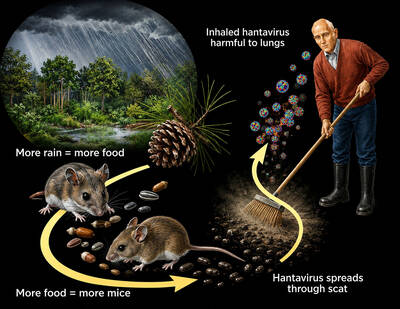
An outbreak aboard a cruise ship of a rare rodent-borne illness called hantavirus has left three passengers dead and sickened others, but global health officials say the risk to the general public remains low because the germ does not easily spread between people. “This is not the next COVID, but it is a serious infectious disease,” said Maria Van Kerkhove, director of epidemic and pandemic preparedness at the World Health Organization (WHO). “Most people will never be exposed to this.” The virus usually spreads when people inhale contaminated residue of rodent droppings. Hantaviruses have been around for centuries and are thought to

Have you ever wondered how people navigate the world when they can’t see a map? For individuals with visual impairments, conventional maps are nearly impossible to use. This is where tactile maps come in — essential tools that allow people to “see” the world through touch. A tactile map is specially designed with raised lines, textures, and symbols to represent geographical features such as roads, rivers, and buildings. Users explore it with their fingertips. However, these maps are not exclusively for people with visual disabilities. They serve as valuable multisensory learning tools that enhance spatial understanding for everyone, making

A: In early May, there were concerts by Icyball, Chyi Yu, Korea’s EXO and Japan’s Anisama, but I missed them all. What a shame. B: That’s OK. There are shows coming up by various artists, including Power Station, Accusefive, Japanese singer Mika Nakashima, Chinese-Icelandic jazzer Laufey, and even Singaporean diva Stefanie Sun. A: After a 12-year hiatus, Stefanie is finally returning to Taipei again. B: In late May, there will be more shows by Crowd Lu, WeiBird, Korea’s Donghae, 2AM, EXID, and Thailand’s BUS. A: The Thai boyband is so popular. It looks like “T-pop” is catching up with J-pop

Since 2005, the third Monday in January has come to be known as “Blue Monday.” In other words, that day is believed to be the most depressing day of the year. This concept seems logical at first. After all, Monday marks the start of the school or workweek after two days of rest and fun. Also, blue is a color that is often associated with sadness. Furthermore, in many parts of the world, January is a time when the weather is cold, rainy, and gloomy. But is there any scientific proof that this January day is truly sadder than any of


 RSS
RSS