


With only 92 days to go before the opening ceremony of the 2017 Taipei Universiade, the Taipei City government on May 17 worked some magic in the National Taiwan Sport University multipurpose gymnasium, having transformed the gymnasium ordinarily used for competitive ball sports into a swimming pool.
Before, when holding major sports tournaments, most host nations would build a new venue. Here, Taipei has spent NT$178 million making a “movable” swimming pool in the gymnasium, and this will be made available to Taoyuan after the Universiade ends.
The swimming pool was made out of 150 high caliber galvanized steel plates covered in a waterproof PVC coating and secured with steel cables. After the pool is filled with water, the size can be changed so it meets international competition standards. The assembly took 60 days to complete, and has passed Federation Internationale de Natation (FINA, International Swimming Federation) and Federation Internationale du Sport Universitaire (FISU, International University Sports Federation) authentication.(Liberty Times, translated by Paul Cooper)
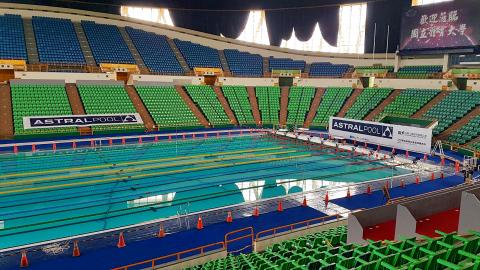
Photo: Yu Jui-jen, Liberty Times
照片:自由時報記者余瑞仁
距離二○一七年台北世大運開幕剩下九十二天,台北市政府五月十七日在國立體育大學綜合體育館變魔術,將平時進行球類競技的體育館變成了游泳池。
過去,為了舉辦大型運動賽事,主辦國大多興建新場館,這回台北花一億七千八百萬元在國體大體育館放上「活動式游泳池」,等世大運落幕後將轉交桃園地方使用。
這座泳池由一百五十片高品質鍍鋅鋼板搭配PVC防水布,由鋼索固定而成,且在注水後,還能進行尺寸微調,以達國際競賽標準。歷經六十天的組裝,總算大功告成,也通過國際游泳總會及國際大學運動總會認證。(自由時報)

You might think knitting is only for grandmas, but surprisingly, many young people are embracing so-called “grandma hobbies.” On social media platforms, activities such as home cooking, embroidery and gardening are becoming popular among teenagers and young adults who are drawn to their relaxing and creative nature. “Grandma hobbies” typically refer to activities that are slow-paced, handmade and nostalgic. Common examples include knitting scarves, baking cookies, sewing clothes and growing plants. These hobbies were once part of everyday life for many women in previous generations, but today they provide an escape from the fast-paced digital world. The appeal

A: Isn’t the 2026 Coachella Valley Music and Arts Festival — a massive music event held every April — about to open in California? B: Yeah the festival is set to take place over two weekends, from April 10 to 12 and 17 to 19, US time. A: I heard this year’s main stage headliners include Sabrina Carpenter, Justin Bieber, Karol G and EDM DJ Anyma. B: The K-pop army is also making an appearance, with legendary group BigBang, SHINee member Taemin and girl group Katseye debuting for the first time. A: Isn’t Coachella also live-streamed on its YouTube

★ Bilingual Story is a fictionalized account. 雙語故事部分內容純屬虛構。 Lucas was already on the ground before he fully understood what was happening. “Hurry! Kneel down!” someone shouted. The asphalt was warm against his knees. Around him, dozens of people lay flat in the narrow street outside Jenn Lann Temple in Dajia. Some pressed their hands together in prayer. Others closed their eyes. Lucas had only come to look at the temple. An hour earlier he had stepped into the noisy courtyard out of curiosity. Inside the main hall, people held incense sticks, bowed three times,

A: Several Japanese and South Korean acts, such as BigBang, are participating in this year’s Coachella Music Festival. Have any Mando-pop singers ever performed at Coachella? B: Yup, K-pop group GOT7’s Hong Kong member Jackson Wang, and Taiwanese band Sunset Rollercoaster, which primarily performs in English, attended the festival before. A: It’s a pity that we didn’t fly to Coachella. But in fact, Taipei has also gradually become an Asian music hub in recent years. B: That’s true. K-pop sensation Twice just held three concerts at the Taipei Dome, followed by Hong Kong singer G.E.M., who is going


 RSS
RSS