


Ooho, an environmental-friendly and entirely edible water container, is expected to hit the market in one year’s time. It is hoped that the product will be able to reduce the environmental impact of PET bottles by replacing them.
The water container was invented in 2014 by Rodrigo Garcia Gonzalez, Pierre Paslier and Guillaume Couche when they were still university students. The material, made from seaweed extract, is edible and can be used to carry all types of beverage including water, juice and soft drinks.
The entire container is biodegradable. For those who do not want to eat the container, they can tear a hole in the container and drink from it, and it only takes the discarded container from four-to-six weeks to biodegrade.
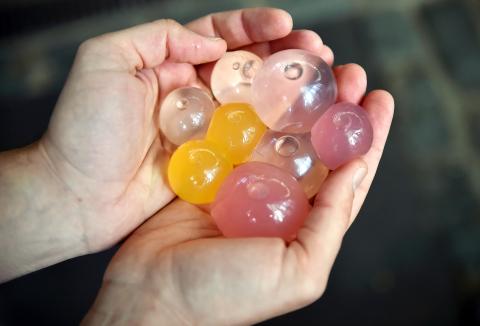
Photo: Reuters
照片:路透社
In order to promote the product, the research team has set up a lab in London called Skipping Rocks, where they are now working on improving the material and technology and are applying for patents.
The lab recently began an online investment round and attracted nearly 450 investors in just a few days, successfully reaching its initial goal of raising 400,000 pounds (NT$ 15,600,000).
Although the price of Ooho is yet to be announced, it is expected to be relatively low, since the production cost is very cheap and even lower than plastic.

Photo: Reuters
照片:路透社
(CNA, translated by Tu Yu-an)
可食用的環保水球Ooho,可望在一年內上市,並可取代寶特瓶,減輕環境負擔。
這種水球在二○一四年由三名大學生龔薩雷茲、帕斯里耶、庫契研發,材質是可食用的海藻萃取物,裡頭可填裝各類飲料,包括水、果汁、汽水等。
由於整顆水球可生物分解。使用者如果不想吃外包裝,可以撕開一個小洞喝水,剩下的包裝僅需要四到六星期就可自然分解。
為了推動產品上市,研發團隊在倫敦成立Skipping Rocks實驗室,近一步研究改進水球材質及製作技術,並申請專利。
實驗室前陣子上網募資,短短幾天內就吸引近四百五十人投資,成功達到四十萬英鎊(約新台幣一千五百六十萬元)的初步募資目標。
雖然水球的上市價格尚未公布,但因製作成本相當低廉,比塑膠還要低,預料最後定價不會太高。
(中央社)

The US-Israeli war with Iran, which began on Feb. 28, has killed thousands of people, destabilized the Middle East and rocked global energy markets by effectively closing the strait. WHAT IS THE STRAIT OF HORMUZ? Lying between Oman and Iran and linking the Gulf north of it with the Gulf of Oman to the south and the Arabian Sea beyond, the strait is 33km wide at its narrowest point, with a shipping lane just 3km wide in either direction. Perhaps the world’s most important energy shipping channel, the waterway is about 167km long. Following through on an old threat, Tehran effectively closed the strait

Have you ever found yourself desperately feeding coins into a claw machine just because you’ve already spent so much trying to win that stuffed animal? Or maybe you’ve continued watching a boring movie simply because you already paid for the ticket? If so, you’ve experienced the “sunk cost fallacy.” A sunk cost refers to time, money or effort that has already been spent and cannot be recovered. This psychological trap is surprisingly common. You might keep playing a video game you no longer enjoy because you’ve invested countless hours in building your character, or maintain a toxic friendship because you’ve known

A: Which TV drama series have been global hits so far this year? B: The US drama “Stranger Things 5,” South Korean drama “Can This Love Be Translated?” and Chinese megahit “Pursuit of Jade” are all popular lately. A: Isn’t “Pursuit of Jade” the costume idol drama about the romance between a charming marquis and a pig-slaughterer? Actor Zhang Linghe and actress Tian Xiwei are both so attractive. B: Plus, Netflix’s Korean-Japanese gay romance drama “Soul Mate” — starring Korea’s Ok Taec-yeon and Japan’s Hayato Isomura — is set to premiere in May. A: These hit international dramas

1. 他甚至還自認為是個了不起的領導人。 ˇ He even went so far as to think himself a great leader. ˇ He even went so far as to think of himself as a great leader. χ He even went so far as to think himself as a great leader. 註:認為某人或某事為何等樣人或何等樣事,可用 think+受詞+受詞補語,或 think of ... as ...,正句第一句比第二句普遍些。用了 of,後面用 as;沒有 of,就不可以用 as。又如: I thought him quite a joke. I thought of him as quite a joke. 2. 你不應該打擾他休息。 ˇ You should not intrude upon him during his time off. χ You should not intrude him during his time off. 註:intrude 作「闖進」、「打擾」、「侵入」解時,是不及物動詞,後面跟 upon。 3. 男孩正在玩陀螺。 ˇ The boy is playing with his top. χ


 RSS
RSS