


Many years ago, when I still had the time to do such things, I would get up early and make my way over to the nearby parks. I would arrive at around 7am.
Even at that early hour, there used to be (and for all I know, still are) a lot of people, generally middle-aged or older, doing their early morning exercises, dance routines, karaoke, stretches or jogging.
I would be looking for scenes that struck me as quirky. I used to see a lot of people hugging tree trunks. I had no idea why they did that. I heard it was a way to absorb the energy, chi, rising through the tree at the start of the day.
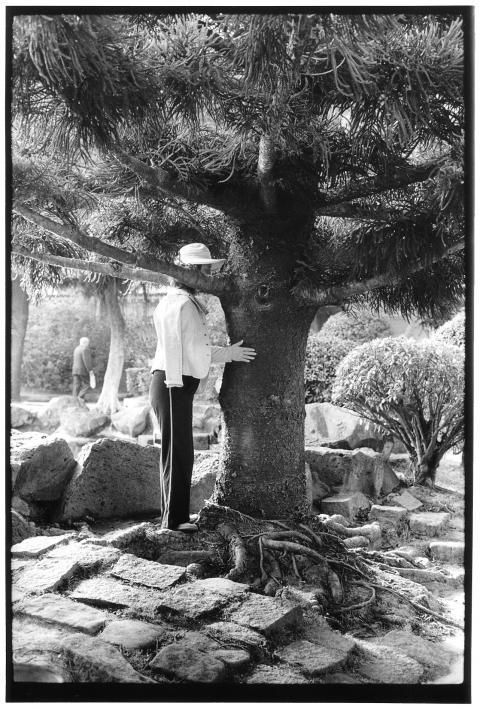
Photo: Paul Cooper, Taipei Times
照片:台北時報記者古德謙攝
I liked the posture of the woman in the first photo. Her face mostly obscured by the lowest branch, her arms are bent 90 degrees at the elbow, the sleeves of her jacket hanging flush to her sides. I stood there for several minutes. She didn’t move the whole time.
The man in the foreground of the second photo was practicing Tai Chi; the man in the background had just been resting in the branches. The first man is the trunk, his arms the lower limbs, the tree twining up and to the left from his extended arm, the second man stepping down onto it.
The third photo is simpler. The woman’s posture mirrors that of the trees surrounding her, and she appears as rooted in the ground as they are.
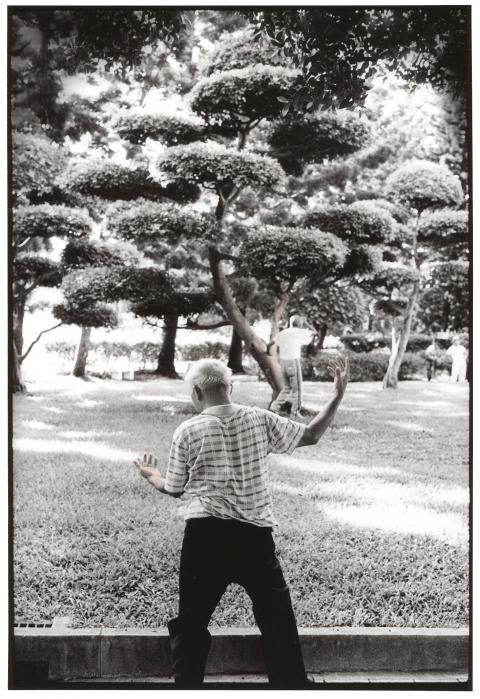
Photo: Paul Cooper, Taipei Times
照片:台北時報記者古德謙攝
(Paul Cooper, Taipei Times)
多年前,當我還有這閒功夫的時候,我會起個大早到附近的公園去,大約早上七點就到了。
即便是清晨,公園裡人已經很多了,多為中老年人,在做運動、跳舞、唱卡拉OK、做伸展操或是慢跑。
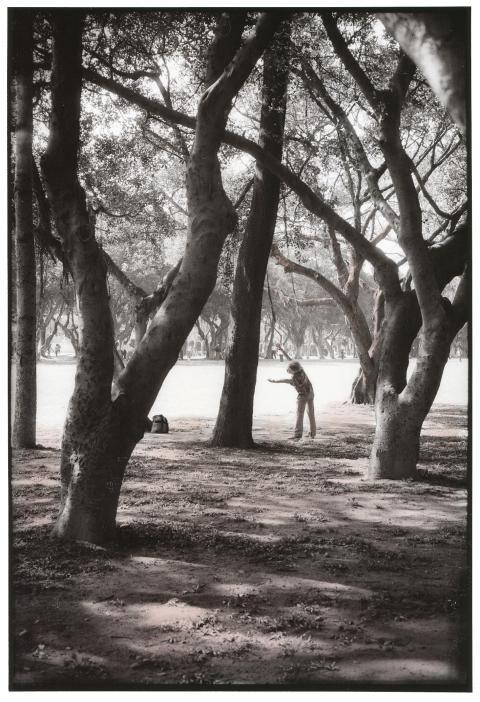
Photo: Paul Cooper, Taipei Times
照片:台北時報記者古德謙攝
我會特別注意到一些看來古怪的景象。以前常看到很多人抱著樹幹,我不曉得這是為什麼,聽說這樣可以從樹木吸收一天之始的能量。
我喜歡第一張照片中那婦女的姿勢。她的臉龐大部分被樹枝遮住了,她的手臂由手肘彎曲成九十度,她外套的袖子貼齊身體下垂。我在那裡待了好幾分鐘,她卻是動都沒動過。
第二張照片前景中的人正在打太極拳,背景中的稍早靠著樹休息。前景的人像是樹幹,他的手臂如樹下枝椏,而後方的樹由其伸展出的手往上向左延伸,而遠景那個人就像是踩著這樹枝跨下來。
第三張照片就簡單些。照片中的女子模仿她周圍樹木的姿態,她看來也像是樹一般根植於土地上。
(台北時報編譯林俐凱譯)
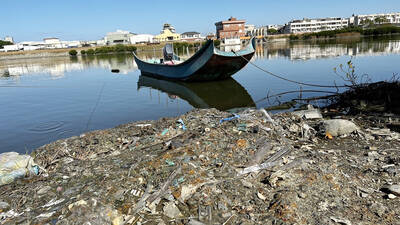
Many consumers are guilty of filling drawers or closets with old laptops, cellphones, fitness trackers and other electronic devices once they are no longer needed. It’s hard to know where to recycle such items, or it seems costly and inconvenient to do so. The world generates millions of tons of electronic waste — also called e-waste — each year. According to the UN’s most recent estimate, people worldwide produced 62 million metric tons of e-waste in 2022, and only about 22 percent of it was properly recycled. The US’ Environmental Protection Agency estimates that less than a quarter of e-waste is
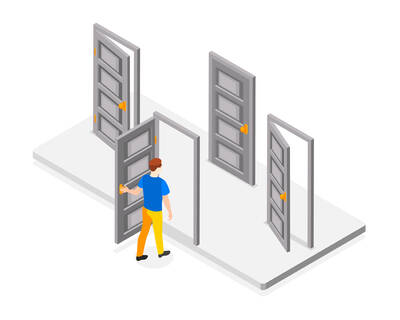
You’re sitting in class when a classmate asks to borrow a pencil. It seems like a small favor, so you agree without hesitation. The following week, the same classmate asks to share your notes. Later, they request help with a group project. You agree each time — after all, you helped out the first time — but before you know it, it has become automatic. This scenario demonstrates the “foot-in-the-door technique,” a psychological concept that shows how agreeing to small, acceptable demands makes it easier to accept larger ones later on. The name for this strategy comes from door-to-door

A: The four-day Tomb Sweeping Day long weekend begins Friday and will run until Monday. Are you going to sweep your ancestors’ tombs? B: I did in advance last weekend, so I can go to Kaohsiung to see the musical “The Phantom of the Opera.” A: Wow, is “Phantom” touring Taiwan again? It debuted in 1986, so this year marks the 40th anniversary of the show. B: And it’s not just touring Kaohsiung starting March 31, but also Taipei starting April 21 and Taichung starting May 26. A: “Phantom” is one of the world’s Four Major Musicals. I’ve seen all of them, except “Les

對話 Dialogue 清清:這禮拜又有連假了,這次一共放四天。 Qīngqing: Zhè lǐbài yòu yǒu liánjià le, zhè cì yígòng fàng sì tiān. 華華:你是要過兒童節還是清明節? Huáhua: Nǐ shì yào guò Értóng jié háishì Qīngmíng jié? 清清:都要過啊!不管幾歲,都要有童心,才能永遠都年輕,知道嗎? Qīngqing: Dōu yào guò a! Bùguǎn jǐ suì, dōu yào yǒu tóngxīn, cái néng yǒngyuǎn dōu niánqīng, zhīdào ma? 華華:好啦!能當個長不大的孩子也好,就不會有那麼多煩惱了。 Huáhua: Hǎo la! Néng dāng ge zhǎngbúdà de háizi yě hǎo, jiù bú huì yǒu nàme duō fánnǎo le. 清清:還好春天有這兩個節假日,常常可以變成連假休息一下。 Qīngqing: Háihǎo chūntiān yǒu zhè liǎng ge jiéjiàrì, chángcháng kěyǐ biànchéng liánjià xiūxi yíxià. 華華:對啊!上禮拜我已經先跟家人去掃墓了,就怕清明節當天人太多。 Huáhua: Duì a! Shàng lǐbài wǒ yǐjīng xiān gēn jiārén qù sǎomù le, jiù pà Qīngmíng jié dāngtiān rén tài duō. 清清:親人雖然過世了,但有清明節掃墓的習俗,讓我們在不同的世界還是能「聚」一下、說說話,真的很有意義。 Qīngqing: Qīnrén suīrán guòshì le, dàn yǒu Qīngmíng jié


 RSS
RSS