


Reclusive, gentle and quick to roll up into a ball, pangolins keep a low profile. But they are also the world’s most heavily trafficked mammal, and experts have been ringing alarm bells over their survival.
More than a million pangolins are believed to have been poached from the wild in the past decade. Most are used to supply demand in China, where pangolin scales are believed to cure conditions from headaches and menstrual cramps to nose bleeding and lack of virility.
There are four species of pangolin in Africa and another four in Asia. Watchdogs say those in Asia are being eaten to extinction, while populations in Africa are declining fast.
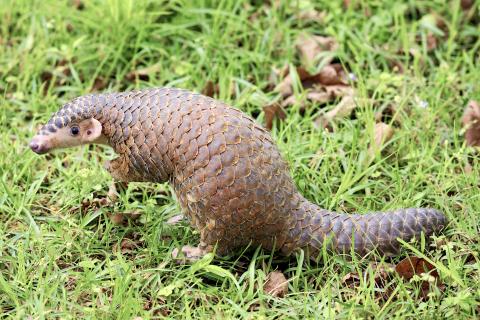
Photo courtesy of Taipei Zoo
照片:台北市動物園提供
In Taiwan, the Formosan pangolin, a subspecies native to the island, has been greatly reduced due to loss of habitat and poaching, despite being listed as a protected species under the Wildlife Conservation Act since 1990. Experts warn that, if the situation does not improve, the Formosan pangolin may become extinct in ten years.
(AFP, additional reporting by Tu Yu-an)
穿山甲生性溫和,隱密低調,遇到危險即捲成球狀。然而,牠們卻是全球走私問題最嚴重的哺乳動物,為此,學者專家一再提出警告。
據了解,過去十年有超過一百萬隻野生穿山甲遭到盜獵,大部分流入中國,因其鱗片據說可以治療頭痛、經痛、流鼻血、甚至壯陽。
全球共有八種穿山甲,非洲及亞洲各有四種。保育團體指出,亞洲的穿山甲已經快被吃光,而非洲的穿山甲也急遽減少。
台灣穿山甲為本土特有亞種,雖自一九九○起列入野生動物保護法下的保育類動物,數量仍因盜獵及棲地減少而遽降。專家警告,若情況未見改善,台灣穿山甲可能會在十年內絕種。
(台北時報涂宇安編譯)
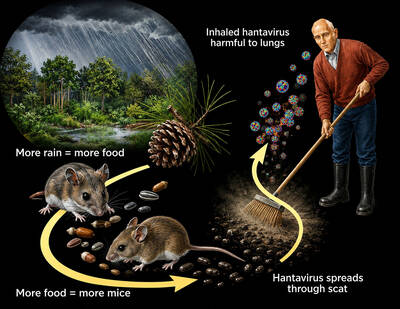
An outbreak aboard a cruise ship of a rare rodent-borne illness called hantavirus has left three passengers dead and sickened others, but global health officials say the risk to the general public remains low because the germ does not easily spread between people. “This is not the next COVID, but it is a serious infectious disease,” said Maria Van Kerkhove, director of epidemic and pandemic preparedness at the World Health Organization (WHO). “Most people will never be exposed to this.” The virus usually spreads when people inhale contaminated residue of rodent droppings. Hantaviruses have been around for centuries and are thought to

Have you ever wondered how people navigate the world when they can’t see a map? For individuals with visual impairments, conventional maps are nearly impossible to use. This is where tactile maps come in — essential tools that allow people to “see” the world through touch. A tactile map is specially designed with raised lines, textures, and symbols to represent geographical features such as roads, rivers, and buildings. Users explore it with their fingertips. However, these maps are not exclusively for people with visual disabilities. They serve as valuable multisensory learning tools that enhance spatial understanding for everyone, making

A: In early May, there were concerts by Icyball, Chyi Yu, Korea’s EXO and Japan’s Anisama, but I missed them all. What a shame. B: That’s OK. There are shows coming up by various artists, including Power Station, Accusefive, Japanese singer Mika Nakashima, Chinese-Icelandic jazzer Laufey, and even Singaporean diva Stefanie Sun. A: After a 12-year hiatus, Stefanie is finally returning to Taipei again. B: In late May, there will be more shows by Crowd Lu, WeiBird, Korea’s Donghae, 2AM, EXID, and Thailand’s BUS. A: The Thai boyband is so popular. It looks like “T-pop” is catching up with J-pop

Since 2005, the third Monday in January has come to be known as “Blue Monday.” In other words, that day is believed to be the most depressing day of the year. This concept seems logical at first. After all, Monday marks the start of the school or workweek after two days of rest and fun. Also, blue is a color that is often associated with sadness. Furthermore, in many parts of the world, January is a time when the weather is cold, rainy, and gloomy. But is there any scientific proof that this January day is truly sadder than any of


 RSS
RSS