


In the Year of the Monkey, we should talk about monkeys, but we must start by talking about people. It is often said that monkeys are the ancestors of humans, but the fact is that we only share a common ancestor with monkeys.
Su Hsiu-hui, a professor in National Pingtung University of Science and Technology’s Institute of Wildlife Conservation, says there are approximately 260 kinds of primates in the world, including apes, baboons and monkeys. Humans are close to gibbons, which are apes. The Monkey King of Journey to the West also resembles an ape. Monkeys are just one genus of primate. Many people think that monkeys are ancestors of us humans, but that is in fact wrong: what can be said is that humans and monkeys are both primates and that they share a common ancestor, but humans have not evolved from monkeys.
Within the monkey genus, there are 22 kinds of macaque, such as the Formosan macaque. The Formosan macaque, which appeared in Taiwan 170,000 years ago and is the only one that is unique to Taiwan, mainly lives in forests. Some can also be found in Japan, probably taken there by people who later abandoned them, or perhaps they escaped. They then bred in the wild, either among themselves or by mating with Japanese macaques.
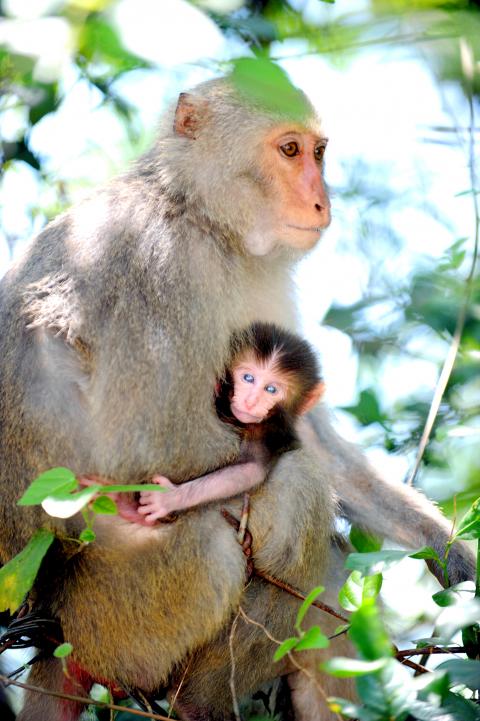
Photo: Chang Chung-i, Liberty Times
照片:自由時報記者張忠義
The species closest to Formosan Macaques are the Japanese macaque and the Rhesus macaque or Rhesus monkey — studies show that the Formosan macaque may have developed from Rhesus macaques that came to Taiwan via Yunnan in China during the Ice Age and then developed into a unique Taiwanese species — and the crab-eating macaque. They can mainly be differentiated by the length of the tail: looking at body length from the top of the head to the end of the tail. The tail of the Formosan macaque makes up about 70 percent to 90 percent, while it makes up about 50 percent of the length on the Rhesus macaque. The crab-eating macaque has the longest tail and the Japanese macaque the shortest, between five and 10cm.
When it comes to body shape, it is quite diverse among primates. The world’s biggest is probably the gorilla — the main character in the film King Kong — which can weigh over 200kg. The smallest known monkey is probably the South American Pygmy Marmoset, whose adults are only 10 to 18cm tall, smaller than a human finger, and weigh less than 100g.
Primates probably also have the most diverse living habits of all animals. Gorillas, for example, can live alone, while the Formosan macaque forms groups of 20 to 30. Gelada baboons, which are found only in the Ethiopian highlands, sometimes live together in big families of more than 800, which is similar to the size of a human village.
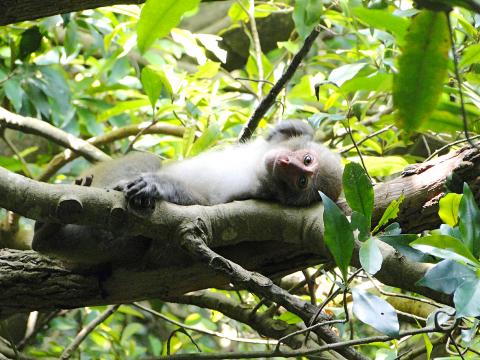
Photo: Huang Po-lang, Liberty Times
照片:自由時報記者黃博郎
(Liberty Times, translated by Perry Svensson)
猴年談猴,但要先從人類說起。傳說人類的祖先是猴子,其實只是跟猴子有同一祖先。
屏東科大野生動物保育研究所教授蘇秀慧指出,全世界靈長類動物大概有二百六十多種,包括猿、狒狒、猴等。跟人類較接近的是長臂猿,是屬於猿的一種,西遊記的的美猴王,也比較像是猿猴,至於俗稱的猴子,只是其中一屬;一般人總以為人類祖先是猴子,其實是一種錯誤說法,只能說人類與猴子同是靈長類而有共同祖先,但人類不是從猴子變來的。
猴子屬中,全世界約有二十二種獼猴,例如台灣獼猴即是早自十七萬年前就已出現在台灣的特有原生種、也是唯一一種,主要生長在台灣的森林。目前在日本也可看到一些,應是人類帶過去後棄置或脫逃,在日本野外繁殖或跟日本獼猴雜交。
跟台灣獼猴較接近的猴屬,有日本獼猴、恆河猴(據研究台灣獼猴可能就是恆河猴在冰河時期穿過中國雲南,到台灣演變而成台灣特有種)、馬來猴等,主要可從尾長分辨不同,若從頭頂到尾端算成體長,台灣獼猴的尾巴長度約佔百分之七十至百分之九十,恆河猴則約百分之五十,馬來猴尾巴最長,日本獼猴則最短,尾巴約只有五至十公分。
而論體型,靈長類的種類相當多元,在全世界,體型最大的,可能就是電影金剛中的大猩猩,重則可達兩百多公斤。而目前所知最小的猴子,應是中南美洲的一種侏儒狨猴,成年猴體長僅約十至十八釐米, 比一根手指還小,體重大多不到一百公克。
靈長類的生活習性大概也是動物中最多元的,例如大猩猩可以一隻一隻的獨居獨行,台灣獼猴則大概是二十至三十隻會形成群體,而在伊索匹亞的高山狒狒,則可有八百多隻共同生活的大家族,幾乎等於人類的村落、鄉鎮群居。
(自由時報記者黃以敬)

Many consumers are guilty of filling drawers or closets with old laptops, cellphones, fitness trackers and other electronic devices once they are no longer needed. It’s hard to know where to recycle such items, or it seems costly and inconvenient to do so. The world generates millions of tons of electronic waste — also called e-waste — each year. According to the UN’s most recent estimate, people worldwide produced 62 million metric tons of e-waste in 2022, and only about 22 percent of it was properly recycled. The US’ Environmental Protection Agency estimates that less than a quarter of e-waste is
Travel fever is back, and it’s contagious. After years of being kept home during the COVID-19 pandemic, people are once again eager to explore the world. Rather than just book any trip, travelers are getting smarter about how they scratch that travel itch. Microcation Defined as four days or fewer and over 160km away from home, the microcation perfectly matches the post-pandemic mindset. After long periods of remaining indoors, people are making up for lost time by taking short, frequent getaways throughout the year. These brief trips avoid the work-life imbalance that comes with long absences. With only a few days away, one’s

You’re sitting in class when a classmate asks to borrow a pencil. It seems like a small favor, so you agree without hesitation. The following week, the same classmate asks to share your notes. Later, they request help with a group project. You agree each time — after all, you helped out the first time — but before you know it, it has become automatic. This scenario demonstrates the “foot-in-the-door technique,” a psychological concept that shows how agreeing to small, acceptable demands makes it easier to accept larger ones later on. The name for this strategy comes from door-to-door

Continued from yesterday(延續自昨日) https://www.taipeitimes.com/News/lang Gig Tripping “Gig tripping” combines concerts with travel. People fly to see their favorite artists perform — usually abroad—and spend a few days sightseeing before or after the show. While die-hard fans have done this since the 1960s, the post-pandemic travel boom changed the game. Even people who aren’t superfans are now booking international concert trips because they want to make the most of travel opportunities. This trend exploded in the US, as the math makes sense. Domestic concert tickets are so costly that flying abroad for the show plus tourism expenses often matches or even beats the price


 RSS
RSS