


Chirping sparrows are a constant headache for farmers, who fear more than anything that the birds will pilfer their rice paddy and millet farm harvests. The Taitung District Agricultural Research and Extension Station has come up with a “solar-powered dummy bird repellent.” Experimental farmland using the repellent had a 30 percent higher harvest rate than the average farm. Other advantages include protecting the environment by saving energy and economizing on labor.
Tseng Hsiang-en, an assistant researcher at the station, says that Taitung County has the greatest amount of farmland devoted to the cultivation of millet in all of Taiwan. Millet is also a special traditional crop among Aborigines, Tseng says. During the month before harvest, however, millet is often picked at by birds, Tseng says, adding that if no preventative measures are taken as much as 95 percent of the harvest can be lost.
Conventional farmers can only hire workers to physically drive away the birds, which Tseng says can cost up to NT$39,000 for each worker per hectare during a single harvest. Tseng says it is excruciating labor because each worker must stand under the sun for at least eight hours every day. Hopefully the new device will help lessen the burden for farmers, Tseng says. In three consecutive experimental millet harvests, the station discovered that preventative measures during the spring harvest for Asian rice were highly effective, Tseng says, adding that rice farms using the repellent had a 30 percent greater harvest than farms using only humans to drive away birds.
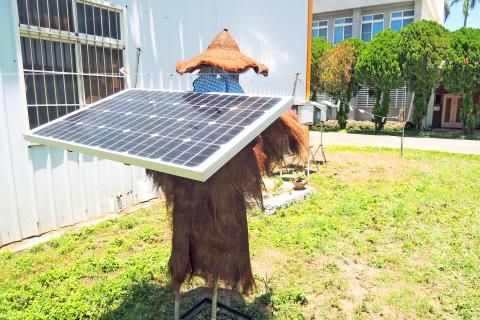
Photo: Chang Tsun-wei, Liberty Times
照片:自由時報記者張存薇
The bird repellent uses a solar-powered panel as its power source and stores power in an accumulator, allowing the device to run autonomously in the field. As soon as the first rays of sunlight hit at dawn, the circuit board detects even the slightest bit of power being generated in the solar-powered panel, and immediately flips a switch to start up a DC motor to power the scarecrow’s mechanized arms. A conducting wire is wrapped around the ends of the arms, which pulls on a noisemaker that makes sounds to imitate the way a human would try to scare off birds. At dusk the electricity switches off and the devices stops running.
In the event of unremitting cloudy or rainy conditions, Tseng says that, if the solar-powered panel does not produce enough electricity, an internal battery system provides a continuous power source. A utility model patent was acquired for the technology, which has been transferred to manufacturers, Tseng says.
(Liberty Times, Translated by Kyle Jeffcoat)
吱吱喳喳的麻雀總是讓農民傷透腦筋,水稻田、小米田最怕麻雀「搶收」。台東區農業改良場研發「太陽能人型驅鳥器」,試驗田收成率比一般田多三成,又有環保節能、省人力的優點。
台東農改場助理研究員曾祥恩說明,台東是台灣小米種植面積最大的縣份,小米更是原住民部落傳統特色作物,可是小米在收穫前一個月極易遭鳥類啄食,如果完全不防制,損失率高達九成五。
他說,傳統農民只能雇工以人力驅趕,但換算一公頃雇工每期成本高達新台幣三萬九千元,且一天至少要在太陽下工作八小時以上,實在很辛苦,所以研發這組設備,希望減輕農民負擔。連續三期稻作試驗中,也可發現水稻春作防制效果佳,採用太陽能人型驅鳥器的稻田,比人工驅鳥的稻田收成率多三成。
「太陽能人型驅鳥器」是以太陽能板發電,並可將電能儲存於電瓶,使機器在田間獨立自主運作。早上天色開始轉亮時,電路板可偵測太陽能板的微量發電,立刻啟動開關、以直流馬達驅動機械手臂,而手臂端綁上導線、可以拉動遠處的響片發出聲響,模擬人工驅鳥方式,黃昏後即停止發電及運作。
曾祥恩說,若遇連續陰雨,太陽能板發電量若不足,可透過內建電池系統持續供應電力,這項技術已獲新型專利保護,並將技術移轉給廠商。
(自由時報記者張存薇)
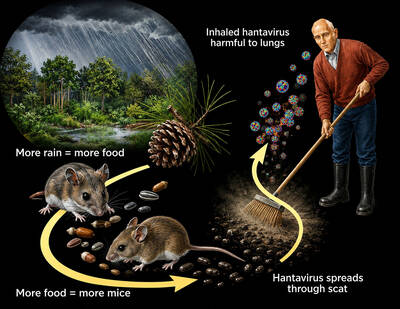
An outbreak aboard a cruise ship of a rare rodent-borne illness called hantavirus has left three passengers dead and sickened others, but global health officials say the risk to the general public remains low because the germ does not easily spread between people. “This is not the next COVID, but it is a serious infectious disease,” said Maria Van Kerkhove, director of epidemic and pandemic preparedness at the World Health Organization (WHO). “Most people will never be exposed to this.” The virus usually spreads when people inhale contaminated residue of rodent droppings. Hantaviruses have been around for centuries and are thought to
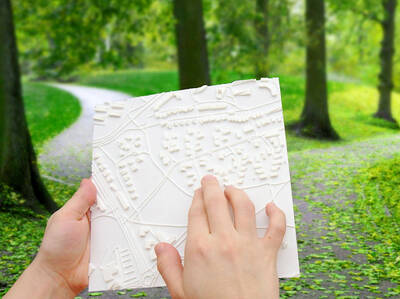
Have you ever wondered how people navigate the world when they can’t see a map? For individuals with visual impairments, conventional maps are nearly impossible to use. This is where tactile maps come in — essential tools that allow people to “see” the world through touch. A tactile map is specially designed with raised lines, textures, and symbols to represent geographical features such as roads, rivers, and buildings. Users explore it with their fingertips. However, these maps are not exclusively for people with visual disabilities. They serve as valuable multisensory learning tools that enhance spatial understanding for everyone, making

1. 他病了三天。 ˇ He has been sick for three days. χ He has been sick since three days. 註︰這裡現在完成時態 have / has been 表示從過去某一時日到現在的一段時間存在的行為或狀態,與它連用的時間副詞應為 「for +若干時」,如 for a year, for three hours 等,意思是歷時多少。 2. 他自從星期三以來都很忙。 ˇ He has been busy since Wednesday. χ He has been busy from Wednesday. 註︰「自從……以來」,該用 since。說從某一天(某一時刻)到某一天(某一時刻)才用 from,如 from Monday till Friday。 3. 房間角落裡散放著一些零星物件。 ˇ There were some odds and ends lying in the corner of the room. χ There were some odds and ends lying at the corner of the room. 註︰「在房間角落裡」該用介詞 in。例如: He stood in the corner. There is a lamp in the corner of the room. at the corner 指房子外部的拐角。例如: A little boy

A: In early May, there were concerts by Icyball, Chyi Yu, Korea’s EXO and Japan’s Anisama, but I missed them all. What a shame. B: That’s OK. There are shows coming up by various artists, including Power Station, Accusefive, Japanese singer Mika Nakashima, Chinese-Icelandic jazzer Laufey, and even Singaporean diva Stefanie Sun. A: After a 12-year hiatus, Stefanie is finally returning to Taipei again. B: In late May, there will be more shows by Crowd Lu, WeiBird, Korea’s Donghae, 2AM, EXID, and Thailand’s BUS. A: The Thai boyband is so popular. It looks like “T-pop” is catching up with J-pop


 RSS
RSS