


When French film actress Brigitte Bardot began a campaign to spare the thousands of stray dogs in Romania’s capital from being put down, she did it with a US$150,000 donation scheme.
A similar campaign is being waged by Ana-Maria Ciulcu, a 13-year-old schoolgirl with braces on her teeth who uses Facebook to appeal to dog lovers all over Europe — and to make sure the dogs go to the right homes.
Ciulcu was a baby when Bardot started her sterilization campaign in 2001. Now she speaks fluent German and has a grasp of the Internet, and she has used both to rescue 150 strays and ship them to Germany, Austria and Belgium since September last year.
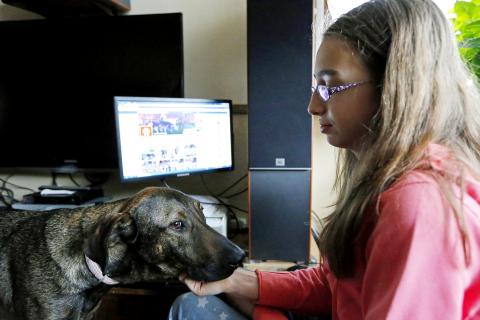
Photo: Reuters
照片:路透社
Bucharest’s state-funded wards, however, now hold 2,800 dogs, and 2,000 dogs have been euthanized in the past two months, according to Romania’s Authority for Animal Surveillance and Protection. About 60,000 strays roam Bucharest.
Ciulcu collects strays on the street. They go to a temporary private shelter, or to the backyard of her home. She has a veterinarian vaccinate them and give them microchip identification tags and eventually gets international passports for them.
All costs, from medicines, vaccines and neutering to identification chips and passports, are covered by Ana-Maria’s family — about 150 euros (US$209) per dog. Transporting the animals to their destinations is covered by the new owner.
(Reuters)

Photo: Reuters
照片:路透社
當法國女影星碧姬.芭杜展開一場讓羅馬尼亞首都數以千計的流浪狗免遭撲殺的運動時,她的經費來自於一項十五萬美元的捐款計畫。
安娜─瑪莉亞‧丘爾庫正進行類似的行動,這位戴著牙套的十三歲女學生利用臉書,求助於全歐洲的愛狗人士,並確定狗狗被送到適當的家庭。
當芭杜於二零零一年展開她的流浪狗絕育行動時,丘爾庫還是個嬰兒。現在她說得一口流利的德語,並熟諳網路,她利用這兩項優勢從去年九月起,搭救了一百五十隻流浪狗,將牠們送到德國、奧地利與比利時收養。

Photo: Reuters
照片:路透社
然而,據羅馬尼亞動物監控與保護管理局統計,布加勒斯特的國營收容所現在有兩千八百隻流浪狗,而過去兩個月有兩千隻被安樂死。約有六萬隻狗在布加勒斯特流浪。
丘爾庫接走街上的流浪狗。牠們被安置在臨時的私人收容所,或她家後院。她讓一名獸醫師給牠們打疫苗,植入識別晶片,最後為牠們取得國際護照。
所有的費用,從醫療、疫苗、結紮到識別晶片與護照,皆由安娜–瑪莉亞的家人支付—每隻狗約一百五十歐元(兩百零九美元)。運送這些動物到目的地的費用則由新飼主負擔。
(路透/翻譯:魏國金)
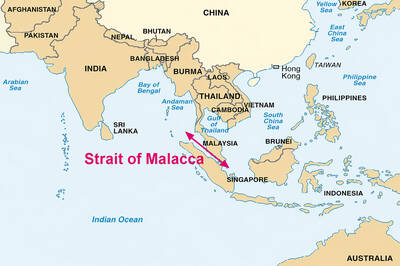
The closure of the Strait of Hormuz has forced policymakers in Asia to face questions over the security of other maritime chokepoints, including the Strait of Malacca, which is the world’s busiest waterway for international trade. WHAT IS THE MALACCA STRAIT? The 900km long Malacca Strait, bounded by Indonesia, Thailand, Malaysia and Singapore, provides the shortest sea route from East Asia to the Middle East and Europe. It carries nearly 22 percent of the world’s maritime trade, according to the Center for Strategic and International Studies (CSIS). This includes oil and gas shipments from the Middle East to the energy-hungry economies of China,

One reason pistachios have taken the food world by storm compared to other nuts is their soft, green color. When ground down into a cream or butter, the green hue __6__ nicely with golden pastries or dark-brown chocolate, making it perfect for Instagram photos and TikTok videos. Their labor-intensive cultivation and __7__ also contribute to their image as a premium ingredient. Thus, buying a pistachio-based product often feels like a __8__ treat. Pistachios also stand out for their distinct flavor and health __9__. They have a subtle, sweet, earthy flavor that goes well with both sweet desserts and

Cameras are everywhere — in our pockets, on our walls and even in space. They capture emotions, preserve history and reflect culture. Through these devices, photography is now essential to modern life, influencing how we perceive ourselves and the world. To understand the root of their power, let’s explore the camera’s remarkable journey. The story begins with the camera obscura, a dark room with a tiny hole. Light passing through the opening projected an inverted image on the opposite wall. Renaissance artists used this principle to paint accurate scenes. However, these images couldn’t be preserved as photographs. That changed

A: This year’s two most anticipated films have finally hit theaters in Taiwan. “Michael” premiered last Wednesday, while “The Devil Wears Prada 2” premiered this Wednesday ahead of its global release. B: Isn’t “Michael” the biopic about the late King of Pop Michael Jackson? A: Yup, it tells the story of Michael’s legendary life, from child star to global icon. And the role is in fact played by his nephew, Jaafar Jackson. B: Michael caused a sensation when touring Taiwan twice in 1993 and 1996. His classic hits, dance moves and music videos reshaped global pop culture at that time. A: I’m gonna


 RSS
RSS