


Over a thousand honeybees forming an elliptical shape as they gather on a cherry tree instead of staying in a beehive was something that farm owner Tsai Cheng-ming had never seen in the several decades that he has lived on Jinjhen Mountain in Taitung County’s Taimali Township. After observing the bees for nearly two hours, the following day when he went back the bees were nowhere to be found. Tsai Nu-jen, head of Taitung District Agricultural Research and Extension Station’s Department of Crop Environment, says that this is a natural swarming phenomenon among China’s wild honeybees, typically occurring in the spring. It means that the local ecological environment is doing well, he says.
Tsai Cheng-ming, owner of Chingshan Farm on Jinjhen Mountain, says that on the morning of Feb. 23 when he was cleaning up his farm he came across a ball-shaped object on a tree by the side of the road. After walking closer to it, he discovered that it was a swarm of over a thousand bees. The “ball of bees” was squirming around on the 3m-tall cherry tree, approximately 1.5 from the ground, Tsai says, adding that the elliptical shape was about 20cm in diameter.
Tsai Nu-jen says that this particular swarm of honeybees from China was in the middle of swarming. Once a group of honeybees grows large and strong enough, it produces a new queen, he says, adding that the old queen leaves the colony and takes a swarm of bees with her, which gathers on a tree until the swarm is complete. Then it prepares to move to a suitable location to make a new colony, while the old colony is left to the new queen bee. The phenomenon of swarming is most commonly seen in the spring, particularly among wild Chinese honeybees. The so-called ball of bees is only a temporary gathering — a natural phenomenon that should not alarm people. Swarming means that a group of honeybees is gradually getting stronger. Seeing a group of bees swarming in the wild is good news, especially in recent years with increasing numbers of bee colonies disappearing.
(Liberty Times, Translated by Kyle Jeffcoat)
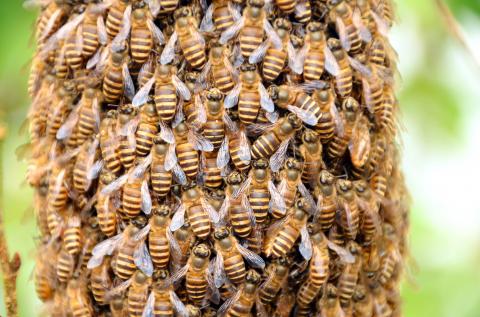
Photo: Wang Hsiu-ting, Liberty Times
照片:自由時報記者王秀亭
上千隻蜜蜂沒在蜂窩裡,卻是聚集在櫻花樹上,形成一團橢圓形蜂球,台東太麻里鄉農園主人蔡政銘說,在金針山生活三、四十年,首見這種情形,觀察了將近兩小時,隔日再看已不見蹤影,台東農業改良場作物環境課長蔡恕仁表示,這是中國野蜂分巢的自然現象,多發生在春天,顯示當地自然生態良好。
金針山青山農園主人蔡政銘表示,二月廿三日上午整理園裡環境時,發現路邊的櫻花樹上有一團球狀物體,走近一看竟是上千隻蜜蜂聚集在一起,「蜂球」附著三公尺高的櫻花樹上蠕動著,離地約一點五公尺,是個長約二十公分的橢圓形球體。
蔡恕仁表示,此一蜂群是中國野蜂正在分巢,每當蜜蜂族群壯大到一定程度,產生新的蜂后時,舊蜂后即會帶走一群蜜蜂,到樹上集結,待集結完成,便準備到下一個適合做巢地點,準備做下一個巢,舊巢就留給新的蜂后;分巢現象常見於春天,特別是中國野蜂,樹上的蜂球只是短暫集結,為一自然現象,民眾不必太過恐慌,分巢顯示蜂群逐漸壯大,特別是近年來蜂群消失時有所聞,野外蜂群有分巢是個好消息。
(自由時報記者王秀亭)
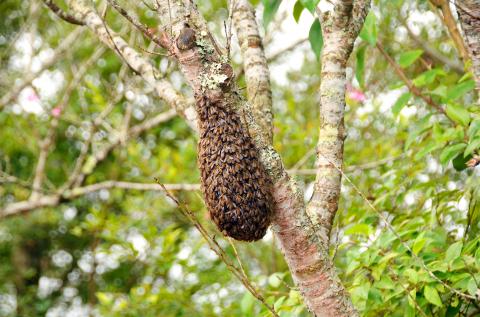
Photo: Wang Hsiu-ting, Liberty Times
照片:自由時報記者王秀亭
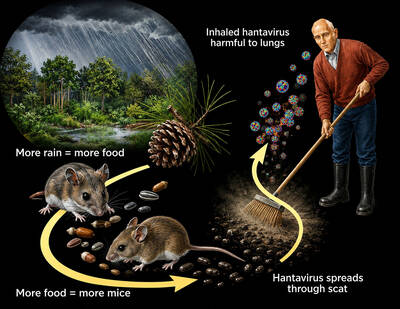
An outbreak aboard a cruise ship of a rare rodent-borne illness called hantavirus has left three passengers dead and sickened others, but global health officials say the risk to the general public remains low because the germ does not easily spread between people. “This is not the next COVID, but it is a serious infectious disease,” said Maria Van Kerkhove, director of epidemic and pandemic preparedness at the World Health Organization (WHO). “Most people will never be exposed to this.” The virus usually spreads when people inhale contaminated residue of rodent droppings. Hantaviruses have been around for centuries and are thought to

Have you ever wondered how people navigate the world when they can’t see a map? For individuals with visual impairments, conventional maps are nearly impossible to use. This is where tactile maps come in — essential tools that allow people to “see” the world through touch. A tactile map is specially designed with raised lines, textures, and symbols to represent geographical features such as roads, rivers, and buildings. Users explore it with their fingertips. However, these maps are not exclusively for people with visual disabilities. They serve as valuable multisensory learning tools that enhance spatial understanding for everyone, making

1. 他病了三天。 ˇ He has been sick for three days. χ He has been sick since three days. 註︰這裡現在完成時態 have / has been 表示從過去某一時日到現在的一段時間存在的行為或狀態,與它連用的時間副詞應為 「for +若干時」,如 for a year, for three hours 等,意思是歷時多少。 2. 他自從星期三以來都很忙。 ˇ He has been busy since Wednesday. χ He has been busy from Wednesday. 註︰「自從……以來」,該用 since。說從某一天(某一時刻)到某一天(某一時刻)才用 from,如 from Monday till Friday。 3. 房間角落裡散放著一些零星物件。 ˇ There were some odds and ends lying in the corner of the room. χ There were some odds and ends lying at the corner of the room. 註︰「在房間角落裡」該用介詞 in。例如: He stood in the corner. There is a lamp in the corner of the room. at the corner 指房子外部的拐角。例如: A little boy

A: In early May, there were concerts by Icyball, Chyi Yu, Korea’s EXO and Japan’s Anisama, but I missed them all. What a shame. B: That’s OK. There are shows coming up by various artists, including Power Station, Accusefive, Japanese singer Mika Nakashima, Chinese-Icelandic jazzer Laufey, and even Singaporean diva Stefanie Sun. A: After a 12-year hiatus, Stefanie is finally returning to Taipei again. B: In late May, there will be more shows by Crowd Lu, WeiBird, Korea’s Donghae, 2AM, EXID, and Thailand’s BUS. A: The Thai boyband is so popular. It looks like “T-pop” is catching up with J-pop


 RSS
RSS