


Looking dazed and sunburned, US endurance swimmer Diana Nyad walked ashore on Sept. 2, becoming the first person to swim from Cuba to Florida without the help of a shark cage.
The 64-year-old Nyad swam up to the beach just before 2pm EDT, about 53 hours after starting her journey from Havana. As she approached, spectators waded into waist-high water and surrounded her, taking pictures and cheering her on.
Nyad’s previous try was cut short amid boat trouble, storms, unfavorable currents and jellyfish stings that left her face puffy and swollen.
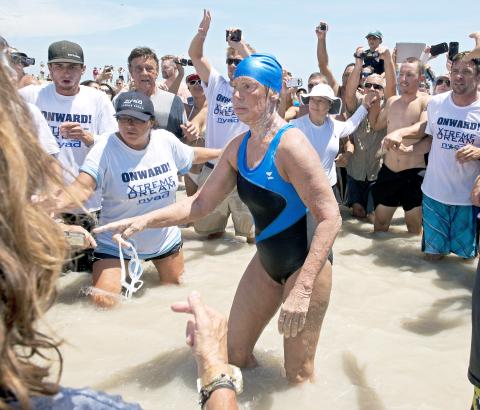
Photo: EPA
照片:歐新社
President Barack Obama was among a flurry of public officials and celebrities who tweeted congratulations. The president’s tweet read, “Never give up on your dreams.”
Although she had some swelling of the lips, tongue and the airway near the mouth, Nyad would not need a long recovery, the doctor said, calling her stable and “very healthy.”
Nyad first garnered national attention in 1975 when she swam the 45km around the island of Manhattan in just under eight hours. In 1979 she swam the 164km from North Bimini, Bahamas, to Juno Beach, Florida, in 27.5 hours.(Liberty Times)
看起來頭暈目眩、嚴重曬傷,美國耐力長泳健將黛安娜.奈雅德九月二日走上岸,成為史上未使用防鯊籠從古巴游到佛羅里達的第一人。
六十四歲的奈雅德在美國東部夏令時間下午兩點抵達目的地,離其從哈瓦那啟程已經過了五十三個小時。當她靠岸時,在岸上等待的觀眾跳進及腰的水裡圍著她拍照、為她歡呼。
奈雅德之前的嘗試因為遇上船故障、暴風雨、亂流,還有水母把她的臉叮腫了而失敗。
政府官員和名人紛紛推文祝賀,包括歐巴馬總統。歐巴馬推文說:「永遠別放棄你的夢想」。
醫生說,即使奈雅德的雙唇、舌頭與氣管有點腫脹,但不需多久時間即可復元,說她情況穩定且「非常健康」。
奈雅德在一九七五年首次獲得全國關注,當時她以不到八小時環繞曼哈頓島游了四十五公里。一九七九年,她費時二十七點五小時游了一百六十四公里,從巴哈馬北比米尼島游到佛羅里達州棕櫚灘。(自由時報/翻譯:詹立群)

Taiwan Travelogue, the novel by Taiwanese author Yang Shuang-zi and translated into English by Lin King, won the prestigious International Booker Prize in London on May 19. It marks the first time a Taiwanese literary work has received the International Booker Prize, setting a historic milestone both for Taiwanese literature and for the award itself. Prior to this achievement, Taiwan had only once appeared on the Booker radar, when Taiwanese author Wu Ming-yi was longlisted for the Booker Prize in 2018 with The Stolen Bicycle. The International Booker Prize honors works of fiction translated into English and published in the UK or Ireland.

A: While Taiwan is celebrating the 7th anniversary of legalizing same-sex marriage, a poll shows that the support rate for same-sex marriage rose sharply from 37.4 percent seven years ago to 69.9 percent last year. B: Actually, I’m a bit curious about the size of Taiwan’s LGBT population. A: I’m not sure. But if we take a Gallup poll in the US as an example, 9.3 percent of American adults identified as LGBT in 2024. B: Wow, is it because the Americans are relatively open? In many other countries, the figures hover around 5 percent. A: Based on this,
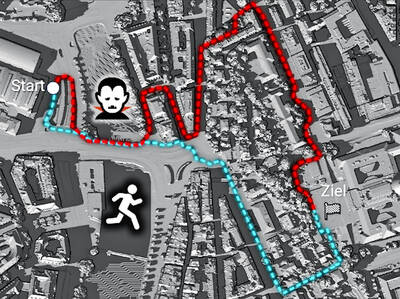
As climate change and urbanization push city temperatures higher, walking outdoors is becoming increasingly uncomfortable in many parts of the world, especially when prolonged time spent in sunlight is involved. As a result, outdoor lovers are now seeking cooler, shaded walking routes. However, most mainstream map apps still do not __1__ shaded footpaths. Enter routing.osm.ch — a Swiss web-based route planner that introduces a novel solution to this problem. Its “Vampire mode,” named after the legendary creatures’ fear of being __2__ natural light, was developed by a Swiss research team led by Professor Stefan Keller. The platform combines open data from

Cities around the world are testing “robotaxis,” hoping that autonomous vehicles will ease traffic and reduce emissions. However, recent analyses suggest these expectations may be overly optimistic. According to consulting firm Kearney, robotaxis could actually make congestion worse rather than better. Because self-driving rides are expected to be cheaper and more convenient than traditional taxis, more people may choose them over walking, biking, or using public transportation. This shift would put more cars on already crowded roads. Another concern is “deadheading,” which refers to robotaxis traveling without passengers between rides. Since autonomous fleets need to reposition themselves throughout the day, these


 RSS
RSS