


The Taiwan Railway Administration’s (TRA) Taipei Railway Workshop, a maintenance depot situated along Civic Boulevard Sec. 5 close to Xinyi District near the Living Mall, will start the second phase of relocating after the Lunar New Year and is expected to be entirely evacuated by the end of the year. Comprised of 17 hectares, the Taipei City Government and TRA have already reached a preliminary consensus that part of the facilities will be designated as a city historical site, which in the future will be open to the public.
During a visit to the depot on Monday, Taipei Mayor Hau Lung-bin announced that the depot’s assembly factory, metalworking factory and engine room would all be included as part of the historical site. The city government will be communicating with the TRA to work out the exact plans for the depot, but in the short term they will be organizing a “Railway Cultural Festival.”
With approximately 16.8 hectares, the Taipei Railway Workshop was always the TRA’s largest and most important maintenance depot. The depot’s architecture is quite diverse and is representative of the railway industry of the Japanese colonial era.
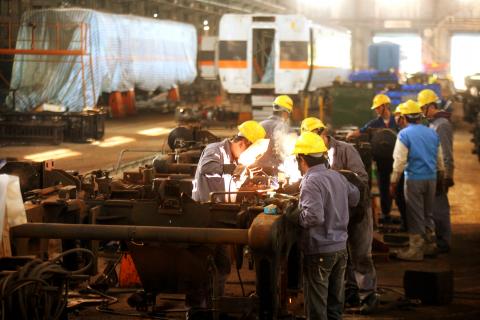
Photo: Liu Jung, Liberty Times
照片:自由時報記者劉榮
Used as a maintenance depot for trains, the Taipei Railway Workshop was originally built in 1933 during the Japanese colonial era, next to the city’s Northern Gate, but moved to its current location along Civic Boulevard in 1935 due to lack of space.
When the Taipei Government’s Cultural Heritage Evaluation Committee held a public hearing in August last year after plans to move the maintenance factory to Fugang in Taoyuan County were approved, a large group of railway aficionados voiced a desire to preserve the depot, but the TRA workers’ union said that with a budget deficit of NT$1.2 billion (US$41,436,466) it would significantly benefit the sustainable operation of the TRA if parts of the depot were used for urban renewal projects.
Taipei’s Department of Cultural Affairs says that apart from the assembly factory, engine room and metalworking factory, the depot also has an employee bathhouse, which was designated as a historical site in 2000. Hau says that since the four buildings have all been designated historical sites, future plans will treat them as cultural assets, and after the maintenance depot has been completely moved, a “Railway Cultural Festival” will be held as early as this summer, allowing the public to get to know this part of history.
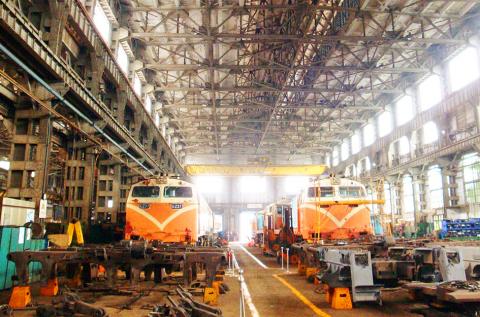
Photo: Liu Jung, Liberty Times
照片:自由時報記者劉榮
(Liberty Times, Translated by Kyle Jeffcoat)
位在市民大道五段緊鄰信義計畫區及京華城的台鐵台北機廠,農曆年後進行第二階段遷廠,可望在年底前功成身退,用地近十七公頃的台北機廠,北市府與台鐵已達成初步共識,將部分設施指定為「市定古蹟」,園區未來也將活化,開放給一般民眾參觀。
台北市長郝龍斌週一參訪台北機廠後宣布,「台北機廠」內的「組立工場」、「鍛冶工場」及「原動室」等,將指定為市定古蹟,台北機廠未來如何規劃,會再與台鐵局溝通,短期也會規劃先舉辦「鐵道文化節」。
台北機廠過去一直都是台鐵局最大的維修廠,佔地約十六點八六公頃,為鐵路局重要的維修廠,廠內的建築樣式多樣,屬於日治時期鐵道產業代表。
台北機廠創建於日治時期一九三三年,為車輛維修及改裝工廠,前身是位於北門旁的清代機器局台北工廠,一九三五年因基地不敷使用,才遷移到市民大道現址。
遷廠到桃園富岡的計畫敲定後,北市文資委員會去年八月召開公聽會時,大批鐵道迷大聲疾呼保留該基地,但台鐵工會也曾主張,台鐵目前赤字高達一千兩百億元,有限度將台鐵機廠進行都更,將有助於台鐵永續經營。
台北市文化局表示,除了「組立工場」、「原動室」、「鍛冶工場」外,台北機廠內的大澡堂,早在二000年就已指定為市定古蹟,郝龍斌說,台北機廠四棟建築被指定為市定古蹟之後,未來會朝文化資產方向規劃,而機廠遷移之後,也會在短期之內,最快在暑假先舉辦「鐵道文化節」,讓大家知道過去的歷史。
(自由時報記者劉榮)

Taiwan Travelogue, the novel by Taiwanese author Yang Shuang-zi and translated into English by Lin King, won the prestigious International Booker Prize in London on May 19. It marks the first time a Taiwanese literary work has received the International Booker Prize, setting a historic milestone both for Taiwanese literature and for the award itself. Prior to this achievement, Taiwan had only once appeared on the Booker radar, when Taiwanese author Wu Ming-yi was longlisted for the Booker Prize in 2018 with The Stolen Bicycle. The International Booker Prize honors works of fiction translated into English and published in the UK or Ireland.
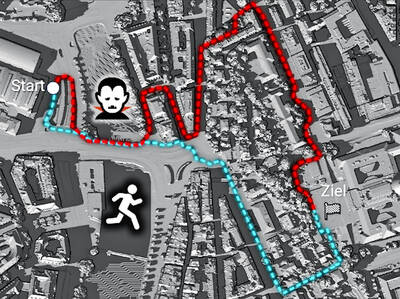
As climate change and urbanization push city temperatures higher, walking outdoors is becoming increasingly uncomfortable in many parts of the world, especially when prolonged time spent in sunlight is involved. As a result, outdoor lovers are now seeking cooler, shaded walking routes. However, most mainstream map apps still do not __1__ shaded footpaths. Enter routing.osm.ch — a Swiss web-based route planner that introduces a novel solution to this problem. Its “Vampire mode,” named after the legendary creatures’ fear of being __2__ natural light, was developed by a Swiss research team led by Professor Stefan Keller. The platform combines open data from

Cities around the world are testing “robotaxis,” hoping that autonomous vehicles will ease traffic and reduce emissions. However, recent analyses suggest these expectations may be overly optimistic. According to consulting firm Kearney, robotaxis could actually make congestion worse rather than better. Because self-driving rides are expected to be cheaper and more convenient than traditional taxis, more people may choose them over walking, biking, or using public transportation. This shift would put more cars on already crowded roads. Another concern is “deadheading,” which refers to robotaxis traveling without passengers between rides. Since autonomous fleets need to reposition themselves throughout the day, these

1. 該協會於全球九十個國家擁有逾一百萬名會員。 ˇ The association consists of over 1 million members in 90 countries. χ The association consists in over 1 million members in 90 countries. 註:consist of 是「由……組成」,而consist in是「在於」、「就是」,比較下列句子: Our department consists of three sections. Success consists in perseverance. Happiness consists in doing one’s duty. 2. 我們的任何錯誤將來都可能帶來麻煩。 ˇ Any mistakes on our part now may lead to problems later on. χ Any mistakes on our part now may lead into problems later on. 註:說「導致」、「引起」用lead to,如to lead to trouble,to lead to disaster,to lead to problems,to lead to something unpleasant等。表示「向某物內部的動向」可用into,如go into a room,to come into a building,to get into trouble等。 3. 這本書是E.M.福斯特的作品,不是喬治.歐威爾。 ˇ This book was written by E. M. Foster, not


 RSS
RSS