


The Chinese have been eating lingzhi, or reishi, mushrooms as medicine for two millennia. However, the most commonly eaten type, known in Chinese as chizhi or red lingzhi, has for a long time mistakenly been considered by people around the world to be the same species as the European glossy ganoderma, whose Latin name is Ganoderma lucidum. After researchers collected some wild red lingzhi from an oak forest near Wuhan in China’s Hubei Province, collaborating researchers in Taiwan and China discovered that red lingzhi was actually a new fungus species that had never been recorded. Accordingly, they have officially named it Ganoderma lingzhi. Their findings have been published in Fungal Diversity, the top international journal of mycology.
Wu Sheng-hua, head of the research project and a fungus expert with the National Museum of Natural Science, says that lingzhi mushrooms belong to the ganoderma genus of the polypore family. Wu says that the annual net output value of lingzhi mushrooms is estimated to be as high as NT$100 billion (US$ 3.34 billion) globally. There are currently more than 100 known species of lingzhi mushrooms, with each species containing somewhat different substances with different effects, so more research needs to be done on them, he says.
(Liberty Times, Translated by Kyle Jeffcoat)
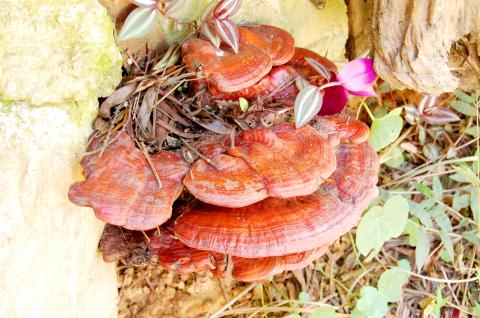
Photo: Huang Mei-chu, Liberty Times
照片:自由時報記者黃美珠
靈芝在華人用於養生已兩千年歷史,然而,最常食用的「赤芝」,長期被國際誤認為和歐洲的「亮蓋靈芝」同種,且都以「ganoderma lucidum」做為拉丁學名。經過學者前往湖北武漢附近的櫟樹林採集野生赤芝,兩岸合作研究發現「赤芝」竟然是尚未被記錄的新種真菌,因此正式定名為 「ganoderma lingzhi(靈芝的漢語發音)」,研究成果將刊登在國際真菌學術期刊排名第一的《Fungal Diversity》。
負責這項研究的國立自然科學博物館研究員吳聲華說,靈芝為多孔菌的靈芝科,估計每年全球產值高達新台幣一千億元,已知有一百多種不同的靈芝,不同種類靈芝的成份和功效都不盡相同,有待進一步分析。
(自由時報記者胡清暉)
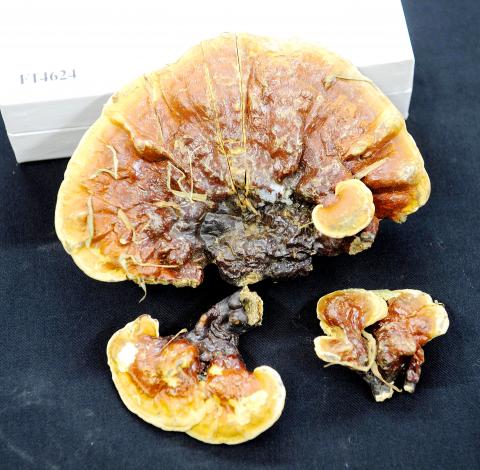
Photo: George Tsorng, Liberty Times
照片:自由時報記者叢昌瑾
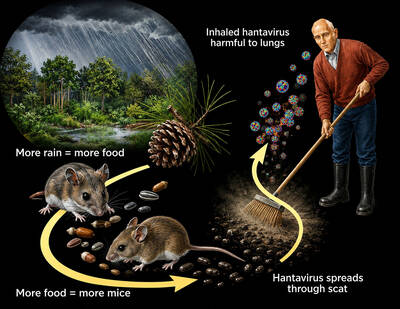
An outbreak aboard a cruise ship of a rare rodent-borne illness called hantavirus has left three passengers dead and sickened others, but global health officials say the risk to the general public remains low because the germ does not easily spread between people. “This is not the next COVID, but it is a serious infectious disease,” said Maria Van Kerkhove, director of epidemic and pandemic preparedness at the World Health Organization (WHO). “Most people will never be exposed to this.” The virus usually spreads when people inhale contaminated residue of rodent droppings. Hantaviruses have been around for centuries and are thought to

Have you ever wondered how people navigate the world when they can’t see a map? For individuals with visual impairments, conventional maps are nearly impossible to use. This is where tactile maps come in — essential tools that allow people to “see” the world through touch. A tactile map is specially designed with raised lines, textures, and symbols to represent geographical features such as roads, rivers, and buildings. Users explore it with their fingertips. However, these maps are not exclusively for people with visual disabilities. They serve as valuable multisensory learning tools that enhance spatial understanding for everyone, making

A: In early May, there were concerts by Icyball, Chyi Yu, Korea’s EXO and Japan’s Anisama, but I missed them all. What a shame. B: That’s OK. There are shows coming up by various artists, including Power Station, Accusefive, Japanese singer Mika Nakashima, Chinese-Icelandic jazzer Laufey, and even Singaporean diva Stefanie Sun. A: After a 12-year hiatus, Stefanie is finally returning to Taipei again. B: In late May, there will be more shows by Crowd Lu, WeiBird, Korea’s Donghae, 2AM, EXID, and Thailand’s BUS. A: The Thai boyband is so popular. It looks like “T-pop” is catching up with J-pop

Since 2005, the third Monday in January has come to be known as “Blue Monday.” In other words, that day is believed to be the most depressing day of the year. This concept seems logical at first. After all, Monday marks the start of the school or workweek after two days of rest and fun. Also, blue is a color that is often associated with sadness. Furthermore, in many parts of the world, January is a time when the weather is cold, rainy, and gloomy. But is there any scientific proof that this January day is truly sadder than any of


 RSS
RSS