


The National Theater and Concert Hall’s (NTCH) “Wikipedia of Performing Arts: a hundred year history” Web site (wiki.ntch.edu.tw) was officially launched last Thursday. Anyone who has information about performing arts in Taiwan is welcome to edit the page and contribute what they know. Like Wikipedia, the front page of the Web site is organized in entries, including ones, updated daily, of “this day in history,” “breaking news,” and “today’s featured photo.” There are also “latest updates” and “today’s performances” to give netizens an idea of what is going on in different towns in Taiwan.
After more than a year of conceiving, planning, collecting information, and constructing the Web site, the site incorporates historical documents from the NTCH collection, accumulated over the past 25 years, as well as information from the Performing Arts Almanac, the Performing Arts Record, and the NTCH ticketing Web site, all of which will serve as the initial basis of the Web site. Now that the site has been launched, the NTCH is open to individuals or groups to collaborate and edit the site together. The Performing Arts Review (PAR), a magazine run by the National Chiang Kai-shek Cultural Center, has also invited performing arts troupes in Taiwan to help with the editing of the historical material, and for each group to add details about its own history, including biographical information about its artists.
“Wikipedia of Performing Arts: a hundred year history” covers a broad range of topics. Given the Wikidepia model, it is hoped that the new site will develop as a major platform integrating and classifying important documents from the past century of the performing arts in Taiwan. However, as anyone is allowed to edit the Web site, and these unreviewed changes are updated automatically, the biggest concern is over the accuracy of the information. Therefore, the NTCH has to quickly set up a mechanism for reviewing at regular intervals to improve the Web site’s reliability.
(LIN YA-TI, TAIPEI TIMES)
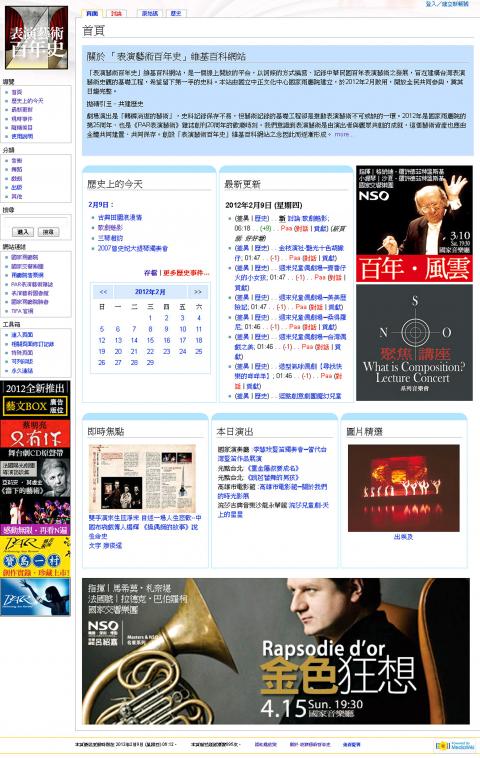
Photo courtesy of the Performing Arts Review (PAR)
照片由《PAR表演藝術》雜誌社提供
國家兩廳院創設的台灣「表演藝術百年史」維基百科網站(wiki.ntch.edu.tw),在上週四正式啟用。只要任何人有表演藝術相關資料,皆歡迎參與「表演藝術百年史」的編修,貢獻一己之力。網站首頁也和維基百科一樣,以詞條的方式編寫,並且每日更新「歷史上的今天」、「即時焦點」、「圖片精選」等,另外還有「最新更新」與「本日演出」,讓網民掌握台灣各地的藝文動態。
在近一年多的構思、策畫、資料彙整,與網站架構後,兩廳院運用其所累積二十五年數萬筆史料典藏,並根據《表演藝術年鑑》、《表演藝術實錄》及兩廳院售票網的資料等,提供網站初期的基本內容。開站後隨即開放個人與團體集思廣益、合力編修網站。隸屬於國立中正文化中心的《PAR表演藝術》雜誌,也邀請國內各表演團隊,一同加入史料編修行列,整合各團隊自成立至今的資料及藝術家生平。
「表演藝術百年史」維基百科網站涵蓋範圍甚廣,借助維基百科模式,希望能逐步整合分類,成為台灣表演藝術珍貴資料的主要平台。然而,正因為任何人都有權利編修且網站內容未經編審即自動更新,所以資料的正確性是最大的疑慮。因此,兩廳院還得盡快建立一套定期審查機制,以增加網站的可信度。
(台北時報記者林亞蒂)

Photo: Lin Ya-ti, Taipei Times
照片:台北時報林亞蒂

A: Popular humorous Japanese manga series “Chibi Maruko-chan” and “Crayon Shin-chan” will collaborate for their respective 40th and 35th anniversaries, publishing three crossover stories in April. B: Both were made into TV animation series, becoming huge hits in Asia. What are the crossover stories about? A: The first story features Shin-chan and his family visiting Maruko-chan’s hometown, Shizuoka City, where they run into each other. B: Wow, that sounds interesting. And then? A: The follow-ups feature Maruko-chan and her family visiting Shin-chan’s hometown, Kasukabe City. I bet the interactions between the two families will be funny. A: 熱門日本漫畫《櫻桃小丸子》、《蠟筆小新》4月將合作,為紀念小丸子40週年與小新35週年,推出三篇跨界聯動漫畫! B:

Travel fever is back, and it’s contagious. After years of being kept home during the COVID-19 pandemic, people are once again eager to explore the world. Rather than just book any trip, travelers are getting smarter about how they scratch that travel itch. Microcation Defined as four days or fewer and over 160km away from home, the microcation perfectly matches the post-pandemic mindset. After long periods of remaining indoors, people are making up for lost time by taking short, frequent getaways throughout the year. These brief trips avoid the work-life imbalance that comes with long absences. With only a few days away, one’s
Many consumers are guilty of filling drawers or closets with old laptops, cellphones, fitness trackers and other electronic devices once they are no longer needed. It’s hard to know where to recycle such items, or it seems costly and inconvenient to do so. The world generates millions of tons of electronic waste — also called e-waste — each year. According to the UN’s most recent estimate, people worldwide produced 62 million metric tons of e-waste in 2022, and only about 22 percent of it was properly recycled. The US’ Environmental Protection Agency estimates that less than a quarter of e-waste is

Dos & Don’ts — 想想看,這句話英語該怎麼說? 1. 我們很早到達電影院。 ˇ We arrived at the theater very early. χ We arrived the theater very early. 註︰arrive 為不及物動詞,後面如果有受詞要用 at 或 in。例如:They arrived in Taipei yesterday.。一般大地方,如國家、省、大城市等前面用 in,凡小地方城鎮、學校等則用 at。 2. 開車半小時以後,我們到達了海灘。 ˇ After half an hour’s drive, we got to the beach. χ After half an hour’s drive, we got the beach. 註︰come, go, get(來、去、到達)某地時,在表示地點的名詞前面應該用 to,如 go to school, go to Taipei, come to Shanghai 等。如果這些動詞後面所跟的是 here, there, home 等副詞,則不用 to。 3. 明天我會回辦公室。 ˇ I will be back in the office tomorrow. χ I will be back to office tomorrow. 註︰to be back 一語裡的 back 是副詞,不是介詞,所以後面要用 at (the market) 或 in (the office)。 假如假期結束,要回學校上課了則可說: ? Kids will be back


 RSS
RSS